Russia War Games Over Ukraine Prompts U.S. Warning

The Blaze
February 26, 2014

KIEV, Ukraine (AP) — Russia ordered 150,000 troops to test their combat readiness Wednesday in a show of force that prompted a blunt warning from the United States that any military intervention in Ukraine would be a “grave mistake.”
Vladimir Putin’s announcement of huge new war games came as Ukraine’s protest leaders named a millionaire former banker to head a new government after the pro-Russian president went into hiding.
The new government, which is expected to be formally approved by parliament Thursday, will face the hugely complicated task of restoring stability in a country that is not only deeply divided politically but on the verge of financial collapse. Its fugitive president, Viktor Yanukovych, fled the capital last week.
Russia War Games Over Ukraine Prompts U.S. Warning
Russian President Vladimir Putin heads the Security Council focused on Ukraine in Moscow’s Kremlin on Tuesday, Feb. 25, 2014. (AP Photo/RIA Novosti, Alexei Druzhinin, Presidential Press Service)
In Kiev’s Independence Square, the heart of the protest movement against Yanukovych, the interim leaders who seized control after he disappeared proposed Arseniy Yatsenyuk as the country’s new prime minister. The 39-year-old served as economy minister, foreign minister and parliamentary speaker before Yanukovych took office in 2010, and is widely viewed as a technocratic reformer who enjoys the support of the U.S.
Across Ukraine, the divided allegiances between Russia and the West were on full display as fistfights broke out between pro- and anti-Russia protesters in the strategic Crimea peninsula.
Amid the tensions, Putin put the military on alert for massive exercises involving most of the military units in western Russia, and announced measures to tighten security at the headquarters of Russia’s Black Sea Fleet on Ukraine’s Crimea peninsula.

Russian spy ship docked in Havana

Yahoo News
February 26, 2014

Havana (AFP) - A Russian warship was docked in Havana Wednesday, without explanation from Communist Cuba or its state media.
The Viktor Leonov CCB-175 boat, measuring 91.5 meters (300 feet) long and 14.5 meters wide, was docked at the port of Havana's cruise ship area, near the Russian Orthodox Cathedral.
The Vishnya, or Meridian-class intelligence ship, which has a crew of around 200, went into service in the Black Sea in 1988 before it was transferred seven years later to the northern fleet, Russian media sources said.
Neither Cuban authorities nor state media have mentioned the ship's visit, unlike on previous tours by Russian warships.
The former Soviet Union was Cuba's sponsor state through three decades of Cold War. After a period of some distancing under former Russian president Boris Yeltsin, the countries renewed their political, economic and military cooperation.
The ship is reportedly armed with 30mm guns and anti-aircraft missiles.
Its visit comes as isolated Havana's current economic and political patron, Venezuela, is facing unprecedented violent protests against President Nicolas Maduro's government.
Cuban President Raul Castro's Communist government is the Americas' only one-party regime.

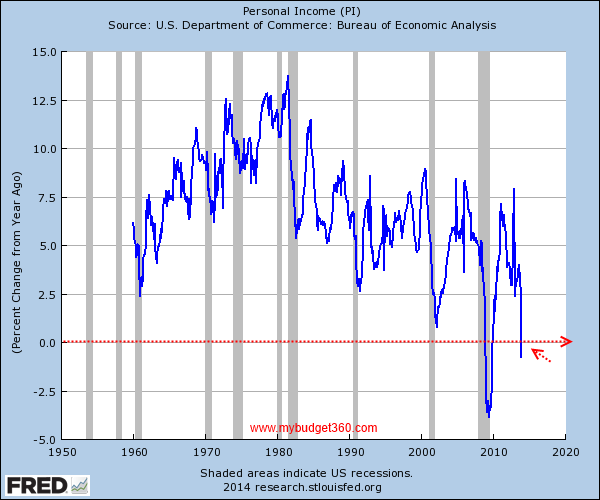
Personal income faces first year-over-year drop since recession ended: As incomes collapse, spending via consumer credit begins to increase.

MyBudget360
February 26, 2014

There is little doubt that our economy runs on access to debt.  Not a tiny bit of debt.  But Himalayan mountains of debt.  The banking crisis was pitched to the public as one of liquidity but in reality, it was one of solvency.  The difference?  One is a temporary inability to repay debts while the other is a complete mathematical inability to support current debts based on income.  The Fed has done everything to increase access to debt to member banks to re-inflate their balance sheets.  Those that think inflation is non-existent need only look at housing values, college tuition, and healthcare costs and see how realistic that is based on their income growth.  This leads us to our current article in terms of personal income.  The latest reading shows that personal income had its first year-over-year drop since the recession ended.  This further underscores the massive disconnect between the stock market and regular American households.  A large part of boosting corporate profits involved slashing wages, benefits, and households making due with less.  This has increased the wealth and income inequality in our nation as the stock market reaches a new apex.  What is troubling is that now that banks are flooded with easy access to credit, they are starting to lend to cash strapped households in a fashion similar to our last credit bubble.
Personal incomes fall
I’m not sure if people are aware of how rare it is for personal income to fall on a year-over-year basis in a fiat system where inflation is championed. 
Inflation when it goes hand in hand with income growth is rarely felt by the public at large.  However, as we have discussed with the shrinking middle class, inflation with no subsequent wage growth translates to a declining standard of living.
Going back to data form the 1950s personal income never declined on a year-over-year timeframe.  That is until the Great Recession.  So this recent reading showing personal income declining year-over-year is notable:
personal income
It is rather clear what is going on here.  Starting in the late 1990s, we see that personal income was facing some severe constraints on growth.  That is, until the debt bubble of the 2000s papered over the reality of growing wealth and income inequality.  The public of course mistook access to debt as access to wealth.  Of course debt needs to be paid back and paid back with what?  Income.  This is why income and debt are two sides of the same coin.  Eventually reality catches up.  It may take a few years or a generation as we are witnessing, but at a certain point debt no longer has the underlying boosting impact it once did.  This is why we are seeing cheap mortgage rates not helping out regular income strapped home buyers in the housing market because large banks and investors are crowding out regular home buyers with cash strapped balance sheets.
Substituting income growth for debt growth
Banks have already gotten their fill from bailouts and very friendly accounting rules bending to assist a shadow bailout.  Yet the public has not benefitted since the Great Recession officially ended in the summer of 2009.
Now that banks have had their fill and the stock market makes new peaks, we see lending now coming back into the system for regular Americans.  But is this good if incomes are declining?
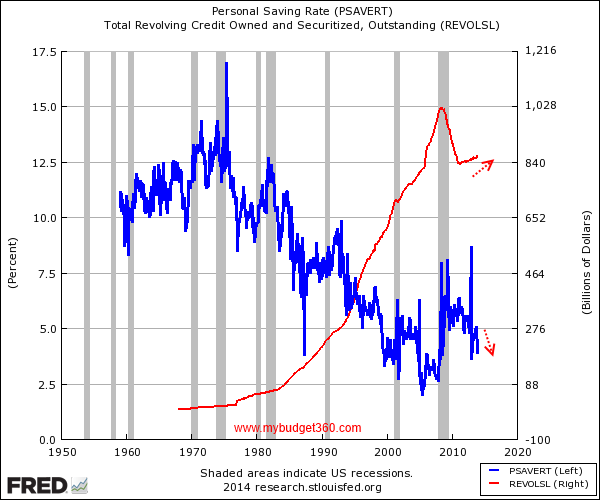
personal savings rate
The above chart is illuminating.  It shows that Americans are substituting saving for purchases with going into debt, once again.  Revolving debt took a hit during the Great Recession but only recently has it started to increase.  This wouldn’t be such an issue if incomes and good paying jobs were abundant but they are not.  Instead Americans to keep up with the rising cost of goods are now using an old trick of borrowing to make up where incomes are faltering.
Deep changes to economy
This Great Recession was no ordinary recession.  We now have nearly 48 million Americans on food stamps at the same time the stock market reaches a new peak.  Not that this helps many since most Americans don’t own stocks and recent corporate profits have been boosted by slashing wages, cutting benefits, and simply squeezing more out of current workers.  This is why we are seeing growing inequality.  You also see some major structural changes in terms of employment:
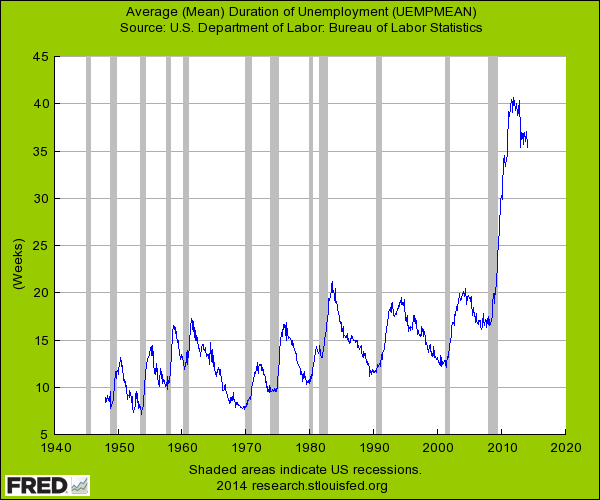
amount of time spent in unemployment
The average duration of unemployment is still incredibly high at over 35 weeks.  In previous recession, the high point was typically around 20 weeks and we’ve had some bad recession since 1940.  Nothing however, like this current economic shift.  Remember that this high average duration of unemployment is happening nearly five years after the official end of the Great Recession in the summer of 2009.  All this information simply points to a shrinking middle class and more inflation in items that matter for regular buyers (i.e., homes, cars, tuition, healthcare, etc).  You don’t need to be an economist to know that falling personal income in a consumer based economy is a bad sign.

Pentagon plans to shrink US Army to pre-WWII level

Yahoo News
February 24, 2014

Washington (AFP) - The Pentagon plans to scale back the US Army by more than an eighth to its lowest level since before World War II, signaling a shift after more than a decade of ground wars.

Saying it was time to "reset" for a new era, Defense Secretary Chuck Hagel recommended shrinking American forces from 520,000 active duty troops to between 440,000 and 450,000.
In a speech outlining the proposed defense budget, he said Monday that after Iraq and Afghanistan, US military leaders no longer plan to "conduct long and large stability operations."
If approved by Congress, the Pentagon move would reduce the army to its lowest manning levels since 1940, before the American military dramatically expanded after entering World War II.
The proposed 13 percent reduction in the army would be carried out by 2017, a senior defense official, who spoke on condition of anonymity, told AFP.

Ukraine: Western Powers Sleepwalking Into Destructive Conflict

Paul Craig Roberts
Infowars.com
February 23, 2014
On the 100th Anniversary of World War 1, the Western powers are again sleepwalking into destructive conflict. Hegemonic ambition has Washington interfering in the internal affairs of Ukraine, but developments seem to be moving beyond Washington’s control.
Image: Ukraine Uprising (Wikimedia Commons).
Regime change in Ukraine for a mere $5 billion dollars would be a bargain compared to the massive sums squandered in Iraq ($3,000 billion), Afghanistan ($3,000 billion), Somalia, and Libya, or the money Washington is wasting murdering people with drones in Pakistan and Yemen, or the money Washington has spent supporting al Qaeda in Syria, or the massive sums Washington has wasted surrounding Iran with 40 military bases and several fleets in the Persian Gulf in an effort to terrorize Iran into submission.
So far, in Washington’s attempt at regime change in Ukraine large numbers of Americans are not being killed and maimed. Only Ukrainians are dying, all the better for Washington as the deaths are blamed on the Ukrainian government that the US has targeted for overthrow.
The problem with Washington’s plot to overthrow the elected government of Ukraine and install its minions is twofold: The chosen US puppets have lost control of the protests to armed radical elements with historical links to nazism, and Russia regards an EU/NATO takeover of Ukraine as a strategic threat to Russian independence.
Washington overlooked that the financially viable part of today’s Ukraine consists of historical Russian provinces in the east and south that the Soviet leadership merged into Ukraine in order to dilute the fascist elements in western Ukraine that fought for Adolf Hitler against the Soviet Union. It is these ultra-nationalist elements with nazi roots, not Washington’s chosen puppets, who are now in charge of the armed rebellion in Western Ukraine.
If the democratically elected Ukraine government is overthrown, the eastern and southern parts would rejoin Russia. The western part would be looted by Western bankers and corporations, and the NATO Ukraine bases would be targeted by Russian Iskander missiles.
It would be a defeat for Washington and their gullible Ukrainian dupes to see half of the country return to Russia. To save face, Washington might provoke a great power confrontation, which could be the end of all of us.
My series of articles on the situation in Ukraine resulted in a number of interviews from Canada to Russia, with more scheduled. It also produced emotional rants from people of Ukrainian descent whose delusions are impenetrable by facts. Deranged Russophobes dismissed as propaganda the easily verifiable report of Assistant Secretary of State Nuland’s public address last December, in which she boasted that Washington had spent $5 billion preparing Ukraine to be aligned with Washington’s interests. Protest sympathizers claim that the intercepted telephone call between Nuland and the US Ambassador in Ukraine, in which the two US officials chose the government that would be installed following the coup, is a fake.
One person actually suggested that my position should be aligned with the “sincerity of the Kiev students,” not with the facts.
Some Trekkers and Trekkies were more concerned that I used an improper title for Spock than they were with the prospect of great power confrontation. The point of my article flew off into space and missed planet Earth.
Spock’s mental powers were the best weapon that Starship Enterprise had. Among my graduate school friends, Spock was known as Dr. Spock, because he was the cool, calm, and unemotional member of the crew who could diagnose the problem and save the situation.
There are no Spocks in the US or any Western government and certainly not among the Ukrainian protesters.
I have often wondered if Spock’s Vulcan ancestry was Gene Roddenberry’s way of underlining by contrast the fragility of human reason. In the context of modern military technology, is it possible for life to survive humanity’s penchant for emotion to trump reason and for self-delusion to prevail over factual reality?
Paul Craig Roberts was Assistant Secretary of the Treasury for Economic Policy and associate editor of the Wall Street Journal. He was columnist for Business Week, Scripps Howard News Service, and Creators Syndicate. He has had many university appointments. His internet columns have attracted a worldwide following. His latest book, The Failure of Laissez Faire Capitalism and Economic Dissolution of the West is now available.

CBO: Debt to Reach 80% of GDP in a Decade

News Max
February 23, 2014

An ominous new report from the Congressional Budget Office paints a bleak picture for America's future, projecting that entitlement spending will send the federal deficit soaring beyond previous estimates.
Federal entitlement spending is projected to rise at an average annual rate of 5.9 percent over the coming decade, increasing spending from $2.1 trillion this year to $3.7 trillion in 2024.

The CBO also projects that the federal budget deficit will rise to more than 4 percent of GDP in the latter part of the coming decade. From 2015 to 2024, the cumulative deficit will reach $7.9 trillion, $1 trillion higher than previously projected.

That would push debt held by the public to nearly 80 percent of GDP in 2024, "far above the post-war norm for the United States and perilously close to levels from which it is hard to recover," James C. Capretta noted in an article published by the Manhattan Institute's Economic Policies for the 21st Century.
But the actual economic situation could be far worse. The CBO projections assume an average annual growth rate in discretionary spending of only 1.8 percent. This would likely take defense spending as a percentage of GDP down to levels "not seen in the post-war era — at a time when global conflicts and potential threats are clearly on the rise," observed Capretta, a senior fellow at the Ethics & Public Policy Center and a visiting fellow at the American Enterprise Institute.

Looking further into the future, deficits are projected to rise even more sharply in years beyond the coming decade due to an aging population and healthcare inflation. The CBO expects debt held by the public to reach 190 percent of GDP by 2038. And that's assuming the nation will not experience another serious economic downturn.

What's more, the CBO projections don't include data on total state debt, which the Insider Report last week disclosed has already topped $5 trillion.

"At the beginning of the Obama presidency, the administration convened a fiscal responsibility summit during which there was a lot of talk about the need to finally address the ticking time bomb of runaway entitlement spending," Capretta wrote. "Suffice it to say that, in year 6 of the Obama presidency, people are not holding their breath that a breakthrough on entitlements is imminent."

He concluded: "It would be far better to take action now and head off the crisis before it ever happens than to wait for the crisis to hit and then attempt to scale back benefit commitments."

Comparing the inflated cost of living today from 1950 to 2014: How declining purchasing power has hurt the middle class since 1950.

MyBudget360
February 23, 2014

Inflation has a subtle eroding effect that impacts entire economies.  In the United States, we have been fortunate to have relatively stable rates of inflation for two generations.  Even in times of high inflation like the 1970s, people were able to adjust unlike places that experience uncontrolled inflation like Argentina is currently facing.  Also, wages rose in tandem which helped buffer the pain of higher costs.  Today however, inflation has eroded the purchasing power of the middle class.  Only when we look at longer periods of time do we see the large impact inflation has on our ability to buy real goods and services.  People found a piece comparing 1938 and 2013 prices on various goods and items to be enlightening.  Since our middle class did not fully emerge until the end of World War II, it might be useful to compare the price of items back from 1950 to where things stand today.  Has inflation had a big impact on our purchasing power since 1950?
1950 living versus that of 2014
It might be useful to first look at a few common items from 1950:
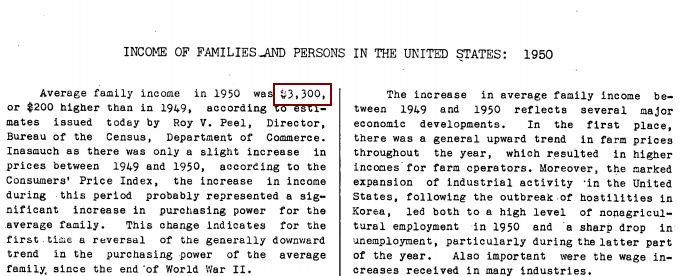
The average family income:        $3,300
The average car cost:                     $1,510
The median home price:               $7,354
These are three very important metrics when it comes to measuring purchasing power in the United States.  Since we consider having a car and a home as cornerstones to a middle class lifestyle, it is useful to look at these figures since we can easily grab these figures from reliable sources.
See below for source data:
average family income
Source:  US Department of Commerce
Then we can see the median home price:
1950 price of homes
Source:  US Census
A Ford car could be had with a price range of $1,339 to $2,262 depending on the model.  Income is an important measure because it gives us an insight into how well families are doing and how much money is being spent on certain items.  So let us derive ratios for each of the items for the 1950s:
Home price / income =  2.2
Car cost / income =         .45 
This is important here.  The typical home cost 2.2 times annual income while a car cost .45 times annual income.  Let us now fast forward to 2014 and see where these things stand:
The average family income:        $51,017
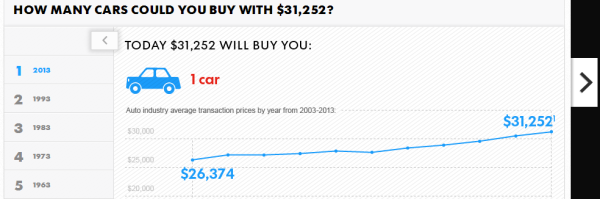
The average car cost:                     $31,252
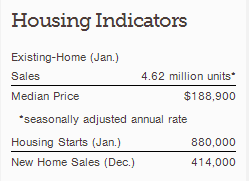
The median home price:               $188,900
Let us show the data here:
median home price 2014
Source:  National Association of Realtors
average car cost 2014
Household income was pulled from Census data based on what the typical household earns.  Inflation has a subtle way of eroding purchasing power.  Let us pull some ratios here:
Home price / income =  3.7
Car cost / income =         .61
Housing has gotten dramatically more expensive.  The cost of a new car has gone up but not so noticeably when looking at inflation data.  Inflation has largely eaten away at income on other fronts like college tuition and healthcare.  These were much more affordable back in the 1950s relative to overall income.
For example, in 1950 at the University of Pennsylvania annual tuition was $600:
univ of penn 1950
We should run a ratio here as well:
Tuition / income = .18
Let us look at current tuition costs:
2014 tuition
Current tuition is over $40,000 per year.
Tuition / income = .79
This is a massive change.  In 1950, a family sending their child to the University of Pennsylvania would only spend 18 percent of their annual income (if they paid in cash) to send their kid to study.  Today it would consume 79 percent of gross annual income.  Even if we look at net take home pay a regular family in no way could send their child to school without going into massive student debt.
A good portion of inflation over this time has been masked by massive amounts of debt and financing.  Car purchases, mortgages, and college are now financed long-term.  Low rateshave masked this erosion but with rates reaching the lower bound of the range, the pain of inflation is now being felt by many households.