August 8, 2020
From the Editor’s Desk, Michael Matt takes a look at some good news regarding the Covid recovery rate before exploring what’s really going on with the global pandemic.
August 8, 2020
 |
File:Population growth rate world 2005-2010 UN.PNG
From Wikimedia Commons, the free media repository
With this rate in population growth comes the concern among military analysts on just how to deal with operations in these highly dense and everchanging populated "mega cities".
In a leaked military video, we see what the controllers are focusing on as they develop what they detail as mega cities around the world.
We know that currently operations are taking place in both Africa, and the Middle East.
In the beginning of the video it mentions growth rates by the year 2030. This caught my attention because Agenda 21,which the Elites have been pushing for "Sustainable Development", has now recently been renamed as "Agenda 2030".
After seeing the video above describing the "mega Cities", pay attention to this next video. Especially the first half which describes "Agenda 2030" and the real intent of this UN initiative.
|


“The size of the US economy and its treasury market and the dollar’s status as a reserve currency make it impossible to find a historical parallel for the current situation. However, being the world’s reserve currency, the US dollar now appears inconsistent with an AA+ rating.”China’s official Xinhua news agency has been brutally attacking the U.S. financial system in recent days. The following is one example….
“The only way the Americans have come up with to improve economic growth has been to take on new loans to repay the old ones.”In fact, Xinhua has even gone so far to suggest that U.S. monetary policy should be under “international supervision” and that a new global reserve currency should be created….
“International supervision over the issue of U.S. dollars should be introduced and a new, stable and secured global reserve currency may also be an option to avert a catastrophe caused by any single country.”Read the entire article
.jpg.aspx?width=200&height=112) A statement on the State Department website noted: “These improvements are being made to provide a gender neutral description of a child’s parents and in recognition of different types of families.” The statement didn't note if it was for child applications only.
A statement on the State Department website noted: “These improvements are being made to provide a gender neutral description of a child’s parents and in recognition of different types of families.” The statement didn't note if it was for child applications only. |
FoxNews.com
Oct. 13, 2010: The Z Backscatter Van uses detects contraband like explosives, drugs or people in hiding with an X-Ray mechanism that has no need for a detector on the far side of an object, allowing it to be extremely mobile, versatile and built into a commercially available van.
|
 |
| Dominique Strauss-kahn |
“The governments of Europe, the United States, and Japan are unlikely to negotiate a social-democratic pattern of globalization – unless their hands are forced by a popular movement or a catastrophe, such as another Great Depression or ecological disaster”
Richard Sandbrook, Closing the Circle: Democratization and Development in Africa, Zed Books limited, London, 2000.
 | |
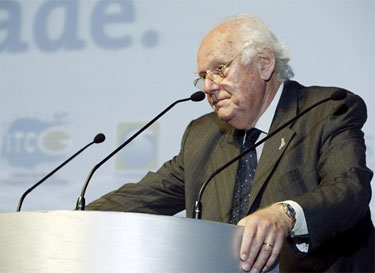 | |
| Self-described ‘ecosocioeconomist’ professor Ignacy Sachs. | |
“To be meaningful, the strategies should cover the time-span of several decades. Thirty-five to forty years seems a good compromise between the need to give enough time to the postulated transformations and the uncertainties brought about by the lengthening of the time-span.”In his paper “The Next 40 Years: Transition Strategies to the Virtuous Green Path: North/South/East/Global”, Sachs accurately describes not only the intended time-span to bring about a global society, but also what steps should be taken to ensure “population stabilization”:
“In order to stabilize the populations of the South by means other than wars or epidemics, mere campaigning for birth control and distributing of contraceptives has proved fairly inefficient.”In the first part of the (in retrospect) bizarrely accurate description of the years to come, Sachs points out redistribution of wealth is the only viable path towards population stabilization and- as he calls it- a “virtuous green world”. The professor:
“The way out from the double bind of poverty and environmental disruption calls for a fairly long period of more economic growth to sustain the transition strategies towards the virtuous green path of what has been called in Stockholm ecodevelopement and has since changed its name in Anglo-Saxon countries to sustainable development.”
“(…) a fair degree of agreement seems to exist, therefore, about the ideal development path to be followed so long as we do not manage to stabilize the world population and, at the same time, sharply reduce the inequalities prevailing today.”“The bolder the steps taken in the near future”, Sachs asserts, “the shorter will be the time span that separates us from a steady state. Radical solutions must address to the roots of the problem and not to its symptoms. Theoretically, the transition could be made shorter by measures of redistribution of assets and income.”
“The pragmatic prospect is one of transition extending itself over several decades.”In the second sub-chapter “The Five Dimensions of Ecodevelopment”, professor Sachs sums up the main dimensions of this carefully outlined move to make Agenda 21 a very real future prospect. The first dimension he touches upon is “Social Sustainability”:
“The aim is to build a civilization of being within greater equity in asset and income distribution, so as to improve substantially the entitlements of the broad masses of population and of reduce the gap in standards of living between the have and the have nots.”This of course means, reducing the standards of living in “The North” (U.S., Europe) and upgrading those of the developing nations (“The South and The East”). This would have to be realized through what Sachs calls “Economic Sustainability”:
“made possible by a more efficient allocation and management of resources and a steady flow of public and private investment.”The third dimension described by the professor is “Ecological Sustainability” which, among other things, limits “the consumption of fossile fuels and other easily depletable or environmentally harmful products, substituting them by renewable and/or plentiful and environmentally friendly resources, reducing the volume of pollutants by means of energy and resource conservation and recycling and, last but not least, promoting self-constraint in material consumption on part of the rich countries and of the privileged social strata all over the world;”
“looking for the endogenous roots of the modernization processes, seeking change within cultural continuity, translating the normative concept of ecodevelopment into a plurality of local, ecosystem-specific, culture-specific and site-specific solutions.”But to realize such a dramatic new direction for the world, Sachs once again stresses the importance of incremental implementation. A matter of boiling the frog slowly as opposed to throwing the poor animal into a boiling-hot cooking pan:
“Even if we know where we want to get, the operational question is how do we proceed to put humankind on the virtuous path of genuine development, socially responsible and in harmony with nature. It is submitted that UNCED 92 should give considerable attention to the formulation of transition strategies that could become the central piece of the Agenda 21.”This is the word- Agenda 21: the UN strategy for redistributing the wealth accumulated by the “North” in order to create a completely “balanced” world society- under auspices of the United Nations of course and the private central banks controlling it. This can only come about by destroying the middle-class. A sudden redistribution and industrialization would not do- for the middle-class would undoubtedly rise in defiance against it. Therefore, Sachs argues for an incremental and carefully planned dissolution of the middle-class phase by phase:
“To be meaningful, the strategies should cover the time-span of several decades. Thirty-five to forty years seems a good compromise between the need to give enough time to the postulated transformations and the uncertainties brought about by the lengthening of the time-span. The retooling of industries, even in periods of rapid growth, requires ten to twenty years. The restructuration and the expansion of the infrastructures requires several decades and this is a crucially important sector from the point of view of environment.”Then Sachs plunges into his most shocking statement:
“However, the single most important reason to consider the transition strategies over a minimum of thirty-five to forty years stems from the non-linearity of these strategies; they should be devised as a succession of changing priorities over time. A good illustration is provided by the population transition. In order to stabilize the populations of the South by means other than wars or epidemics, mere campaigning for birth control and distributing of contraceptives has proved fairly inefficient.”Sachs argues that “an accelerated programme of social and economic development of the rural areas should be the outmost priority in the first phase of a realistic population stabilization scheme.”
“Starting the operation with a one per ten thousand tax and increasing it so as to reach one per thousand in ten to twenty years seems a fairly realistic proposal, the more so that the scheme creates an interesting market for the private enterprises involved in R and D.”Reading all this, the question as to what entity should take charge is not difficult to answer. Sachs:
“In order to generate maximum synergies between the national strategies and global action, the United Nations should create a forum for the periodical discussion and evaluation of these strategies and a research, monitoring and flexible planning facility to put them in a global perspective.(…). The forum should have a fair representation of all the main actors involved: governments, parliaments, citizen movements and the business world. Given its importance, it should be lifted from specialized agencies to a central place in the UN system.”
From SDR to Bancor. A limitation of the SDR as discussed previously is that it is not a currency. Both the SDR and SDR-denominated instruments need to be converted eventually to a national currency for most payments or interventions in foreign exchange markets, which adds to cumbersome use in transactions. and though an SDR-based system would move away from a dominant currency, the SDR'r value remains heavily linked to conditions and performance of the major component countries.A more ambitious reform option would be to build on the previous ideas and develop, over time, a global currency. Pg 26. (emphasis mine)
"It is very important just to underscore that... the future evolution of the dollar's role in the system, depends really primarilly on how effective we are here in the United States, in getting not just recovery back on track, our financial system repaired, but we get our fiscal position back to the point where people will judge it as sustainable.."
"The powers of financial capitalism had another far reaching aim, nothing less than to create a world system of financial control in private hands able to dominate the political system of each country and the economy of the world as a whole. This system was to be controlled in a feudalist fashion by the central banks of the world acting in concert, by secret agreements, arrived at in frequent private meetings and conferences. The apex of the system was the Bank for International Settlements in Basle, Switzerland, a private bank owned and controlled by the worlds central banks which were themselves private corporations. The growth of financial capitalism made possible a centralization of world economic control and use of this power for the direct benefit of financiers and the indirect injury of all other economic groups."Tragedy and Hope: A History of The World in Our Time (Macmillan Company, 1966,) Professor Carroll Quigley of Georgetown University


| |
| |


