Pentagon plans to shrink US Army to pre-WWII level

Yahoo News
February 24, 2014

Washington (AFP) - The Pentagon plans to scale back the US Army by more than an eighth to its lowest level since before World War II, signaling a shift after more than a decade of ground wars.

Saying it was time to "reset" for a new era, Defense Secretary Chuck Hagel recommended shrinking American forces from 520,000 active duty troops to between 440,000 and 450,000.
In a speech outlining the proposed defense budget, he said Monday that after Iraq and Afghanistan, US military leaders no longer plan to "conduct long and large stability operations."
If approved by Congress, the Pentagon move would reduce the army to its lowest manning levels since 1940, before the American military dramatically expanded after entering World War II.
The proposed 13 percent reduction in the army would be carried out by 2017, a senior defense official, who spoke on condition of anonymity, told AFP.

Ukraine: Western Powers Sleepwalking Into Destructive Conflict

Paul Craig Roberts
Infowars.com
February 23, 2014
On the 100th Anniversary of World War 1, the Western powers are again sleepwalking into destructive conflict. Hegemonic ambition has Washington interfering in the internal affairs of Ukraine, but developments seem to be moving beyond Washington’s control.
Image: Ukraine Uprising (Wikimedia Commons).
Regime change in Ukraine for a mere $5 billion dollars would be a bargain compared to the massive sums squandered in Iraq ($3,000 billion), Afghanistan ($3,000 billion), Somalia, and Libya, or the money Washington is wasting murdering people with drones in Pakistan and Yemen, or the money Washington has spent supporting al Qaeda in Syria, or the massive sums Washington has wasted surrounding Iran with 40 military bases and several fleets in the Persian Gulf in an effort to terrorize Iran into submission.
So far, in Washington’s attempt at regime change in Ukraine large numbers of Americans are not being killed and maimed. Only Ukrainians are dying, all the better for Washington as the deaths are blamed on the Ukrainian government that the US has targeted for overthrow.
The problem with Washington’s plot to overthrow the elected government of Ukraine and install its minions is twofold: The chosen US puppets have lost control of the protests to armed radical elements with historical links to nazism, and Russia regards an EU/NATO takeover of Ukraine as a strategic threat to Russian independence.
Washington overlooked that the financially viable part of today’s Ukraine consists of historical Russian provinces in the east and south that the Soviet leadership merged into Ukraine in order to dilute the fascist elements in western Ukraine that fought for Adolf Hitler against the Soviet Union. It is these ultra-nationalist elements with nazi roots, not Washington’s chosen puppets, who are now in charge of the armed rebellion in Western Ukraine.
If the democratically elected Ukraine government is overthrown, the eastern and southern parts would rejoin Russia. The western part would be looted by Western bankers and corporations, and the NATO Ukraine bases would be targeted by Russian Iskander missiles.
It would be a defeat for Washington and their gullible Ukrainian dupes to see half of the country return to Russia. To save face, Washington might provoke a great power confrontation, which could be the end of all of us.
My series of articles on the situation in Ukraine resulted in a number of interviews from Canada to Russia, with more scheduled. It also produced emotional rants from people of Ukrainian descent whose delusions are impenetrable by facts. Deranged Russophobes dismissed as propaganda the easily verifiable report of Assistant Secretary of State Nuland’s public address last December, in which she boasted that Washington had spent $5 billion preparing Ukraine to be aligned with Washington’s interests. Protest sympathizers claim that the intercepted telephone call between Nuland and the US Ambassador in Ukraine, in which the two US officials chose the government that would be installed following the coup, is a fake.
One person actually suggested that my position should be aligned with the “sincerity of the Kiev students,” not with the facts.
Some Trekkers and Trekkies were more concerned that I used an improper title for Spock than they were with the prospect of great power confrontation. The point of my article flew off into space and missed planet Earth.
Spock’s mental powers were the best weapon that Starship Enterprise had. Among my graduate school friends, Spock was known as Dr. Spock, because he was the cool, calm, and unemotional member of the crew who could diagnose the problem and save the situation.
There are no Spocks in the US or any Western government and certainly not among the Ukrainian protesters.
I have often wondered if Spock’s Vulcan ancestry was Gene Roddenberry’s way of underlining by contrast the fragility of human reason. In the context of modern military technology, is it possible for life to survive humanity’s penchant for emotion to trump reason and for self-delusion to prevail over factual reality?
Paul Craig Roberts was Assistant Secretary of the Treasury for Economic Policy and associate editor of the Wall Street Journal. He was columnist for Business Week, Scripps Howard News Service, and Creators Syndicate. He has had many university appointments. His internet columns have attracted a worldwide following. His latest book, The Failure of Laissez Faire Capitalism and Economic Dissolution of the West is now available.

CBO: Debt to Reach 80% of GDP in a Decade

News Max
February 23, 2014

An ominous new report from the Congressional Budget Office paints a bleak picture for America's future, projecting that entitlement spending will send the federal deficit soaring beyond previous estimates.
Federal entitlement spending is projected to rise at an average annual rate of 5.9 percent over the coming decade, increasing spending from $2.1 trillion this year to $3.7 trillion in 2024.

The CBO also projects that the federal budget deficit will rise to more than 4 percent of GDP in the latter part of the coming decade. From 2015 to 2024, the cumulative deficit will reach $7.9 trillion, $1 trillion higher than previously projected.

That would push debt held by the public to nearly 80 percent of GDP in 2024, "far above the post-war norm for the United States and perilously close to levels from which it is hard to recover," James C. Capretta noted in an article published by the Manhattan Institute's Economic Policies for the 21st Century.
But the actual economic situation could be far worse. The CBO projections assume an average annual growth rate in discretionary spending of only 1.8 percent. This would likely take defense spending as a percentage of GDP down to levels "not seen in the post-war era — at a time when global conflicts and potential threats are clearly on the rise," observed Capretta, a senior fellow at the Ethics & Public Policy Center and a visiting fellow at the American Enterprise Institute.

Looking further into the future, deficits are projected to rise even more sharply in years beyond the coming decade due to an aging population and healthcare inflation. The CBO expects debt held by the public to reach 190 percent of GDP by 2038. And that's assuming the nation will not experience another serious economic downturn.

What's more, the CBO projections don't include data on total state debt, which the Insider Report last week disclosed has already topped $5 trillion.

"At the beginning of the Obama presidency, the administration convened a fiscal responsibility summit during which there was a lot of talk about the need to finally address the ticking time bomb of runaway entitlement spending," Capretta wrote. "Suffice it to say that, in year 6 of the Obama presidency, people are not holding their breath that a breakthrough on entitlements is imminent."

He concluded: "It would be far better to take action now and head off the crisis before it ever happens than to wait for the crisis to hit and then attempt to scale back benefit commitments."

Comparing the inflated cost of living today from 1950 to 2014: How declining purchasing power has hurt the middle class since 1950.

MyBudget360
February 23, 2014

Inflation has a subtle eroding effect that impacts entire economies.  In the United States, we have been fortunate to have relatively stable rates of inflation for two generations.  Even in times of high inflation like the 1970s, people were able to adjust unlike places that experience uncontrolled inflation like Argentina is currently facing.  Also, wages rose in tandem which helped buffer the pain of higher costs.  Today however, inflation has eroded the purchasing power of the middle class.  Only when we look at longer periods of time do we see the large impact inflation has on our ability to buy real goods and services.  People found a piece comparing 1938 and 2013 prices on various goods and items to be enlightening.  Since our middle class did not fully emerge until the end of World War II, it might be useful to compare the price of items back from 1950 to where things stand today.  Has inflation had a big impact on our purchasing power since 1950?
1950 living versus that of 2014
It might be useful to first look at a few common items from 1950:
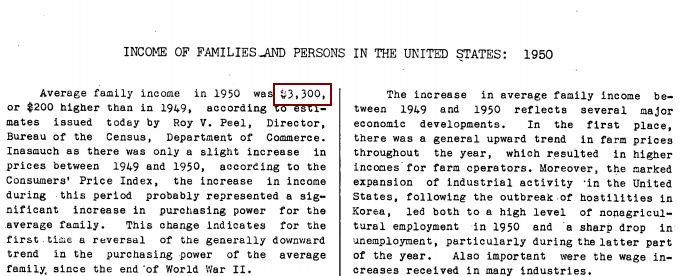
The average family income:        $3,300
The average car cost:                     $1,510
The median home price:               $7,354
These are three very important metrics when it comes to measuring purchasing power in the United States.  Since we consider having a car and a home as cornerstones to a middle class lifestyle, it is useful to look at these figures since we can easily grab these figures from reliable sources.
See below for source data:
average family income
Source:  US Department of Commerce
Then we can see the median home price:
1950 price of homes
Source:  US Census
A Ford car could be had with a price range of $1,339 to $2,262 depending on the model.  Income is an important measure because it gives us an insight into how well families are doing and how much money is being spent on certain items.  So let us derive ratios for each of the items for the 1950s:
Home price / income =  2.2
Car cost / income =         .45 
This is important here.  The typical home cost 2.2 times annual income while a car cost .45 times annual income.  Let us now fast forward to 2014 and see where these things stand:
The average family income:        $51,017
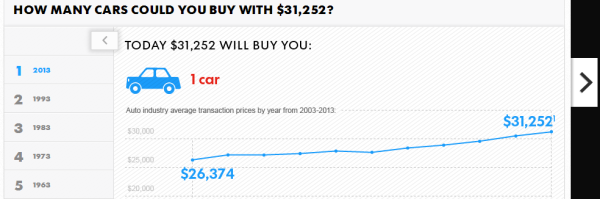
The average car cost:                     $31,252
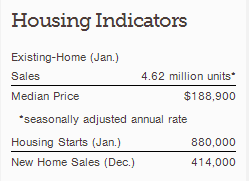
The median home price:               $188,900
Let us show the data here:
median home price 2014
Source:  National Association of Realtors
average car cost 2014
Household income was pulled from Census data based on what the typical household earns.  Inflation has a subtle way of eroding purchasing power.  Let us pull some ratios here:
Home price / income =  3.7
Car cost / income =         .61
Housing has gotten dramatically more expensive.  The cost of a new car has gone up but not so noticeably when looking at inflation data.  Inflation has largely eaten away at income on other fronts like college tuition and healthcare.  These were much more affordable back in the 1950s relative to overall income.
For example, in 1950 at the University of Pennsylvania annual tuition was $600:
univ of penn 1950
We should run a ratio here as well:
Tuition / income = .18
Let us look at current tuition costs:
2014 tuition
Current tuition is over $40,000 per year.
Tuition / income = .79
This is a massive change.  In 1950, a family sending their child to the University of Pennsylvania would only spend 18 percent of their annual income (if they paid in cash) to send their kid to study.  Today it would consume 79 percent of gross annual income.  Even if we look at net take home pay a regular family in no way could send their child to school without going into massive student debt.
A good portion of inflation over this time has been masked by massive amounts of debt and financing.  Car purchases, mortgages, and college are now financed long-term.  Low rateshave masked this erosion but with rates reaching the lower bound of the range, the pain of inflation is now being felt by many households.

NYC: More Black Babies Killed by Abortion Than Born

CNS News
February 21, 2014

(CNSNews.com) – In 2012, there were more black babies killed by abortion (31,328) in New York City than were born there (24,758), and the black children killed comprised 42.4% of the total number of abortions in the Big Apple, according to a report by the New York City Department of Health and Mental Hygiene.
The report is entitled, Summary of Vital Statistics 2012 The City of New York, Pregnancy Outcomes, and was prepared by the New York City Department of Health and Mental Hygiene, Office of Vital Statistics. (See  Pregnancy Outcomes NYC Health 2012.pdf)
Table 1 of the report presents the total number of live births, spontaneous terminations (miscarriages), and induced terminations (abortions) for women in different age brackets between 15 and 49 years of age. The table also breaks that data down by race – Hispanic, Asian and Pacific Islander, Non-Hispanic White, Non-Hispanic Black – and also by borough of residence: Manhattan, Bronx, Brooklyn, Queens, Staten Island.
The numbers show that in 2012, there were 31,328 induced terminations (abortions) among non-Hispanic black women in New York City.  That same year, there were 24,758 live births for non-Hispanic black women in New York City.  There were  6,570 more abortions than live births of black children.
In total, there were 73,815 abortions, which means the 31,328 black babies aborted comprised 42.4% of the total abortions.
For Hispanic women, there were 22,917 abortions in New York City in 2012, which is 31% of the total abortions.
Read the entire article

Department of Homeland Security cancels national license-plate tracking plan

Washington Post
February 20, 2014

Homeland Security Secretary Jeh Johnson on Wednesday ordered the cancellation of a plan by the Immigration and Customs Enforcement agency to develop a national license-plate tracking system after privacy advocates raised concern about the initiative.
The order came just days after ICE solicited proposals from companies to compile a database of license-plate information from commercial and law enforcement tag readers. Officials said the database was intended to help apprehend fugitive illegal immigrants, but the plan raised concerns that the movements of ordinary citizens under no criminal suspicion could be scrutinized.
The data would have been drawn from readers that scan the tags of every vehicle crossing their paths, and would have been accessed only for “ongoing criminal investigations or to locate wanted individuals,” officials told The Washington Post this week.
“The solicitation, which was posted without the awareness of ICE leadership, has been cancelled,” ICE spokeswoman Gillian Christensen said in a statement. “While we continue to support a range of technologies to help meet our law enforcement mission, this solicitation will be reviewed to ensure the path forward appropriately meets our operational needs.”
Lawmakers and privacy advocates reacted with approval.

Is Obama Accelerating The Collapse Of America?

Personal Liberty
February 20, 2014