Exclusive: China crackdown driven by fears of a broad conspiracy


BEIJING | Tue Apr 12, 2011 2:09pm EDT
BEIJING (Reuters) - Days of interrogation in a cold, secluded room taught Liu Anjun that China's security forces see dissidents and protesters like him as players in a plot to topple the Communist Party, a fear that is magnifying Beijing's hard crackdown on dissent.
The most internationally prominent target of that crackdown has been the artist Ai Weiwei, but the net reaches far wider and reflects Party anxiety that it confronts not just general discontent, but a subversive movement waiting to pounce.

Liu, a gravel-voiced, charismatic agitator for petitioners' rights, was taken from his family on February 18. Police bundled him into a van and locked him in a hotel room in south Beijing, where he was watched by rotating teams of guards, he said.

There, for six days, police interrogators showed Liu pictures of dissidents, human rights lawyers, and activists, seeking information about their mutual contacts, beliefs and plans, Liu told Reuters at his home in a Beijing alley where he was recovering after his release from 45 days in detention.

The police have been hunting for evidence of a web of conspiracy bringing together domestic and foreign foes that the Chinese government believes are behind recent calls for Middle East-inspired "Jasmine Revolution" protests against the Party.

"They took out picture after picture, mainly of democracy activists and rights defenders, and asked about each of them," Liu said, seated in his cigarette smoke-filled living room.

"They were trying to build up links among everybody, trying to get me to tell them who was supporting what," said Liu, who walks on crutches after a leg injury sustained in a protest over the demolition of a former home.

Chinese leaders believe domestic foes, their foreign backers and Western governments are scheming to undermine and ultimately topple the Communist Party. Recent speeches and articles from security officials echo with warnings of subversive plots backed by Western "anti-China" forces.

Shortly before China's clampdown ramped up in February, a senior domestic security official, Chen Jiping, warned that "hostile Western forces" -- alarmed by the country's rise -- were marshalling human rights issues to attack Party control.
Read the entire article

Trump: US Will ‘Never Be Great Again’ if Obama Allows $8 Gasoline

Moneynews.com
April 12, 2011

Oil prices may jump to record highs in the next couple of months, all because of President Barack Obama’s policies, and that could send the U.S. economy back into the dark ages, says billionaire real-estate mogul and reality-TV star Donald Trump.

“Oil is going to a level that may be unprecedented. Gasoline is going to be $6 to $8 a gallon,” he told CNBC. “If oil continues to go up, it’s going to be very rough. This country can never recover, because oil is our lifeblood.”

Oil hit a 2½-year high above $112 a barrel Friday.


Read more: Trump: US Will ‘Never Be Great Again’ if Obama Allows $8 Gasoline

Japan Raises Nuclear Alert at Troubled Plant to Highest Level, Equal to Chernobyl

Damaged reactor building of Unit 4, left, of the tsunami-crippled Fukushima Dai-ichi nuclear power plant in Okuma town, Fukushima Prefecture, northeastern Japan
(AP Photo/Tokyo Electric Power Co.)
FOXNews.com
April 12, 2011

TOKYO -- Japan raised the severity level of the crisis at its crippled nuclear plant Tuesday to rank it on par with the 1986 Chernobyl disaster, citing cumulative radiation leaks contaminating the air, tap water, vegetables and seawater.

Japanese nuclear regulators said the rating was being raised from 5 to 7 -- the highest level on an international scale overseen by the International Atomic Energy Agency -- after new assessments of radiation leaks from the Fukushima Dai-ichi plant since it was disabled by the March 11 tsunami.

The new ranking signifies a "major accident" with "wider consequences" than the previous level, including widespread health effects, according to the Vienna-based IAEA.

However, Japanese officials have played down any health effects of radioactive releases so far from the Fukushima plant. They said the leaks amount to only a tenth of the radiation emitted in the Chernobyl disaster, while acknowledging they eventually could exceed Chernobyl's emissions if the crisis continues.

Gas Prices Climbing Toward $5 Per Gallon

Gas prices are spiking to $4.39 per gallon at the BP station at Congress Parkway and Dearborn Street, Chicago.
(Credit: CBS)
CBS
April 11, 2011

CHICAGO (CBS) – At one time, $5 per gallon gas seemed like a far-fetched idea, but that is no longer the case.

As of Monday, the average price for a gallon of regular unleaded gasoline in the Chicago area is $4.11, compared with $3.71 a month ago, and about $3.10 a gallon at this time a year ago.

Some experts say $5 per gallon gas is possible by Memorial Day-or sometime in summer. Others caution that reaching that mark is unlikely over the next six weeks. In Chicago, the prices keep rising to near-record levels–with no relief in sight.

Right now, oil markets are so skittish that records set in 2008 could fall.

"Bretton Woods" II Convenes - Globalist George Soros Holds Summit For Financial Reshaping of Global Economy

“Bretton Woods II” convenes
RT
April 10, 2011

Major financial players from around the world are debating the future of the global economy in the iconic US town of Bretton Woods. The summit held by billionaire philanthropist George Soros is focusing on the place emerging nations will take in the new world order. RT’s Lauren Lister reports from the venue.


Related article: The Globalists Plan for a Coming World Currency

The housing gamble: What if home prices remained stagnant until 2020? 6 charts laying out the argument for stagnant or declining home prices for another 10 years. Peak in dual income households, home prices still inflated relative to incomes, Federal Reserve unable to hold mortgage rates low forever.

MyBudget360.com

What would happen if home prices remain stagnant for another decade?  It is hard to imagine that the cornerstone of the American dream would somehow become a bad investment for the next decade.

 For decades every generation was conditioned into believing that housing was the best investment a family could make.  For many it provided a stable home for retirement once the mortgage was paid off.  One third of all homes in the United States that are owner occupied have no mortgage.  Yet this mindset of buying and paying off a mortgage has largely been lost.  No mortgage burning parties in the digital age. 

It may be making a comeback not because people want this but because there is no other financial choice.  Given the current domestic and global trends, it is likely that housing will be suffering another troubled decade from 2011 to 2020 just like it experienced from 2001 to 2010.  I want to lay out six charts as to why I believe housing will have difficulty moving up in price in the next ten years.


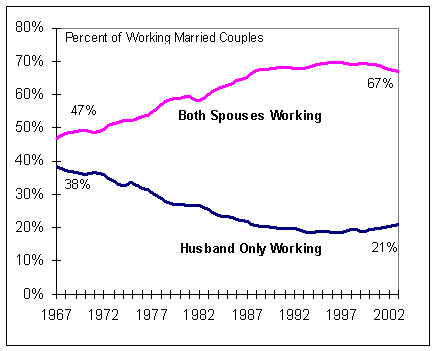
Chart #1 – Dual income households peaking
dual-income-workers

One of the big reasons many families did not feel the deep pinch from 1970 to 2000 was because of the rise of the dual income household becoming the standard.  It should be obvious that with more incomes under one roof purchasing power would increase.

Yet this is really where we start seeing the loss of the middle class.  What used to be a path accomplished with one blue collar income now required two incomes.  Yet as the chart above highlights we may have hit a plateau in terms of dual income households as a percentage.  In the late 1960s 47 percent of households had both spouses working.  In the early 2000s it was up to 67 percent.
Read the entire report

Libya, Planned Parenthood, Wisconsin Unions


Libya, Planned Parenthood, Wisconsin Unions from The John Birch Society on Vimeo.