EXCLUSIVE—ZIMMERMAN BROTHER: OBAMA 'BULLIED' MY FAMILY

Breitbart
February 6, 2013


George Zimmerman was back in court today for a hearing on the start date for his trial on murder charges. Zimmerman, of course, was the Hispanic neighborhood watchman in Sanford, Florida, who trailed a young black man named Trayvon Martin after calling 911, got into an altercation with Martin in which Martin ended up pounding Zimmerman’s head into the pavement, and then ended up shooting Martin in the chest. The media used the Zimmerman case as an opportunity to bully Americans over their supposed racial intolerance. Even the President of the United States weighed in in the midst of an election cycle, suggesting that if he had a son, he’d look like Trayvon Martin.

Breitbart News had the opportunity to sit down for a one-on-one interview with George’s brother, Robert, in Los Angeles. Excerpts of that interview played tonight on Fox News’Hannity.
Robert didn’t pull any punches about President Obama’s role in raising the threat level to his brother – and to his family. “We do feel that we’re threatened,” Robert told Breitbart News. “There’s not been a legal resolution in this matter. And even the day that there is legal resolution in this matter, the day that happens I don’t think that every single fear of some kind of retribution will simply just go way, but we’re coping as bets we can, day by day.”
Robert saved especially harsh criticism for President Obama, who inserted himself in the Zimmerman case, even inviting race-baiter Al Sharpton to the White House shortly after Sharpton threatened the town of Sanford over the Police Department’s decision not to arrest Zimmerman originally. When the President was asked about the Zimmerman case in the Rose Garden, Robert said, “Here was this president, from the backdrop of the Rose Garden, making comments about someone based on his skin color. I think we felt bullied, we were a little let down initially, and that disappointment grew because if you don’t have the support of at least the law on your side, of the most powerful man in the Western Hemisphere reminding the world that it is entitled to watch, reminding Americans that the world is watching and that we will get through this with due process, but instead bringing up statements about his skin color … it was alarming to say the least.”
Robert went further: “I don’t think a white president would have been able to get away with the same thing from the Rose Garden in an election season.”
The fallout to the Zimmerman family has been extreme. According to Robert, they often require security for everyday tasks. They have had to move around to avoid targeting. And now, George faces a trial in a case where many legal observers agree there is no evidence to support the prosecutor’s second degree murder charge. No matter what happens, George Zimmerman will, thanks to the President and the media, remain a racist in many Americans’ minds. “If you can’t rebut assertions of racism,” said Robert, “the noise kind of drowns you out. You’re really left defenseless, and you have no other choice but to go into hiding.”
Ben Shapiro is Editor-At-Large of Breitbart News and author of the book “Bullies: How the Left’s Culture of Fear and Intimidation Silences America” (Threshold Editions, January 8, 2013).

Iran's Ahmadinejad seeks strategic axis with Egypt

Reuters
February 6, 2013
1 of 6. Iran's President Mahmoud Ahmadinejad (C) gestures in front of the shrine of Prophet Mohammed's grandson Hussein ibn Ali at the Al-Hussein mosque, named after the grandson, in old Cairo February 5, 2013.
Credit: Reuters/Amr Abdallah Dalsh


(Reuters) - President Mahmoud Ahmadinejad, on the first visit to Cairo by an Iranian leader in more than three decades, called for a strategic alliance with Egypt and said he had offered the cash-strapped Arab state a loan, but drew a cool response.
Ahmadinejad said outside forces were trying to prevent a rapprochement between the Middle East's two most populous nations, at odds since Iran's 1979 Islamic revolution and Egypt's signing of a peace treaty with Israel in the same year.
"We must all understand that the only option is to set up this alliance because it is in the interests of the Egyptian and Iranian peoples and other nations of the region," the official MENA news agency quoted him in remarks to Egyptian journalists published on Wednesday.
The two countries have not restored diplomatic ties since Egypt overthrew its long term leader Hosni Mubarak in 2011, but its first Islamist president, Mohamed Mursi, gave Ahmadinejad a red-carpet welcome on Tuesday to a summit of Islamic nations.
"There are those striving to prevent these two great countries from coming together despite the fact that the region's problems require this meeting, especially the Palestinian question," Ahmadinejad said.

States step up fight against use of surveillance drones by law enforcement

Fox News
February 6, 2013


Lawmakers in at least 11 states are proposing various restrictions on the use of drones over their skies amid concerns the unmanned aerial vehicles could be exploited by local authorities to spy on Americans.

Concerns mounted after the Federal Aviation Administration began establishing safety standards for civilian drones, which are becoming increasingly affordable and small in size.

Some police agencies have said the drones could be used for surveillance of suspects, search and rescue operations, and gathering details on damage caused by natural disasters.

Virginia lawmakers on Tuesday approved a two-year moratorium on the use of drones by police and government agencies.

Proponents of the legislation say the unfettered use of drones could infringe on Virginians' privacy rights. The legislation was supported by the ACLU, the Tea Party Federation and agriculture groups, while several law enforcement organizations opposed the moratorium.

"Our founders had no conception of things that would fly over them at night and peer into their backyards and send signals back to a home base," said Sen. A. Donald McEachin, D-Henrico and sponsor of the Senate bill.

The United States of Debt Addiction: Our reliance on debt has created an entire economy fortified in the fires of moral hazard and fiscally dangerous leverage.

MyBudget360
February 6, 2013


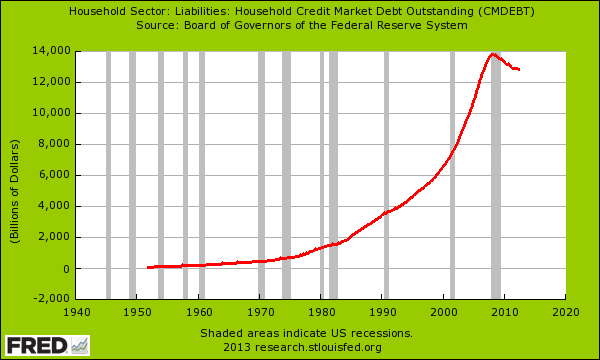
16 point 7 trillion dollars.  That is our current national debt.  12 point 8 trillion dollars.  That is the amount households carry in mortgage and consumer debt.  We are now addicted to debt to lubricate the wheels of our financial system.  There is nothing wrong with debt per se, but it is safe to say that too much debt relative to how much revenue is being produced is a sign of economic problems.  At the core of our current financial mess is how we use debt as a parachute for any problem.  We’ve been masking the shrinking of the middle class by allowing households to take on too much debt for a couple of decades.  The results were not positive.  Too this degree, we have now created a massive moral hazard economy where savings are punished into oblivion.  There is very little incentive to put your money in a bank account yielding zero percent interest when real inflation is eating away at your money like a hungry wolf.  So what do people do?  Well many simply cannot save and therefore choose to go into debt to finance cars, housing, and education with very little down.  Where does this debt addiction lead us?
A little bit of deleveraging
US households have deleveraged from the peak in the crisis.  However, much of this deleveraging has been forced via the 5 million foreclosures that have occurred:
total us debt
I’m not sure if we can interpret that as some sign of a healthy and growing economy.  Households have had their access to debt limited in many sectors.  Yet one sector that never retreated was that in higher education.  There is little doubt that there is a major bubble in higher education.  Instead of addressing the problems head on we now have more access to debt as the solution.  In order to compete in our service driven economy, having a skill is very important.  Most will make the investment to pursue a college degree but the issue is that with easy access to debt, prices have soared.  It is no surprise that college prices are following the trajectory of what happened in housing.
If you look at the above chart, a big part of the contraction has come from deleveraging from mortgages and credit card debt.  Yet we are now once again loading up on auto debt and college debt.  The system is now setup to punish any type of savings.  Good luck trying to stash your money in a bank account and outrun even the steady pace of inflation.
Take a look at the current savings rate for Bank of America:
bank of america
Of course the Fed has a hand in all of this.  The Fed realizing that our system for over a decade has been juiced by debt spending, had to step in and make it unattractive to save to the point that people are willing to dive into risky investments yet again.  Because of this however, you create moral hazard.  For example, with housing you have many government backed loans that are now accessible with very little down.  In fact, this has been the path of ownership for most Americans since many are without savings.  One out of three Americans has no savings and nearly half are one or two paychecks away from being out on the streets.
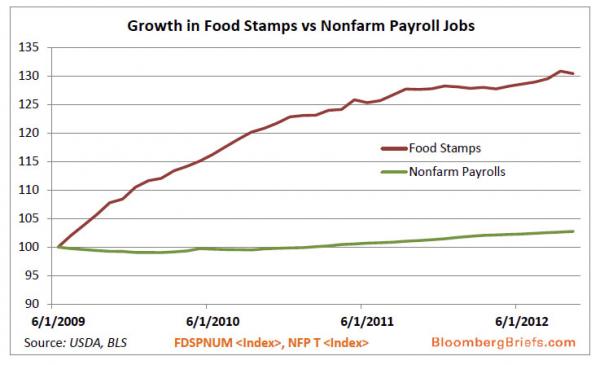
This is why we have seen such a dramatic rise in food stamp usage:
foodstamps vs payrolls_0
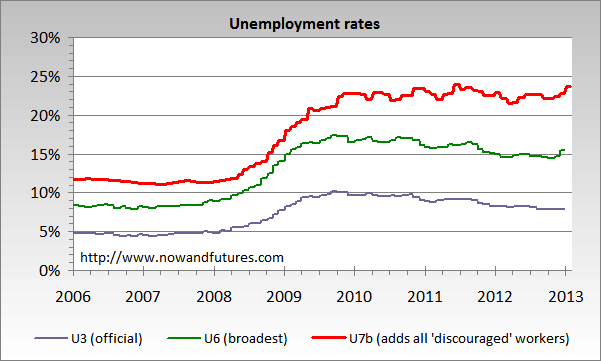
Why save to buy anything when you can simply go into debt for it?  That seems to be the course we are treading on.  We have reached a critical point where our national debt is now higher than our annual GDP.  This crossing of the Rubicon is seen as a major financial tipping point.  We have also mastered how to hide certain employment figures:
unemploymentU3U6U7
If we look at the U7b measure, the unemployed + underemployed + discouraged workers are nearly up to 25 percent.  We were discussing how many younger Americans are simply riding out the weak economy by going to college.         
People think that this recovery has come from organic forces when in reality, it has come because of number games and also the Fed injecting trillions of dollars into the banking industry.  Ironically these banks are using this money to speculate in markets like stocks and housing where they are now crowding out working and middle class Americans.  When you have access to a printing press with no restraints, it becomes too tempting to spend into oblivion.  Instead of confronting the core problems of the crisis, we are simply repeating them yet again; easy access to low down payment mortgages, easy access to student debt, consumer credit slowly expanding, and major Wall Street speculation.  Addictions are never easily cured and we have yet to come to terms with our insatiable appetite for debt.     

Gene Simmons to Obama: "You Have No F--King Idea!"

SIC SEMPER TYRANNIS!!!
Mark Matheny
February 6, 2013

When it comes to policies regarding Israel and the defense of it's borders, Singer Gene Simmons says Obama has no clue. Gene also had some revealing things to say about the UN....

Justice Department memo reveals legal case for drone strikes on Americans


NBC News
February 5, 2013
A confidential Justice Department memo concludes that the U.S. government can order the killing of American citizens if they are believed to be “senior operational leaders” of al-Qaida or “an associated force” -- even if there is no intelligence indicating they are engaged in an active plot to attack the U.S.
The 16-page memo, a copy of which was obtained by NBC News, provides new details about the legal reasoning behind one of the Obama administration’s most secretive and controversial polices: its dramatically increased use of drone strikes against al-Qaida suspects abroad, including those aimed at American citizens, such as the  September 2011 strike in Yemen that killed alleged al-Qaida operatives Anwar al-Awlaki and Samir Khan. Both were U.S. citizens who had never been indicted by the U.S. government nor charged with any crimes.  
The secrecy surrounding such strikes is fast emerging as a central issue in this week’s hearing of White House counterterrorism adviser John Brennan, a key architect of the drone campaign, to be CIA director.  Brennan was the first administration official to publicly acknowledge drone strikes in a speech last year, calling them “consistent with the inherent right of self-defense.” In a separate talk at the Northwestern University Law School in March, Attorney General Eric Holder specifically endorsed the constitutionality of targeted killings of Americans, saying they could be justified if government officials determine the target poses  “an imminent threat of violent attack.”

Young riding out recession by going into debt for college: Millennial unemployment jumps by two percent.

MyBudget360
February 3, 2013


As the animal spirits of the economy rage wild, there are still difficult challenges ahead for younger Americans.  While thestock market is up highlighting corporate euphoria, many companies are doing this with 4 million fewer workers.  So the economic recovery is not evenly distributed and they rarely are.  Yet younger Americans are still facing tough challenges ahead.  One major trend has to do with many people going back to college.  While education is positive, the costs are becoming incredibly high and many simply cannot afford it.  This is why total student debt outstanding is now over $1 trillion.  Why is this so important?  Well for one, we are seeing data showing that recent graduates, those in the last decade, are not yielding solid gains from their ventures into college.  With 4,000 colleges in the US, many are subpar and many are designed as vehicles to extract student loans.  How is this economy treating younger Americans?
The trend for college
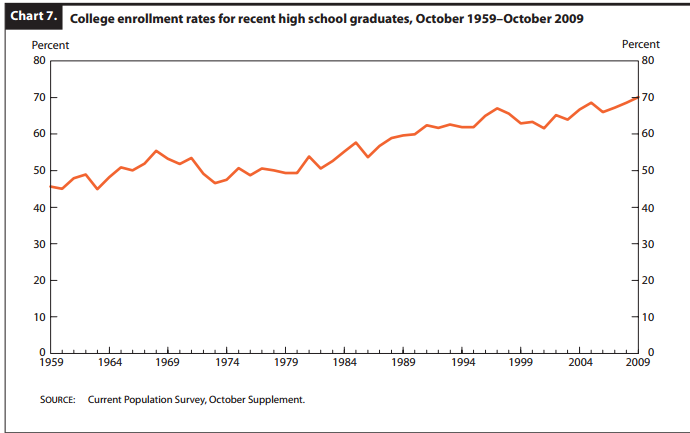
One piece of data that is very telling is the number of students enrolled in college:
college enrollment rates
What does the above chart tell us?  For one, it shows that more high school graduates are going to college.  Over 70 percent of high school graduates now enroll in college.  Those finishing college is much lower of course, below 30 percent.  However the above chart may not tell the entire story.  We have to account for the rise of women attending colleges as well.  This is also one of those important points to understand where in the past, one income was sufficient for a middle class lifestyle while now we are deep into a two-income trap.
Simply going to college is not a guarantee for a successful career.  It never was.  However now, there is a major mismatch between college costs and the actual value that is extracted in the market.  People have a hard time questioning the mission of college but when the costs are so high, you have to ask questions.  Plus, the only reason it is so expensive is the massive amount of loans funneled into the industry.
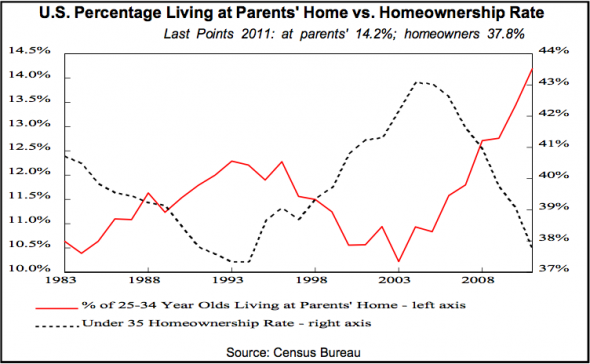
We also have a very high number of young Americans living at home:
young living at home
Many have come back home after school concludes being labeled the boomerang generation.  In an age of independence, you can rest assured that this trend to move back home has to do more with economics rather than cultural changes.  I found it interesting that many of the new building projects in real estate now are focusing on mulit-unit properties in anticipation for these young Americans to move out of their parent’s place as they seek to strike out on their own.
What we find underneath the recent employment reports is that many are getting work in lower paying service sector jobs.  Certainly not any employment that would justify tens of thousands of dollars in student loan debt.  The unemployment rate for those 16 to 19 is well over 37 percent.  This has been common for a very long time but highlights how common it is for people to flow right into the college education system.  Yet how much thought is given behind this?
“(Policy Mic) Youth unemployment shows signs that worse things may be around the corner.
Generation Opportunity, a national, non-partisan organization advocating for millennials ages 18-29, shows the youth unemployment rate for 18-29 year olds specifically for January, 2013 was 13.1% (NSA). For December 2012 it was 11.5%, while the unemployment rate in November was 10.9%.”
The declining labor participation rate actually puts an astounding 1.7 million young adults out of the employment figures.  They are not counted in the unemployed figures because many have given up looking for work.  It is still challenging for many young Americans and the student debt bubble is likely to align with the current youth crisis.