Cyprus Deal Turns Bank Depositors into Lenders, Abolishes National Sovereignty

The New American
March 25, 2013


Cyprus Deal Turns Bank Depositors into Lenders, Abolishes National Sovereignty
Late Sunday night the president of Cyprus, Nicos Anastasiades, was officially informed of the deal the unelected Eurogroup had come up with in order for Cyprus to receive its bailout from the European Central Bank. Anastasiades flew to Brussels on Sunday to meet with Mario Draghi, the president of the European Central Bank (ECB), Christine Lagarde, the managing director of the International Monetary Fund (IMF), and José Barroso, the president of the European Commission (EC). The meeting was run by Herman Van Rompuy, the president of the European Council. On his way to the meeting, Anastasiades admitted that “the situation is very difficult.”
That was an understatement. Once the details were explained to Anastasiades, the Eurogroup — consisting of unelected finance ministers from each country that uses the euro, and headed by another unelected bureaucrat, Jeroen Dijsselbloem — issued a statement of unanimity:
The Eurogroup has reached an agreement with the Cypriot authorities on the key elements necessary for a future macroeconomic adjustment program. This agreement is supported by all euro area Member States as well as the three institutions.
The details were ugly. There will first of all be a “downsizing of the [country’s] financial sector” by theft of part of every account over roughly $130,000 (€100,000) in Cyprus’ two largest banks, the Bank of Cyprus and the Cyprus Popular Bank (the Laiki Bank), which hold half of all bank deposits in the country. Any amount above $130,000 will make a “contribution” to the deal amounting to an estimated 20 percent while those accounts held in Cyprus’ other 26 banks will be nicked four percent. The Cyprus Popular Bank will be liquidated and accounts $130,000 or smaller will be transferred to the Bank of Cyprus. Accounts over $130,000 will disappear along with any investors’ bonds in that bank. The country’s capital gains tax rate will be increased along with corporate income tax rates.
Said “downsizing” was exacerbated by Anastasiades telling his friends what was coming on Thursday and to get their money out before the deal was announced. According to the Daily Mail, within the next 48 hours some $6 billion of foreign deposits (estimated to be between $20 and $40 billion) was transferred out of the country, leaving a banking system weakened by haircuts already suffered due to the Greek financial crisis teetering on the edge.
Anticipating that once the banks were opened small depositors would be taking their money out as well, the deal kept the remaining banks closed indefinitely, limiting depositors just $130 maximum daily withdrawals from their accounts through ATM machines.
And a new term was introduced into the lexicon of the day: “bail-in." A bail-in occurs when the contract terms of a bond are unilaterally and illegally changed by an outside illegal and unelected body so that the bond holder who normally would stand at the head of the line in a bankruptcy gets to “contribute” part of his investment to save the bank in which he invested. In essence it’s a forced haircut.

Rosa Korie Explains Why Public Must Awaken to Agenda 21


Infowars.com
March 27, 2013
Rosa Koire, ASA, is the executive director of the Post Sustainability Institute. She is a forensic commercial real estate appraiser specializing in eminent domain valuation.
Her nearly 30 years of experience analyzing land use and property value enabled her to recognize the planning revolution sweeping the country.
While fighting to stop a huge redevelopment project in her city she researched the corporate, political, and financial interests behind it and found UN Agenda 21.
Impacting every aspect of our lives, UN Agenda 21/Sustainable Development is a corporate manipulation using the Green Mask of environmental concern to forward a globalist plan. Rosa speaks across the nation and is a regular blogger on her website: http://www.democratsagainstunagenda21…

Too big to fail or ignore: How the US went from over 13,000 banks in 1987 to 6,000 today. $7.4 trillion in deposits backed by $32 billion dollars.

MyBudget360
March 27, 2013


Remember when too big to fail brought our economy to a grinding halt?  Of course you do because this is a recent financial event with dramatic ramifications.  In the time since the buffet of bailouts was rolled out you might be surprised that the too big to fail banks have only grown even larger and if they were too big to fail before, what happens when they become even bigger?  Some walk around in a financially comfortable delusion about our current system even though we all realize that we will never payback our $16 trillion in national debt.  You also have a banking system backing $7.4 trillion in insured deposits with $32 billion (that is, 0.43 percent).  Yet in our current system the Fed is digitally inflating away our currency and limiting available banking options.  Are we simply ignoring the too big to fail?
Shrinking the number of banks while becoming even bigger
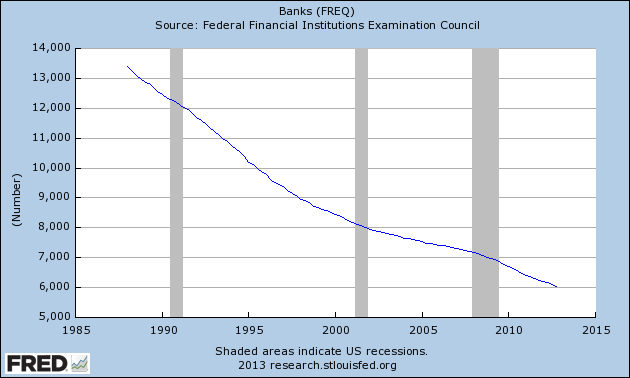
The US banking industry has been consolidating for many years.  In fact, we have gone from over 13,000 banks in the US in 1987 to roughly 6,000 today:
number of banks
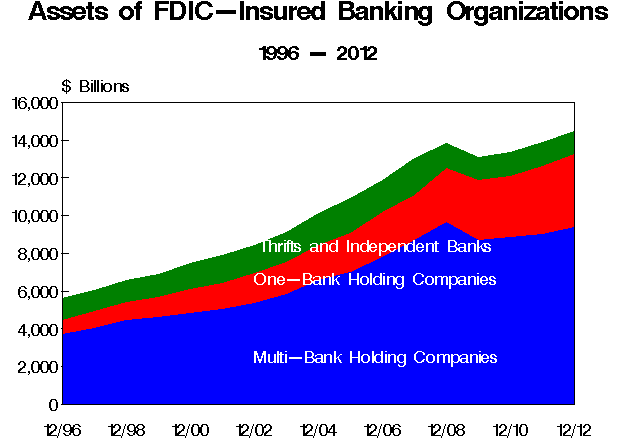
At the same time, you can track the trend that banks have gotten much larger in this same period of time in terms of the assets they carry:
assets at fdic banks
You need to remember what banks consider “assets” because it will be a different definition from what you would consider an asset.  For a bank, a mortgage is an asset.  This is money that you owe the bank while the mortgage is a liability on your balance sheet.  The home is an asset but certainly not the mortgage.  Think you own your home?  Stop paying on that mortgage and find out who really owns it.  Yet banks can increase their asset column by the simple act of writing more mortgages.  This is good when housing prices only go up but when they go down, suddenly those assets can go underwater.  Deposits are not an asset to a bank since these are liabilities that must be paid back to customers.  That is why the fact that $7.4 trillion in deposits is backed up by only $32 billion is somewhat astonishing.  I think few people realize this but in reality, the Fed and U.S. Treasury would simply turn on the printing press and inflate away our currency if they had to (and they are).
large asset banks

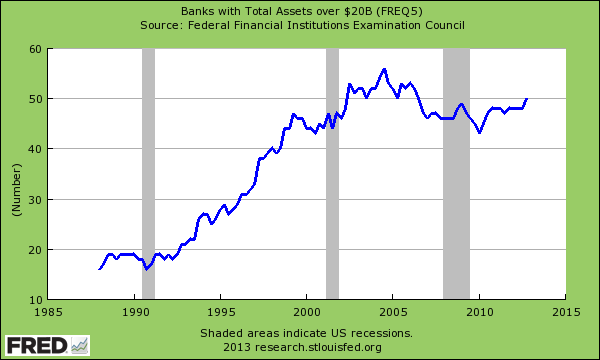
We have more than 50 banks with $20 billion in assets or more.  Take JP Morgan Chase for example.  Chase had $2.031 trillion in assets under management in 2009.  Today?  That number is $2.359 trillion (an increase of $328 billion at a time when we fully realized that too big to fail was the central culprit of our economic collapse).  Yet here we are simply allowing the banking sector to get even larger with the full unbridled support of the Federal Reserve.
What occurred in Cyprus is somewhat telling even though this was a tiny island in Europe.  To preserve the central currency the Euro exacted some tough measures on Cyprus and their banks.  Cyprus is a tiny part of the EU but it is part of the union.  This is very telling in terms of how central banks will act when push comes to shove.  In a way, we see similar actions of how the government and banking system is essentially forcing states where cost of living is more modest to subsidize the spending of expensive states (i.e., New York and California).  One clear example of this is the mortgage deduction.  Most people get very little benefit from this because the typical home in the US is roughly $170,000.  So the deduction only helps out a little.  But what about people that take on $500,000, $750,000, or even million dollar mortgages?  These people can claim a ridiculously high deduction and this comes at a cost to the rest of the nation.  Banks benefit of course because they can carry more “assets” on their books and appear larger.
The financial system encourages heavy leverage.  It is a big reason why student debt is now well over $1 trillion as well.  There is little reason why the banking system would want to put any sensible brakes on this until of course, we have another financial crisis that will hit because the same risks are being taken just in slightly different forms.  Yet people are getting more in tune to this and the standard of living for most Americans has gone stagnant.  Sure the press is focused on the Dow reaching a record peak but a very tiny portion of Americans even own stock and a good part of gains came from slashing labor and reducing wages.  Too big to fail has become too big to ignore but ignoring is exactly what we are doing.  Let us all rest assured and feel comfortable that $7.4 trillion is backed by $32 billion.

NY Times says CIA supplying arms to Syria insurgents

Press TV
March 27, 2013


According to the New York Times Arab governments, Turkey and the CIA have sharply increased the flow of weapons to Syrian insurgents.

While expanding a secret airlift of arms and equipment for the militants to use against President Bashar al-Assad, the New york times has based their findings according to air traffic data, interviews with officials in several countries and the accounts of rebel commanders. 


Follow our Facebook on: https://www.facebook.com/presstvchannel

North Korea puts Rocket Units on Alert to ‘attack US’


The Telegraph
March 26, 2013
The announcement, carried by the KCNA state media, was in the name of the Supreme Command, which has attracted attention in South Korea because it is an emergency division of the government that is only operational during time of war.
In the announcement, North Korea said it would “show off our army and people’s stern reaction to safeguard our sovereignty and the highest dignity through military actions.”
The comments come a day after Kim Jong-un was again pictured visiting military units, watching exercises on the east coast involving troops storming ashore from hovercraft and artillery shelling targets.

The Robot Reality: Service Jobs Are Next to Go

CNBC
March 27, 2013
Mandel Ngan | AFP | Getty Images
President Barack Obama and Israeli Prime Minister Benjamin Netanyahu sample matza bread offered to them by small robots during a tour of a technology exposition at the Israel Museum in Jerusalem.


If you meet Baxter, the latest humanoid robot from Rethink Robotics – you should get comfortable with him, because you'll likely be seeing more of him soon.
Rethink Robotics released Baxter last fall and received an overwhelming response from the manufacturing industry, selling out of their production capacity through April. He's cheap to buy ($22,000), easy to train, and can safely work side-by-side with humans. He's just what factories need to make their assembly lines more efficient – and yes, to replace costly human workers.
But manufacturing is only the beginning.
This April, Rethink will launch a software platform that will allow Baxter to do a more complex sequencing of tasks – for example, picking up a part, holding it in front of an inspection station and receiving a signal to place it in a "good" or "not good" pile. The company is also releasing a software development kit soon that will allow third parties – like university robotics researchers – to create applications for Baxter.
These third parties "are going to do all sorts of stuff we haven't envisioned," says Scott Eckert, CEO of Rethink Robotics. He envisions something similar to Apple's app store happening for Baxter. A spiffed-up version of the robot could soon be seen flipping burgers at McDonalds, folding t-shirts at Gap, or pouring coffee at Starbucks.
"Could [Baxter] be a barista?" asks Eckert. "It's not a target market, but it's something that's pretty repeatable. Put a cup in, push a button, espresso comes out, etc. There are simple repeatable service tasks that Baxter could do over time."

Egyptian mosque turned into house of torture for Christians after Muslim Brotherhood protest

Fox News
March 27, 2013
Amir Ayad lies in a hospital bed after he was allegedly beaten by Islamic hardliners who stormed a mosque in suburban Cairo. (MidEast Christian News)

Islamic hard-liners stormed a mosque in suburban Cairo, turning it into torture chamber for Christians who had been demonstrating against the ruling Muslim Brotherhood in the latest case of violent persecution that experts fear will only get worse.

Such stories have become increasingly common as tensions between Egypt’s Muslims and Copts mount, but in the latest case, mosque officials corroborated much of the account and even filed a police report. Demonstrators, some of whom were Muslim, say they were taken from the Muslim Brotherhood headquarters in suburban Cairo to a nearby mosque on Friday and tortured for hours by hard-line militia members.

“There is no longer anything to hold them back. The floodgates are open.”
- Shaul Gabbay, University of Denver professor on Egypt's Muslim Brotherhood

“They accompanied me to one of the mosques in the area and I discovered the mosque was being used to imprison demonstrators and torture them,” Amir Ayad, a Coptic who has been a vocal protester against the regime, told MidEast Christian News from a hospital bed.

Ayad said he was beaten for hours with sticks before being left for dead on a roadside. Amir’s brother, Ezzat Ayad, said he received an anonymous phone call at 3 a.m. Saturday, with the caller saying his brother had been found near death and had been taken to the ambulance.