Showing posts with label debt ceiling. Show all posts

The Legacy of Debt: Interest Costs Poised to Surpass Defense and Nondefense Discretionary Spending

Wall Street Journal
February 3, 2015

The U.S. has come a long way since the days of trillion-dollar deficits, just a few years ago. The White House projects 2016 will have the smallest budget deficit in eight years. Yet the budgetary impact of the debt that’s been accumulated–$18 trillion in total, $13 trillion of that owed to the public–will reassert itself.
Currently, the government’s interest costs are around $200 billion a year, a sum that’s low due to the era of low interest rates. Forecasters at the White House andCongressional Budget Office believe interest rates will gradually rise, and when that happens, the interest costs of the U.S. government are set to soar, from just over $200 billion to nearly $800 billion a year by decade’s end.
By 2021, the government will be spending more on interest than on all national defense. according to White House forecasts. And one year later, interest costs will exceed nondefense discretionary spending–essentially every other domestic and international government program funded annually through congressional appropriations. (The largest part of the budget is, and will remain, the mandatory spending programs of Social Security, Medicare and Medicaid. Mandatory spending is over $2 trillion and is set to double to $4 trillion by 2025.)
The total dollars spent on defense and nondefense discretionary spending will continue to rise, albeit slowly, in the coming decade. But as a share of the economy, both categories of spending are poised to shrink for the next decade, squeezed down as interest rates rise. Mandatory spending will rise from 12.4% of GDP to about 14.5% of GDP over this period.
By 2025, the White House projects interest costs will be 2.8% of GDP. The CBO is somewhat less optimistic and expects it will be 3%. Most economists and budget experts would agree that interest payments at 3% of GDP are manageable for an economy. The true cost may be the squeeze to other places the government could be spending a decade from now.

+106%: Obama Has More Than Doubled Marketable U.S. Debt

CNS News
February 19, 2014

(CNSNews.com) - The marketable debt of the U.S. government has more than doubled--climbing by 106 percent--while President Barack Obama has been in office, increasing from $5,749,916,000,000 at the end of January 2009 to $11,825,322,000,000 at the end of January 2014, according to the U.S. Treasury's latest Monthly Statement of the Public Debt.
During the eight-year presidency of George W. Bush, the marketable debt of the U.S. government almost doubled--climbing 93 percent--from $2,977,328,000,000 at the end of January 2001 to $5,749,916,000,000 at the end of January 2009.
During the time that Bush and Obama have been in office, the marketable debt of the U.S. government has nearly quadrupled, increasing by $8,847,994,000,000.
Chart of Marketable Debt
However, despite the massive increase in the government's marketable debt during Bush's eight years, Obama managed to accumulate more additional marketable debt in his first five years in office than all the presidents who preceded combined.

CBO Director Warns Of Financial Trouble Stemming From Big Spending

Personal Liberty Digest
February 13, 2014

A warning from the director of the Congressional Budget Office was lost in the static Tuesday as House Republicans sold out fiscal conservatives and caved to Democrat demands in extending the Nation’s debt limit without a single provision to control government spending. In testimony before the Senate, CBO director Douglas Elmendorf told lawmakers that the “large and growing Federal debt” could very likely bring about financial hardship in the coming years.
“The large budget deficits recorded in recent years have substantially increased federal debt, and the amount of debt relative to the size of the economy is now very high by historical standards. CBO estimates that federal debt held by the public will equal 74 percent of GDP at the end of this year and 79 percent in 2024 (the end of the current 10-year projection period),” Elmendorf told the Senate in prepared testimony.
He continued, “Such large and growing federal debt could have serious negative consequences, including restraining economic growth in the long term, giving policymakers less flexibility to respond to unexpected challenges, and eventually increasing the risk of a fiscal crisis (in which investors would demand high interest rates to buy the government’s debt).”
The CBO projects solid economic growth for the next few years. But the nonpartisan fiscal watchdog predicts that ongoing high unemployment combined with a growing number of people leaving the workforce could offset economic gains.
“Moreover, the rate of participation in the labor force — which has been pushed down by the unusually large number of people who have decided not to look for work because of a lack of job opportunities — is projected to move only slowly back toward what it would be without the cyclical weakness in the economy,” Elmendorf said.
By 2017, according to the CBO representative, U.S. economic growth is expected to “diminish to a pace that is well below the average seen over the past several decades.”

UPDATE: SENATE PASSES 'CLEAN' DEBT CEILING BILL

Breitbart
February 12, 2014


UPDATE (2/12/2014 3:52 PM): The Senate passed the "clean" debt ceiling bill, sending the legislation to President Obama, who is expected to sign it into law. The bill suspends the debt limit until March 15, 2015. 

The vote to pass the bill was 55-43. An earlier procedural vote to advance debate passed 67-31, with Senate Minority Leader Mitch McConnell (R-KY) and Whip John Cornyn (R-TX) joining mostly Democrats to invoke cloture. 
Sen. Ted Cruz of Texas forced the 60-vote procedural vote. Two GOP Senate aides told Breitbart News that McConnell forcefully urged him not to do so at a closed-door meeting yesterday.
According to an analysis by the Senate Budget Committee Republican staff, the national debt will rise to $18.2 trillion while the debt limit is suspended.
UPDATE (2/11/2014 5:29 PM): The House has passed a “clean” bill to extend the debt limit until March, 2015 by a vote of 221-201.
The vast majority of Republicans voted against the bill, while nearly 200 Democrats carried it across the finish line. 28 Republicans voted “yes.”
Speaker John Boehner, who usually does not vote, voted "yes," as did Majority Leader Eric Cantor and Whip Kevin McCarthy. House Budget Committee Chairman Paul Ryan voted "no."
Cantor blamed the debt ceiling increase on Democrats. "House Republicans need more responsible and willing partners in Washington so we can finally and boldly address our long term debt crisis," he said in a statement. 
Ryan called the vote a "missed opportunity."
"We need to pay our bills today and make sure we can pay our bills tomorrow," Ryan said in a statement after the vote. 
The House GOP's inability to force even a modest fight on the debt ceiling prompted an outcry from conservative groups, including several calls to replace the current House leadership. 
"Today, Republican ‘leadership’ in the House completely gave up fighting for the priorities of the American people and once again caved to the demands of President Obama and the Democrats. This latest failure is just more proof that it’s time to dump the GOP leadership in Congress," said ForAmerica Chairman Brent Bozell.
The 28 Republicans who voted "yes":
  • John Boehner (OH)
  • Ken Calvert (CA)
  • Dave Camp (MI)
  • Eric Cantor (VA)
  • Howard Coble (NC)
  • Chris Collins (NY)
  • Charles Dent (PA)
  • Michael Fitzpatrick (PA)
  • Michael Grimm (NY)
  • Richard Hanna (NY)
  • Doc Hastings (WA)
  • Darrell Issa (CA)
  • Peter King (NY)
  • Kevin McCarthy (CA)
  • Buck McKeon (CA)
  • Patrick Meehan (PA)
  • Gary Miller (CA)
  • Devin Nunes (CA)
  • David Reichert (WA)
  • Hal Rogers (KY)
  • Peter Roskam (IL)
  • Ed Royce (CA)
  • Jon Runyan (NJ)
  • John Shimkus (IL)
  • Chris Smith (NJ)
  • David Valadao (CA)
  • Frank Wolf (VA)
UPDATE (2/11/2014 12:13 PM): Speaker John Boehner will bring a clean debt ceiling bill to the floor today, marking the end of an era in which House Republicans sought spending cuts and reforms in equal or greater amount to the increase in the debt ceiling.
President Obama and congressional Democrats had said they were opposed to even discussing spending cuts in the context of the debt ceiling. But Republicans couldn't even come together with their own plan.
“It's a recognition that we don't have 218 votes. When you don't have 218 votes, you have nothing,” Boehner said in a press conference.
House leadership began the effort offering to tack on relatively-modest GOP priorities like the Keystone pipeline on the debt ceiling increase. That wasn't enough for the right, who wanted to go big or go home. “There's only votes for something bold,” said Rep. Jim Jordan, a former chairman of the House Republican Study Committee, “I was willing to do something bold.”
The last ditch effort, announced in a closed-door meeting yesterday, was to add a spending increase to the debt ceiling in the hopes of garnering a bipartisan coalition that could bring the bill over the finish line.
That didn't work, either, leading to an intense meeting with barbs traded and accusations of bad faith.
Now, Boehner will work to provide a handful of Republicans, himself included, to vote with around 200 Democrats to increase the nation's debt ceiling without any cuts.
“I would hope not,” Boehner said when asked by a reporter if the “Boehner rule” was dead. But, he conceded, it was a “lost opportunity,” adding, “I am disappointed to say the least.”
The vote, originally scheduled for Wednesday, was moved forward to today because of a pending snowstorm.
The House will separately vote to reverse many of the veterans' benefits cuts that were in the Ryan-Murray budget deal and "pay for" the spending increase with additional sequester cuts in 2024, five election cycles from now.
UPDATE (2/11/2014 9:45 AM): Speaker John Boehner will bring a clean debt ceiling bill to the house floor Wednesday, several members said departing a closed door meeting.
Original Story: After storming out of the GOP's debt ceiling meeting and pacing furiously 100 yards down a hallway deep the bowels of the Capitol, South Carolina Republican Rep. Jeff Duncan wheeled around to face a couple reporters that had managed to keep up with him.
“Why don't you talk to my son?” Duncan asked, pointing angrily at his black iPhone. “Tell him about the debt that he's going to pay. $17.3 trillion right now. This is him on the phone. He's a Clemson student, I'd be glad for you to explain how he's going to pay that back,” Duncan added, his voice full of sarcasm.
Duncan was irate about the plan Speaker John Boehner and the House GOP leadership team had just unveiled to raise the debt ceiling. Rather than use the must-pass vote to tackle rampant deficits, Boehner's plan would actually increase spending now and theoretically “pay for” the new spending with more sequester cuts five election cycles from now.
GOP lawmakers generally received the plan poorly, and the mood coming out of the meeting was grim.
“I don't think anybody grappled with anything. I just heard the same old arguments I've heard for three years,” said Rep. Devin Nunes of California, a close friend of Boehner's.
Nunes went on to make what is probably the best real-world case for the new proposal. “Nobody likes any of this. There's problems with every bill we put up. The leadership feels this one gives the best chance for Republicans and Democrats to vote for it to get to 218 votes.”
“What's that spoonful of sugar that you need to help this medicine go down?” asked Rep. Steve Womack of Arkansas, a top moderate voice in the GOP conference. “That's the elusive part of this thing. I don't envy Speaker Boehner. He's got a difficult job – nearly impossible – to bring 232 people together and find the votes that establishes the strength of our conference. We're still trying to find that magic formula,” he added.
After several weeks of trying to find a plan – any plan – that could garner 218 Republican votes, leadership moved on to plan B – putting members between a rock and a hard place.
The Boehner debt ceiling plan reverses cuts to veterans' benefits that were part of the Ryan-Murray budget deal. Normally, voting to raise the debt ceiling is politically toxic. Now voting against raising the debt ceiling is also voting to cut veterans' benefits.
The revised incentive structure was not lost on the Republican lawmakers, who complained loudly. “Look, people who never want to vote for the debt limit also don't want to vote against veterans,” Nunes said.
The predictable reaction on the right was, hey, we didn't support those veterans cuts in the first place. Now you want us to swallow a debt ceiling increase to get rid of them?
As the meeting turned slightly nasty – with barbs traded and accusations of bad faith – it became clear this thing wasn't even close to getting 218 Republicans.
It might be that wasn't the goal.
“At our retreat, leadership was saying they wanted to craft a plan that was 'no skin off the Democrats' backs.' That's a direct quote. And I think this accomplishes that,” said Rep. Matt Salmon.
As the meeting went on, the Senate voted overwhelmingly to advance a bill to reverse the veterans' cuts – no debt ceiling in sight – indicating that significant numbers of Democratic votes could be coming in to bail out the GOP.
It's a far cry from the visions of reform that have captivated House Republicans in past debt ceiling fights. This time around, there's even a small faction on the party's right flank urging Boehner just to bring a “clean” debt ceiling to be done with the whole charade.
How did the Republicans get here, in a circular firing squad over a plan so relatively lame it's worse than the status quo?
Georgia Rep. Rob Woodall, a sophomore lawmaker who has quickly climbed the leadership ladder to a plum spot on the House Rules Committee, wondered the same thing.
“What in the world has happened between August of 2011 – when the president and the Senate were partners with us, to both raise the debt ceiling, and try to solve the problem – to today, where folks say 'no, clean debt ceiling. No problem, nothing to see here'?” he asked. “Drives me crazy.”
Matthew Boyle contributed to this report.

U.S. To Hit Debt Ceiling Sooner Than Thought, Brace Yourselves

Before It's News
January 26, 2014

More political theater, On February 7 the United States will once again reach its statutory debt limit, meaning it cannot legally borrow any more money.
Since the obvious option of cutting spending to match the amount of revenue that the government collects is off the table for some inexplicable reason, Congress will have to pass a new, higher debt ceiling to replace current law.
Just understand that the two weeks until the deadline we should be prepared for all sorts of lies, threats, and forecasts of doom if the debt ceiling is not increased. 
Like the U.S. Treasury will likely hit the debt ceiling earlier than first thought, Treasury Secretary Jack Lew said, setting the stage for another fiscal showdown.
“When I previously wrote to you in December, I estimated that Treasury would exhaust extraordinary measures in late February or early March,” Lew wrote in a letter to House Speaker John Boehner, R-Ohio, and the other top three congressional leaders.
“Based on our best and most recent information, we believe that Treasury is more likely to exhaust those measures in late February,” said the letter, which can be found at tinyurl.com/UPI-Lew-letter.
A surge of February spending, mainly for 2013 tax refunds, will leave the Treasury with little room to maneuver after the official debt limit is reached Feb. 7, he said in the letter.
Boehner spokesman Michael Steel said in a statement Republicans would need concessions from Democrats before they’d agree to raise the borrowing limit.
“The speaker has said that we should not default on our debt, or even get close to it, but a ‘clean’ debt limit increase simply won’t pass in the House,” Steel said. “We hope and expect the White House will work with us on a timely, fiscally responsible solution.”
President Obama has said he will not negotiate over the debt limit, calling it a congressional responsibility, not a bargaining chip.
White House senior adviser Dan Pfeiffer told “Fox News Sunday” that President Obama will “not pay ransom” for getting Congress to fulfill its duty to increase the ceiling and that members should “spare the country the drama.”
Both parties are trying to put on a good show for the American public. Dividing the American people seems to be an art form for Obama and his administration. 

WILL U.S. PUBLIC DEBT REACH $22 TRILLION BY FEB. 2014?

etf Guide
October 22, 2013

objectRon DeLegge, Editor
Just imagine an undisciplined out-of-control spender whose credit limit has just been extended. In other words, they can continue overspending without any accountability. That “they” is the U.S. government.
It’s been almost a week since Congress reached a temporary deal to suspend the U.S. government’s debt ceiling and the Treasury department has already wasted no time by adding another $375 billion in new debt.
Suspension of a cap on U.S. debt, which was previously fixed at $16.69 trillion, means the Treasury department, headed by Jack Lew, can effectively spend whatever amount of money it needs or wants.
How much debt can the U.S. government rack up by the next debt ceiling deadline on Feb. 7, 2014? At the current spending pace of $375 billion per week, U.S. public debt would reach $22.70 trillion.
Numerous times, we’ve written extensively about how the U.S. Treasury had been using accounting shenanigans to avoid going over the previous legal debt limit. We also made the point that any corporation or corporate executive that attempted to use the U.S. Treasury’s same accounting tactics would be charged with fraud. Others too have caught on to the U.S. Treasury’s financial games.

"When you are the largest economy in the world, when you are the safe haven in all circumstances, as has been the case, you can't go into that creative accounting business," said International Monetary Fund Managing Director Christine Lagarde in an interview with NBC News' Meet the Press.
What does the bond market have to say about this?


After reaching a yearly high of 2.97%, the yield on 10-year U.S. Treasuries (NYSEARCA:IEF) has since fallen by 12.5%. Put another way, the bond market is saying that it doesn’t care about the fiscal realities of the U.S. government’s unmanageable debt load. Eventually, when it does start caring, that reality will be first reflected in key price levels highlighted in our latest Technical Forecast. 
In the meantime, Treasury bulls are celebrating. 
ETFs that benefit from lower yields and higher Treasury bond prices like the ProShares Ultra 20+ Yr. Treasury ETF (NYSEARCA:UBT) and the Direxion Daily 20+ Yr. Treasury Bull 3x Shares (NYSEARCA:TMF) have gained between 8% to 12% since early September. Treasury bonds with long-term maturities (NYSEARCA:TLT) like those tracked by UBT and TMF are most sensitive to changes in interest rates compared to Treasuries (NYSEARCA:SHY) with maturities of less than 10-years.
The table above is from the U.S. Treasury’s daily statement.

The ETF Profit Strategy Newsletter uses a combination of market sentiment, fundamental/technical analysis, market history, and common sense to be on the right side of the market. Since the beginning of the year, 74% of our time stamped ETF picks have turned a profit and our biggest win was a +525% gainer. (through 9/30/13)

Follow us on Twitter @ ETFguide

Raising the "IOU" Ceiling

SIC SEMPER TYRANNIS!!!
Mark Matheny
October 17, 2013

Mark Matheny discusses the recent shutdown propaganda and the "Debt Slavery" system known as the U. S. Monetary system.


Bloomberg Faults Congress for ‘Kicking the Can Down the Road’

Politicker.com
October 17, 2013

Michael Bloomberg today.
Michael Bloomberg underground at the secret location under Central Park today.
Washington lawmakers finally reached a deal to re-open the government just hours before the debt ceiling deadline, but Mayor Michael Bloomberg isn’t celebrating yet.
“All of what they’re talking about is simply kicking the can down the road,” Mr. Bloomberg told Politicker this afternoon.
The mayor was responding to a request for his take not long before Republican lawmakers had officially conceded their fight. But Mr. Bloomberg, sounding confident a short-term deal would be reached, predicted another standoff soon.
“It is true it would be after the Christmas holiday shopping season, I suppose, but we’re gonna have the same problem come January. We’ve got to stop all of this stuff and come up with a rational system,” he argued at the press conference, which was called to announce the activation of a giant new back-up water tunnel, which was officially switched on at 5 p.m. this evening.

Shutdown Shuts Down: Dems And RINOs Win, Conservatives Lose In Congress’ Capitulation To Obama

Personal Liberty Digest
October 16, 2013

The Senate is ending the government shutdown. By the time you read this, the Senate will likely have voted on a bill to fund the government through January 15 of next year and to raise the Federal debt limit until February 7. The only GOP “win” in the Senate bill involves new requirements that Obamacare buyers seeking government subsidies must prove their qualifications by demonstrating low income.
With a House vote expected later in the evening, President Barack Obama is expected to sign off on the bill before the Thursday debt limit “deadline,” as forecast by the U.S. Treasury.
House Speaker John Boehner (R-Ohio) is not expected to delay or attempt to amend whatever the Senate is passing. “We fought the good fight; we just didn’t win,” he said Wednesday on a Cincinnati radio show. “There’s no reason for our members to vote ‘no’ today,” he said later.
Boehner’s full capitulation comes just a day after House Republicans attempted to counter the Senate bill by cobbling together their own last-minute plan before realizing the votes to see it through simply weren’t there.
Even Senator Ted Cruz (R-Texas), who had stood firm against the debt limit deal unless Congress voted to defund Obamacare, stood aside Wednesday to allow the Senate to expedite a vote – even though   Senate Majority Leader Harry Reid (D-Nev.) cannot bring the measure before the full Senate for consideration today without unanimous consent.
Judging from conservative comments across the internet, there’s a great deal of ambivalence among Republicans as to whether Cruz is to be praised or blamed for his role in the shutdown debate – including Wednesday’s go-along.
On one hand, Cruz mobilized whatever conservative support might have been latent among Congressional GOP leaders and their constituents. He did strike early and often – when tapping into public opinion to defund Obamacare and pressuring Congress to listen to the people’s will would have mattered. He had little GOP support, as the ensuing weeks proved.
On the other hand, there’s no denying that Cruz kept up his tough talk while dialing down his walk, once it became clear that he and Mike Lee (and maybe Rand Paul) were becoming an increasingly isolated three-man army within their own party’s Senate bloc. He or Lee or anyone could filibuster today’s Senate vote and bide more time for leveraged compromise, if leveraged compromise were in the offing.
But the majority of spineless Senate Republicans simply wouldn’t sit at Cruz’ table. A unified pushback against the Democrats never stood a chance of coming together from the balkanized ranks of Republican Senators.
And it’s important to remember there’s little gain in vilifying the few Congressmen who put up a principled fight, when the entire charade was perpetrated from the far left. If Obama and Reid and lock-step Democrats weren’t hell-bent on borrowing more money – Obamacare concessions be damned – there would never have been a fight between the GOP-controlled House and the Democratic-controlled Senate in the first place.
Instead, we’re on track to make debt-ceiling history once again. Now that Obama and the Dems have carte blanche, we should be ticking past the $17 trillion threshold any day now.

In Debt We Trust

SIC SEMPER TYRANNIS!!!
Mark Matheny

October 13, 2013

Reports yesterday on many alternative websites said that EBT transactions were down due to some type of failure that occurred across the United States. As of around 11 pm last night, the system was operational once again.

Many sites were predicting riots and economic collapse to ensue if the system were to stay down, ... and that would be one possible scenario in such an event since there are about 47 million people of foodstamps here in the U.S. currently.

However, the deadline for the debt ceiling to be reached on October 17 is significant, but in my opinion not a doomsday date. The reason for this is that the Fed will continue it's money printing in order to satisfy its debts. In otherwords, it will simply devalue the currency even more in order to pay its creditors, putting more of a burden upon the American people in the form of inflation.

As I talked with a friend last night, we both came to the same conclusion. The EBT failure may have been a warning from the White House telling it's loyal dependent followers "not to bite the hand that feeds them".

Possibly more fear tactics from the Obama Administration.....

"IN DEBT WE TRUST" should be what is printed on the Federal Reserve Notes we pass off as money........

The US cannot avoid a soft default even if a hard default is avoided: Debt ceiling already breached and US Treasury operating in emergency mode while US is paying $415 billion in annual interest expenses.

MyBudget360
October 13, 2013

All the talk has shifted from the government shutdown to the US actually defaulting on outstanding debts.  The markets were in deep fear but the last couple of days rumors that the debt ceiling would be raised put the rocket boosters on the stock market.  Of course, the majority of Americans have little money in stocks so this was more of a spectacle.  Yet what isn’t discussed is the US is already in a long-term soft default on outstanding debts.  That is, through various financial wizardry, the US is going to devalue the amount it owes through inflation by digitally printing enormous amounts of money.  The Fed already has a balance sheet above $3.6 trillion when prior to the recession, it was below $800 billion.  The end result of course is that debt based purchases like housing, college, and cars have soared in the amount they cost even though the typical household makes what they once did in 1987 adjusting for inflation.  A soft default simply means that debts will be paid but with inflated money.
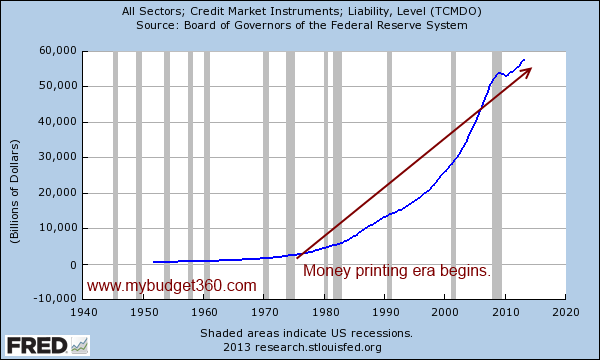
Total debt markets balloon after printing money era begins
We are addicted to debt.  The total US debt markets are now approaching $60 trillion:
total credit markets
This wasn’t always the case.  Starting in the 1970s as the US and many other nations moved away from the gold standard to fiat systems, central banks were unleashed to print as much money as they wished.  For decades we have been on a tremendous spending spree.  There is no way we can payback our outstanding debts.  Similar to the household that takes on too much debt at some point, even servicing the debt becomes more problematic (i.e., more continual debt ceiling battles).
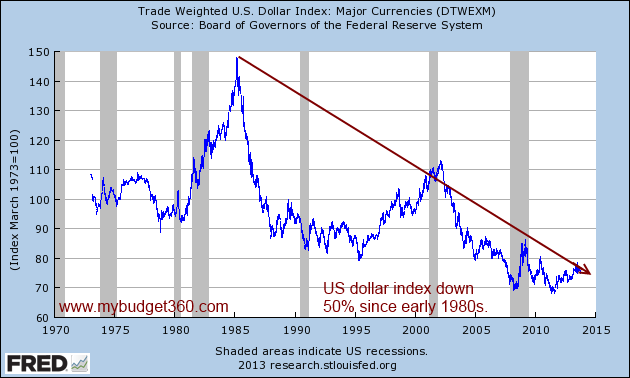
While the US does have the largest economy in the world the amount of debt we carry is jaw dropping.  In many ways, the US dollar has taken on the brunt of this pain over the decades.
US dollar collapses
The US dollar has lost 50 percent of its purchasing power over the last generation:
us dollar
This impact is a result of devaluing our dollar but also inflating our way into spending.  There is a specific reason why items like housing, healthcare, cars, and college education are now completely out of reach for households without gigantic financing.  There was a time when someone was able to work a part-time job and pay their way through college.  Try doing that today with the current costs of higher education.  Is it any wonder why student debt now tops $1.1 trillion?
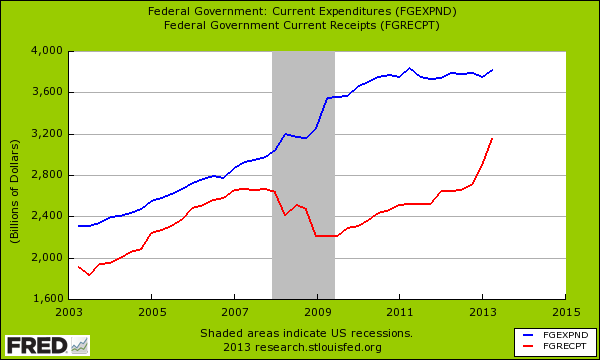
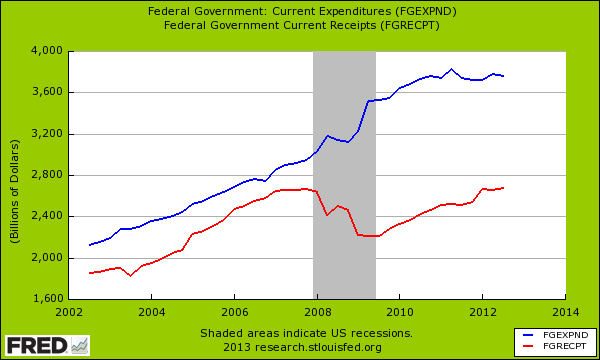
A soft default simply means that the US has no choice but to inflate its way out of this debt.  GDP is now growing much slower as we are a mature economy.  Yet debt is growing at a much faster pace making up for the gap that we are seeing.  Government spending has far outpaced government receipts:
debt and spending
The big jump in receipts recently was built on the back of debt based maneuvers (i.e., QE, bailing out the banks, and massive injections of debt into the economy).  This is the reason why receipts increased while government spending remained elevated.
The debt we will never payback
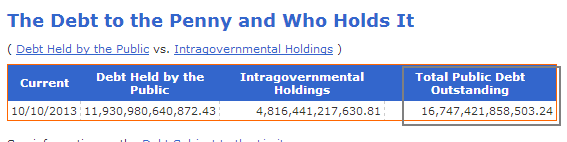
We will never payback the debt that is owed:
us debt to the penny
This is an interesting situation.  Most people realize that this debt will not be paid back.  In fact, the markets completely get this.  Take for example the Fed’s unprecedented purchasing of mortgage backed securities.  Why would the market lock in rates of 3.5 to 4 percent for 30 years with all the incredible amounts of risk present?  The answer to that is the market has no appetite for that and that is why the Fed is essentially the biggest player in the mortgage market.  Yet the law of unintended consequences rears its head.  Because of this setup banks are now leveraging easy access to debt to eat up real assets in the economy in the form of single family homes (and inflating the cost of homes once again for regular Americans).
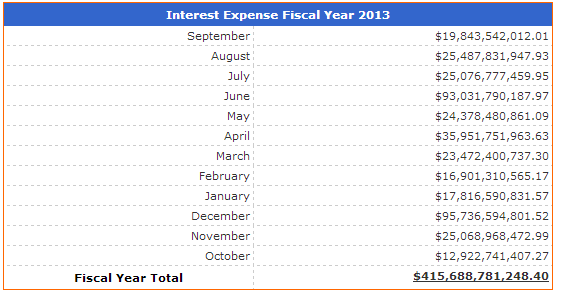
The interest expense on the debt is already up to $415 billion per year:
interest expense
We owe $16.74 trillion.  If this were an interest only loan the rate would be 2.4 percent per year (who else can command a rate that low?).  What is interesting is The Treasury is already using extraordinary measures to avoid a default.  The debt ceiling was raised to $16.699 trillion on May 19, 2013 but we are beyond that.  Of course the October 17 date is a big one because we simply cannot be operating in emergency mode for much longer.  It is very likely something will be done but a soft default, that is, inflating ourselves out of this debt is likely to happen no matter what occurs in the next few weeks.

Obama Agrees To Negotiate With Congress

The Western Center for Journalism
October 9, 2013


Barack Obama is backing away from his prior refusal to seek a compromise with Congress, indicating he will meet with lawmakers Thursday in an effort to end the ongoing federal government shutdown.

House Republicans, who have received the brunt of Obama’s vitriol throughout the stalemate, are invited to meet with the president to discuss funding and reopening the government. This decision stands in contrast to his repeated insistence he will accept nothing less than a “clean” spending bill — one that does not target the increasingly contentious ObamaCare law.
This move, which came around the same time as polling results showed his approval rating at a dismal 37 percent, indicates that Obama might be ready to concede at least some of the GOP’s points. That assumption might be overly optimistic, however, given his supreme reticence to acquiesce.
In actuality, Obama is likely focused on his demand for another debt limit increase. With a deadline fast approaching, he cannot afford to be saddled with a shutdown while making the case for giving the government even more money.

Read the entire article

U.S. Is Broke, Can't Afford to Raise the Debt Ceiling

SIC SEMPER TYRANNIS!!!
Mark Matheny
September 26, 2013

Obama is claiming that raising the Debt Ceiling in the U.S. doesn't raise the debt. We know however that over the last 100 times that Congress raised the debt ceiling, our debt has increased with it. Peter Schiff is saying that the U.S. is so broke we are not in a position to raise the debt ceiling anymore.


Obama: 'Raising the Debt Ceiling...Does Not Increase Our Debt,' -Though It Has 'Over 100 Times'

CNS News
September 19, 2013

Raising the debt ceiling doesn't increase the nation's debt, Pres. Obama declared in a speech today.
In a speech at the Business Roundtable headquarters in Washington, D.C., Obama dismissed concerns about raising the debt ceiling by noting that it'd been done so many times in the past:
"Now, this debt ceiling -- I just want to remind people in case you haven't been keeping up -- raising the debt ceiling, which has been done over a hundred times, does not increase our debt; it does not somehow promote profligacy.  All it does is it says you got to pay the bills that you've already racked up, Congress.  It's a basic function of making sure that the full faith and credit of the United States is preserved."
Obama went on to suggest that "the average person" mistakenly thinks that raising the debt ceiling means the U.S. is racking up more debt:
"It's always a tough vote because the average person thinks raising the debt ceiling must mean that we're running up our debt, so people don't like to vote on it, and, typically, there's some gamesmanship in terms of making the President's party shoulder the burden of raising the -- taking the vote."
But, isn't the fact that the U.S. has hit its debt ceiling "over a hundred times" - and, thus, has had to keep raising it - proof that raising the limit does, in fact, lead to increased debt?

Sequestering the working and middle class – The implications of runaway debt. GDP at record levels yet nonfarm employment is 4 million below previous peak. Trillion dollar coins. Greece unemployment reaches a new record.

MyBudget360
January 13, 2013


Gear up those printing presses.  You might be thinking that some of the policy talk coming out today is from The Onion but no, the idea of a $1 trillion coin is being discussed.  The Federal Reserve is already very willing to become a shadow bad bank and take on all the questionable assets from the latest bubble from member banks.  As the middle class is crushed, our nation is becoming more polarized.  You have a massively large group of people that are now classified as poor in the world’s wealthiest nation.  We have over 47 million Americans on food stamps.  Theaverage per capita pay is $26,000 much to the surprise of many people conditioned on only getting their data from the mainstream press.  Those that deny inflation are not looking hard enough.  The purchasing power for working and middle class Americans is being slowly destroyed.  Europe is still facing major headwinds with Greece reaching a troubling new record with their unemployment rate.  All this rhetoric means the Fed and ECB will continue on their path of quantitative easing and digital money printing.
Sequestering the working and middle class
One of the major stories that was not reported during this crisis is that many companies used the economic crisis as a reason to lay off employees or slash wages.  Yet by looking at GDP, you will realize that we are at a current peak yet nonfarm employment is down by 4 million from the previous peak:
GDP and nonfarm employment
In other words we are producing just as much with far fewer people.  Where are these people now?  Many of them are now on food stamps.  Over 47 million Americans are receiving food assistance.  Their voice is largely unheard and politicians have little incentive to recite their concerns.  We are now stumbling from one crisis to another like a drunkard.  Only a few hours after the fiscal crisis was diverted for the short-term we were then talking about the debt ceiling.  This even inspired the idea of minting a trillion dollar platinum coin to pay off some of our national debt.
It would be comical if it were not so absurd.  The GDP equation is rather simple:
GDP = private consumption + gross investment + government spending + (exports − imports)
We’ve been going hog wild on the government spending portion recently.  Take a look at the current government spending and revenues:
fed spending
After the recession government spending ramped up dramatically to make up for the losses in revenue.  But we are still spending at record levels while not taking in enough.  We are running gargantuan trillion dollar deficits for as far as the eye can see.  Maybe minting a few trillion dollar coins isn’t such a bad idea.  We wouldn’t be the first nation to lead this charge.  Zimbabwe already went down this road with a trillion dollar note:
Zimbabwe_$100_trillion_2009_Obverse(1)
Nothing bad ever came from that right?  The problem with the road we are leading in is that the US middle class is being crushed.  Even projections for this are highlighted in many reports:
share of middle class
For the very wealthy, they don’t mind pursuing this global low wage system where they can squeeze dollars all around the planet.  Do you want to work for $1,000 or $2,000 per year?  This is the future for many.
There really are no easy decisions.  Take a look at a high wage system with cronyism in their government, Greece.  They recently just reached a new peak unemployment rate of 26.8 percent:
unemployment greece
Youth unemployment (15 to 24) is now up to 56.6 percent.  So much for high unemployment suddenly creating a healthier marketplace and a fertile environment for the middle class.  This sequestering of the middle class has been ongoing for a few decades now and has happened under both political parties.  People need to wake up and pay attention to what is really going on.  These massive increases in debt do come at a price.  Maybe a trillion dollar coin is our sale price.

CRUZ ON DEBT CEILING: OBAMA TRYING TO SCARE PEOPLE WITH FINANCIAL APOCALYPSE

Breitbart
January 7, 2012

Direct Link Here to Video
http://landing.newsinc.com/shared/video.html?freewheel=91074&sitesection=breitbartprivate&VID=24168752

Let me be clear, I do not support default on the debt and we should never default on the debt and the only players who are threatening to default are President Obama and Harry Reid. This is an issue, and earlier in the show you played the President threatening default. In any given month tax revenue are 200 billion and interest is 30 or 40 billion. There is it plenty of revenue to service the debt and any responsible President would've stood at that podium and said 'whatever happens with the debt ceiling, we will always pay our debt. We'll never default on the debt' and the reason the President isn't doing that is he's trying to scare people and raise the spector of financial apocalypse." - Sen. Ted Cruz (R-TX) on Fox News Sunday 1/6/12

Harry Reid on Hiking Debt Limit to $18.794T: ‘We’ll Raise It’

Editor's Note: The Obama Thug House is already talking about raising the Debt ceiling again.... I hate to say it but we are HIT LIKE A SOUP SANDWICH.....

CNS News
November 8, 2012


(CNSNews.com) – Senate Majority Leader Harry Reid (D-Nev.) said on Wednesday that if the $16.394 trillion current legal limit on the federal government's debt must be raised in the next few months by another $2.4 trillion, “We’ll raise it."
That would set the debt limit at $18.794 trillion.
During a Capitol Hill press conference on Wednesday, CNSNews.com asked: “Senator Reid, the Treasury Department said last week that we will hit the debt ceiling again near the end of the year. Are you prepared—will you support—"
“I think the debt ceiling will come after the first of the year,” Reid said. “But please everyone accept this: They tried it before—they, the Republicans.”
“They tried it before – ‘We’re going to shut down the government, and we’re not going to raise the debt ceiling,’” he said. “If they want to go through that again, fine."
“But we’re not going to be held subject to something that was done as a matter of fact in all previous administrations,” Reid said.
CNSNews.com then asked, “But will you support raising it by another $2.4 trillion?”
“If it has to be raised, we’ll raise it,” he said.