Showing posts with label Wall Street. Show all posts

"Trump’s" Stock Rally Best Since 1945

The New American
November 11, 2017

Before the market opened on the day after Donald Trump won the election a year ago, futures were predicting a precipitous drop in the Dow Jones Industrial Average of 900 points. By the close of business that day, sentiment reversed and the market closed up 250 points, to 18,500.
That was 5,000 points ago, and the market has set all manner of records along the way. The rally in stocks is the best election year performance since 1945, and the fourth-best in history. By contrast, the Dow was up just 1.8 percent following Obama’s election in 2008.
The president is, not surprisingly, taking all the credit, exclaiming on Tuesday, “The reason our stock market is so successful is because of me.” In reality, investors have largely gotten over the shock of Trump’s win and have instead been focusing on company sales, profits, and earnings. Each of them, across a wide swath of American companies and industries, has seen great improvements over the past year. Helped along with a strong dollar, corporate earnings consistently exceeding forecasts, growth in real (inflation-adjusted) wages, drop in unemployment, and the increase in labor participation rates, the Dow has nearly quadrupled since March, 2009 following the start of the Great Recession.
It has been a blowout quarter for earnings, according to FactSet, with companies reporting profits that are nearly five percent better than estimates along with record sales. In fact, more than three out of every four companies reporting sales and earnings are posting better than expected results, which is close to a record.
Expectations for more of the same are giving bulls confidence that the stock market will continue to make new highs. Improvements in both consumer and investor confidence coupled with expectations that there will be some, perhaps considerable, cuts in corporate and personal income taxes are likely to drive stocks higher. Add in the lower tax rate for repatriating cash held overseas by American companies, and trillions more could come home to add to capital spending that is already up more than eight percent year over year.
The increase in the GDP — which clocked in at more than a three percent annual rate over the last six months — is likely to continue for another reason: synchronization. The global economy is booming as well, with estimates that the planet’s economy will grow by more than three percent a year for at least the next two years. Another measure of robust global growth is that the number of economies around the world that are in recession is at a record low.
There are technical indicators, too, the simplest and most reliable one being this: The most bullish thing the market can do is continue to go up. Merrill Lynch’s Sell-Side Indicator, a measure of bullish sentiment among investors, is close to its highest level in six years.
Finally, there’s something called the “seasonality” indicator that shows that the strongest months for stock performance are November and December. The market has gone up 60 percent of the time in November dating back to 1928, while it has moved higher 75 percent of the time in the month of November over the past two decades.
President Trump’s declarations of personal responsibility for the rise in stocks aside, there are plenty of reasons for investors to continue to drive the markets higher.

The stock market is finally recognizing severe global volatility: Stock market has worst performance in two years.

MyBudget360
October 13, 2014

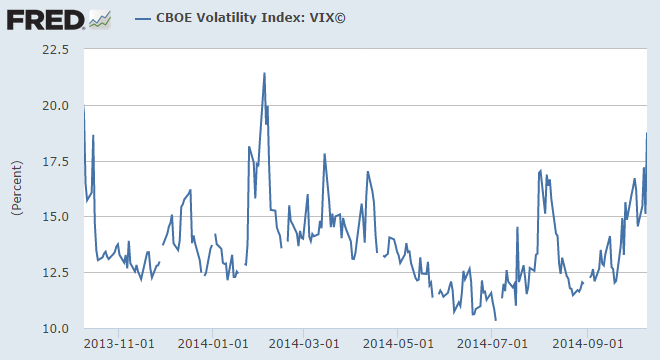
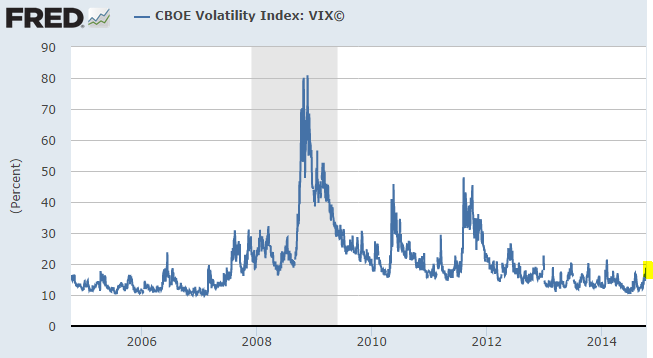
Volatility in the market came roaring back this week.  Stocks had their worst weekly performance in two years.  It was hard to understand given the interconnected nature of the markets how little of an impact was being had in US stocks when global markets and governments are facing dramatic challenges.  The markets are slowly coming to the realization that the Federal Reserve simply does not have all the answers to every crisis that arises.  A low interest rate is not going to stall geo-political risk or the spread of infectious diseases.  There are more complicated forces at work here especially when the biggest consumer economy in the US is seeing those exact consumers lose purchasing power with inflation.  There wasn’t any significant news that set the markets off this week aside from trends that have been ongoing for some time now.  It just appears that the markets are reflecting a more realistic position of what is happening around the world.
Volatility is back
One of the most surprising things in this historic stock rally going back to 2009 is that there has been relatively low volatility.  It has been one giant bounce from the bottom.  That is atypical in many recoveries especially after a crisis like the Great Recession.  The world has become a very complicated place with risk running wild in many areas.  It looks like volatility is now being recognized once again:
vix
vix short-term
Those participating in the markets, not your average worker, are much more disconnected from the micro economic trends that impact those working citizens in many countries around the world.  If we look at Europe, they continued to be mired in heavy unemployment and slow growth.  Our battle is with stagnant wages and a growing number of those simply not participating in the labor force.
Yet it is important to note that many simply do not own stocks.
Many don’t own stocks
Most realize there are heavy crosscurrents hitting our economy at a structural level.  The middle class is shrinking.  Benefits are declining.  The ability to purchase a home is getting tougher.  Debt is the new way of buying items for working Americans, not savings.  These have major impacts on where things go.
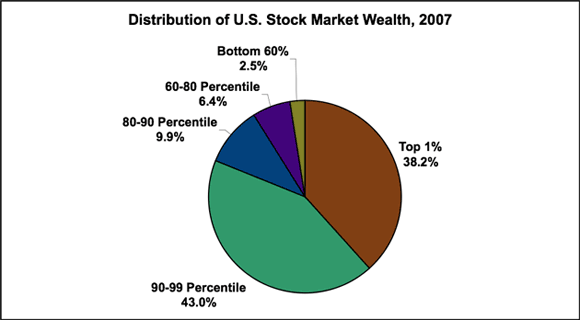
But even in the US, the wealthiest nation, many Americans simply do not own stocks:
us-stock-wealth
80 percent of all stock wealth is held with the top 10 percent of the population.  So most people have very little at play when it comes to owing stocks.  When you see a selloff as we did last week, bigger hands are viewing something significant in the markets.
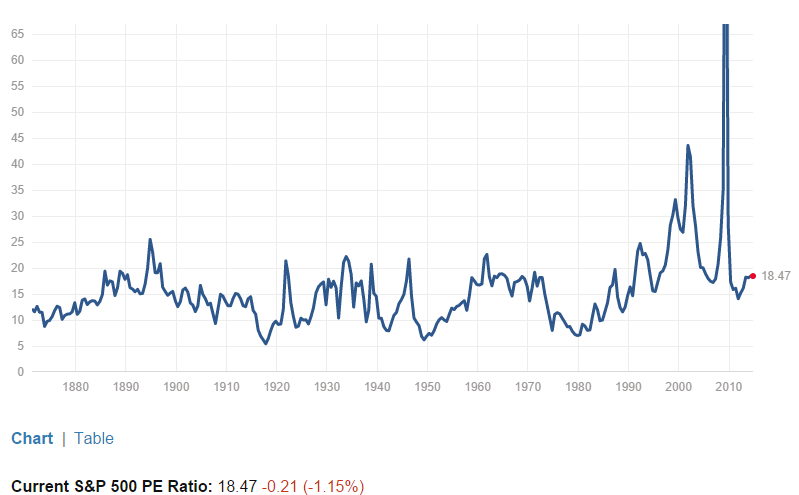
It also creates a disenfranchisement by the public with the economy since their voices are simply not being heard.  Stocks overall are valued too high:
pe ratio
Even looking at conservative pricing models, the S&P 500 is overvalued by 20 percent.  Unless earnings can justify higher prices, it is reasonable to expect a correction given the 200 plus percent run in the stock market.  At a certain point, something will need to give.  It seems like this past week at least, the market is starting to realize that there are many unknowns in the world economy ahead.  Markets abhor information vacuums and that is exactly what we have.

Central Banks Now Dominate Stock Market, Study Finds

The New American
June 23, 2014
Central Banks Now Dominate Stock Market, Study Finds
Central banks and government entities around the world are now dominant players in the stock market with some $30 trillion invested in equities and other assets, according to a new survey released this week offering the first comprehensive analysis of public-sector investments. About half of that is from central banks. In other words, monetary authorities, which conjure fiat currency into existence out of thin air, are using much of that “funny money” to gobble up real assets — propping up stock prices but eroding the value of people’s savings through inflation of the currency supply. The significance of the findings is monumental. 
By far the largest overall central bank-controlled investor is the Communist Chinese dictatorship’s “State Administration of Foreign Exchange (SAFE),” which is part of the regime’s central bank known as the “People’s Bank of China.” According to the survey, SAFE has almost $4 trillion under management, including massive stakes in publicly traded European companies. Beyond SAFE, Beijing’s central bank has also been directly scooping up minority positions in key European companies and industries. Other Asian central banks are becoming giant players in equities, too.   
While the privately owned U.S. Federal Reserve System has apparently been sticking with government bonds and mortgage-backed securities, its own massive role in distorting markets and central planning has been documented extensively by this magazine and countless analysts. Among other radical measures, the U.S. central bank has showered trillions of dollars on crony megabanks around the world. Since the economic crisis, the Fed has also engaged in currency printing on an unprecedented scale, euphemistically referred to as “quantitative easing,” or QE. Its balance sheet is now over $4 trillion and still growing.  

Stocks unravel after factory report; Dow sinks 300-plus points

CNBC
February 3, 2014


U.S. stocks were hammered on Monday, with benchmark indexes falling through key support levels after a gauge of factory activity disappointed, heightening concern about the economy before Friday's monthly jobs report.
Stocks had wavered ahead of the report that had U.S. manufacturing expanding at a substantially slower pace in January, driving overall factory activity to an eight-month low.
"A report like this scares people ahead of the payroll number on Friday," said Andres Garcia-Amaya, global market strategist at J.P. Morgan Funds, who added the report's soft new orders component was of particular concern.
"We had such a strong year last year there was complacency among investors," who questioned whether they should take some profits or see if there were further reasons to invest in the U.S., with the trouble in emerging markets proving to be the initial catalyst for the steep selling in recent sessions, he added.

Read the entire article

The EBT recovery – Food stamp cuts impact Wal-Mart: The consequences of a low wage recovery create a larger group of Americans living food stamp to food stamp.

MyBudget360
February 3, 2014

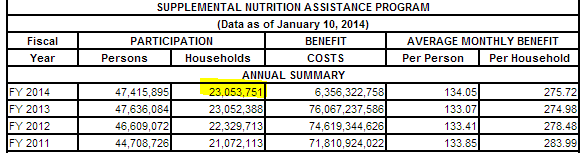
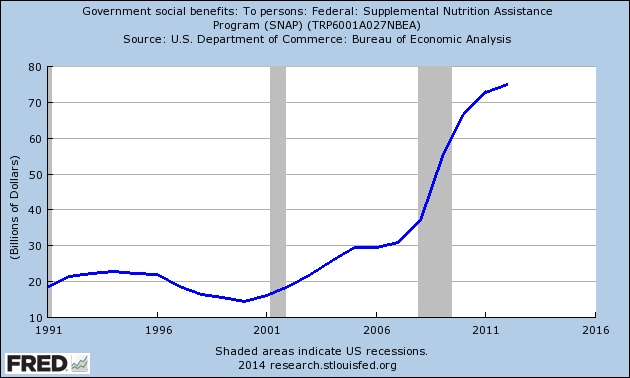
This recovery is the most lopsided recovery the US has faced in more than a generation.  Wal-Mart recently announced a big hit to their bottom-line because of the recent cuts to the nationwide food stamp program.  Over 47 million Americans now depend on food stamps to get by on a monthly basis to feed their families.  In reality, these are debit cards that are automatically refilled on a monthly basis causing queues to form at some Wal-Marts on the last day of the month at midnight.  This is a massive market.  In fiscal year 2013 over $76 billion in food stamps were issued.  This has also led to a mini renaissance in stores like Family Dollar and the 99 Cents Store.  Even these low priced giants have faced tougher challenges as the nation’s poor get even poorer.  There doesn’t seem to be any major retrenchment on the number of food stamp participants.  How can that be if the employment figures are supposedly looking so rosy?  The issue of course is that many of the new jobs have come in the form of low wage work.  Many food stamp recipients are actually employed and are part of the working poor.  When Wal-Mart takes a hit because of a cut in food stamp benefits you know that this recovery is barely treading water.
Wal-Mart takes a hit on food stamp benefits      
Wal-Mart for better or worse provides some of the lowest prices amongst big retailers.  So when this giant confirms that the cut in food stamps is impacting their sales it is worth listening:
“(CNN Money) The cut in food stamps went into effect Nov. 1. Food stamps had been increased during the height of the recession, but that expansion expired without Congressional action.
The expiration of the program saved the government $5 billion.
More cuts in food stamp funding could be on the way. A bipartisan deal on a new farm bill reached earlier this week could trim $90 a month in benefits for 850,000 food stamp recipients, saving the government nearly $1 billion a year.”
This is a big deal considering that we are still near a peak in food stamp usage:
food stamp number of americans
Source:  SNAP
It is hard to say whether the numbers would be higher if it weren’t for the government pulling back on food stamp funding.  Fiscal year 2014 started in October 2013 so we’ll likely have a better sense in later reports but Wal-Mart is probably a leading indicator on the nation’s poor.  Food stamps have provided a Band-Aid for millions in terms of not turning this Great Recession into the next Great Depression.  However this should not be seen as some kind of endorsement for the recovery.  It is hard to call this a recovery when the ranks of American poor only seem to be growing.  The financial industry has done exceptionally well but very little has trickled down to the public.
The amount allocated to food stamp funding has only remained elevated in spite of the recession ending officially in the summer of 2009:
food stamp money spent
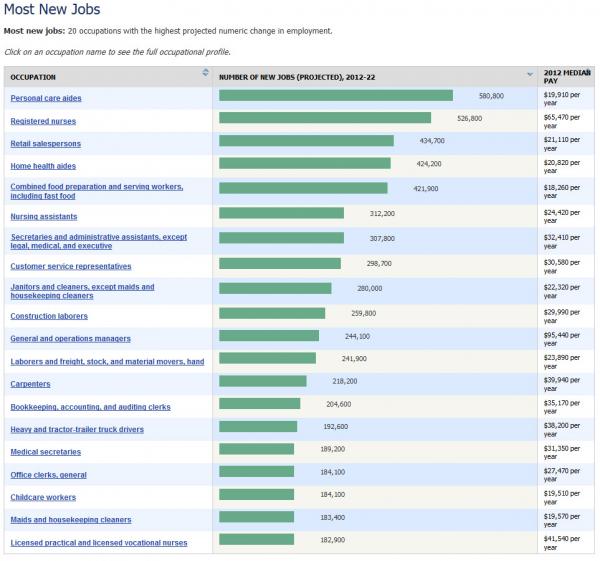
Part of this EBT recovery is because of low wage jobs being added.  Why is this recovery so weak?  Because many of the jobs being added are in the low wage sectors:
low wage job growth
These are the top five job fields for growth as forecasted by the BLS:
 -1.  Personal care aides
-2.  Registered nurses
-3.  Retail salesperson
-4.  Home health aides
-5.  Food preparation
 All of these carry annual salaries under $35,000.  Try sending your kids to a good college, pay for healthcare, and out compete Wall Street to buy a home with that income.  No wonder why a drop of $90 in monthly food stamps is enough to shake the bottom-line of the biggest retailer in our country.  The growing income inequality in the nation is a big issue when a large part of the system is built on financial cronyism.  Trying to force massive austerity on the poor and working class while giving out corporate welfare to the financially connected has resulted in this massive chasm between poor and rich.  Don’t expect food stamp usage to pull back dramatically anytime soon short of the government continuing to cut benefits.

Marc Faber: 'We Are Now In A Gigantic Speculative Bubble'

SIC SEMPER TYRANNIS!!!
Mark Matheny
November 29, 2013

Is another Bubble accumulating in the market? Marc Faber certainly thinks so.


Marc Faber, Publisher of the Gloom, Boom & Doom Report, said in an interview on Nov 29, 2013:
"Recently we have to say that we are in a massive financial bubble, in bonds, in equities, we are in a bubble in asset prices that have gone up dramatically. Farm land is up 10 times just over the last 10 years. Bitcoins are up now, and who knows what's next to go up? We are in a gigantic speculative bubble...."

Faber continued saying that he sees no value in stocks any longer.

Citigroup Written Legislation Moves Through the House of Representatives

libertyblitzkrieg.com
October 31, 2013
Five years after the Wall Street coup of 2008, it appears the U.S. House of Representatives is as bought and paid for as ever. We heard about the Citigroup crafted legislation currently being pushed through Congress back in May when Mother Jones reported on it. Fortunately, they included the following image in their article:
Screen Shot 2013-10-29 at 12.54.50 PM
Unsurprisingly, the main backer of the bill is notorious Wall Street lackey Jim Himes (D-Conn.), a former Goldman Sachs employee who has discovered lobbyist payoffs can be just as lucrative as a career in financial services. The last time Mr. Himes made an appearance on these pages was in March 2013 in my piece: Congress Moves to DEREGULATE Wall Street.
More from the New York Times:
The House is scheduled to vote on two bills this week that would undercut new financial regulations and hand Wall Street a victory. The legislation has garnered broad bipartisan support in the House, even after lawmakers learned that Citigroup lobbyists helped write one of the bills, which would exempt a wide array of derivatives trading from new regulation.
Remember what George Carlin observed:
“Bipartisan usually means some larger-than-usual deception is being carried out.”
The bills are part of a broader campaign in the House, among Republicans and business-friendly Democrats, to roll back elements of the 2010 Dodd-Frank Act, the most comprehensive regulatory overhaul since the Depression. Of 10 recent bills that alter Dodd-Frank or other financial regulation, six have passed the House this year. This week, if the House approves Citigroup’s legislation and another bill that would delay heightened standards for firms that offer investment advice to retirees, the tally would rise to eight.
But simply voting on the bills generates benefits for both House lawmakers and Wall Street lobbyists, critics say. For lawmakers, it comes in the form of hundreds of thousands of dollars in campaign contributions. The banks, meanwhile, welcome the bills as a warning to regulatory agencies that they should tread carefully when drawing up new rules.
“The House is the odd man out in terms of doing Wall Street’s bidding,” said Marcus Stanley, policy director of Americans for Financial Reform, a nonprofit group critical of the financial industry. “They’re letting Wall Street write the law to its own benefit in ways that harm the public.”
Wall Street’s support from the House extends beyond favorable votes. When bank executives are called to testify before Congress, industry lobbyists distribute proposed questions to lawmakers and their staff, seeking to exert some control over the debate, according to emails written by staff members on the House Financial Services Committee that were reviewed by The Times.
The legislation, Mr. Himes said in an interview, poses no financial risk to the country. And while he is the second-largest recipient among House Democrats of financial sector donations, that is not what is compelling his vote, he said.
Of course not. What are you a conspiracy theorist?
“It hardly determines, thank goodness, how legislators think about these issues,” said Mr. Himes, a former Goldman Sachs executive.
“After inflicting so much pain and suffering on the American people, now is not the time to let the largest banks back into the casino,” Representative Maxine Waters, the ranking Democrat on the House Financial Services Committee, said in a statement.
Sorry ma’m you’re just a little late.
Some House bills have the explicit purpose of delaying new regulation. One bill scheduled for a vote this week could temporarily restrain the Labor Department from imposing a new rule requiring some financial advisers to take on a fiduciary duty to clients when providing retirement investment advice. Such a duty would demand that the advisers act in the best interest of the client.
The bill that Citigroup helped draft takes aim at one of the more contentious provisions in Dodd Frank, a requirement that banks “push out” some derivatives trading into separate units that are not backed by the government’s insurance fund. The goal was to isolate this risky trading and to prevent government bailouts.
How contentious! This is America after all.
Read the entire article here.

What Happened In Cyprus Will Happen Everywhere: Marc Faber

CNBC
April 2, 2013

Growing wealth inequality means that the wealthy have nowhere to hide and that events like those in Cyprus will happen in more countries around the world, including developed nations, said Marc Faber, the contrarian investor and publisher of the Gloom, Boom & Doom Report.

"It will happen everywhere in the world, in Western democracies," Faber said"Squawk on the Street" on Tuesday. "You have more people that vote for a living than work for a living. I think you have to be prepared to lose 20 to 30 percent. I think you're lucky if you don't lose your life."
"If you look at what happened in Cyprus, basically people with money will lose part of their wealth, either through expropriation or higher taxation," he added.
"The problem is that 92 percent of financial wealth is owned by 5 percent of the population. The majority of people don't own meaningful stock positions and they don't benefit from a rise in the stock market. They are being hurt by a rising cost of living and we all know that the real incomes of median households has been going down for the last few years," he said.

Peter Schiff: Economic Conditions Worse Now than on Black Monday

Money News
October 25, 2012

The economic backdrop that sparked the stock market crash of 1987 is still in place and has grown worse, says Peter Schiff, CEO of Euro Pacific Capital.

In 1987, “the market was spooked by concerns over international trade and government debt, which then became known as the twin deficits" — the budget deficit and the trade deficit, Schiff writes an economic commentary.

The deficits together totaled 6.4 percent of gross domestic product (GDP) then.

Flash forward to now: the deficits add up to 13 percent of GDP. “But today's investors are largely untroubled,” Schiff says.

The Federal Reserve’s massive easing program has made investors immune to worries over the deficits, he maintains. But ultimately, the joy ride will end.

“When America's creditors wake up, particularly those foreign governments now shouldering the lion's share of the burden [financing U.S. debt], concerns over our twin deficits will return with a vengeance,” Schiff says.

With the Fed so committed to quantitative easing, stocks might escape a crash, but not the dollar and Treasurys, he notes.

“Black Monday is more likely to occur in the currency and/or bond markets, with safe-haven flows moving into gold, not Treasurys.”

Marc Faber, publisher of the Gloom Boom & Doom Report, also expects exploding government debt to cause a crisis, and not just in the United States.

“I think within five to 10 years you have a colossal mess everywhere in the Western world,” he tells CNBC.

The Right to Bear Bazookas vs Wall Street

Max Keiser Report
August 2, 2012


Aug 2, 2012 by 
Watch the full Keiser Report E322 later today!

In this episode, Max Keiser and Stacy Herbert discuss crimes against capital, financial blockades and hoax Op-eds. They also suggest that Boris Johnson may be the illegitimate step nephew of Louis XV and how all your financial opinions come from a warped fortune cookie written by some guy that just dropped massive tabs of acid. And they discuss this while minding their Second Amendment right to bear a shoulder launch missile. In the second half, Max interviews Birgitta Jonsdottir about the need to form Pirate Parties around the world to protect privacy, democracy and stop financial blockades of certain groups for their beliefs and campaigns.

Follow Max Keiser on Twitter: http://twitter.com/maxkeiser

UNPRECEDENTED: TOP DOJ OFFICIALS WERE OBAMA BUNDLERS WITH WALL STREET TIES

Breitbart
May 9, 2012


Four of the top officials at the Department of Justice were all big money fundraisers for President Obama’s 2008 campaign with strong ties to Wall Street—the very entity the Obama Administration has said must be criminally prosecuted for bringing about the biggest financial crisis in U.S. history.

  • Attorney General Eric Holder: formerly of Covington & Burling law firm, in 2008 Holder himself represented big banks such as UBS and MBNA Bank. Holder was Barack Obama’s 2008 campaign co-chairman and raised $50,000 for the president’s campaign.
  • Associate Attorney General Thomas Perrelli: a managing partner at Jenner and Block law firm, whose clients include Merrill Lynch, Perrelli stepped down from his number-three position at DOJ in March. A former member of Obama’s National Campaign Finance Committee, Perrelli bundled$500,000 in campaign contributions.
  • Deputy Associate Attorney General Karol Mason: Karol Mason of Alston & Bird previously chaired the firm’s public finance group. She also bundled $500,000 for Obama. Holder awarded her a “Distinguished Service Award” for her work at the Department of Justice. Now, after almost three years at the Department of Justice, she has returned to Alston & Bird to work on their real estate finance and capital markets group.
  • Associate Attorney General Tony West: West was a partner at Morrison and Foerster law firm, whose clients include MF Global, Merrill Lynch, Morgan Stanley, and Bank of America. West was also co-chairman of Obama’s campaign and, according to the San Francisco Chronicle, “was instrumental in helping the candidate raise an estimated $65 million in California.” Formerly the head of the DOJ’s Civil Rights Division, West is now number three at the DOJ and bundled$500,000 for the president’s campaign.  
Despite Holder and Obama’s “get tough” rhetoric against Wall Street, to date, there has not been a single criminal charge filed by the federal government against any top executive of the elite financial institutions. 

Grassley Asks DOJ Again if They’ve Taken Action Against Wall Street


The Blog of Legal Times
March 12, 2012
Sen. Chuck Grassley (R-Iowa) is pushing the Department of Justice for details on what it has done to pursue criminal charges against the major Wall Street banks and executives who he says are responsible for the nation’s financial crisis.
In a letter to Attorney General Eric Holder Jr. issued today, Grassley asked for a list of cases that detail which convictions were obtained against CEOs, CFOs, board members, presidents and other executives of Wall Street firms and banks.
The letter comes two days after Grassley criticized the DOJ response to the financial crisis during a Senate Judiciary Committee hearing. And it comes in direct response to reaction from the DOJ posted on the Blog of Legal Times, according to a Grassley spokeswoman.

SNL's Bloomberg addresses Occupy Wall Street in Manhattan pitch

nbc.com
October 16, 2011


NBC's 'Saturday Night Live' featured a cold open with an interpretation of an explanatory speech by Mayor Michael Bloomberg on the Occupy Wall Street movement and on pitching the Big Apple.
Fred Armisen played Mayor Michael Bloomberg in the cold open for NBC's "Saturday Night Live" last night, and SNL's Bloomberg addressed the Occupy Wall Street matter as an opportunity to present New York City as a trend-setting tourist destination.


Read more: http://www.digitaljournal.com/article/312866#ixzz1ay6WD0CP


World Bank's Zoellick: Markets heading to new danger zone

World Bank Chief Robert Zoellick gestures while speaking at the Asia Society's annual dinner in Sydney August 14, 2011.
Credit: Reuters/Tim Wimborne
Reuters.com
August 14, 2011

(Reuters) - The loss of market confidence in economic leadership in key countries like the United States and Europe coupled with a fragile economic recovery have pushed markets into a new danger zone, something that policymakers have to take seriously, the head of the World Bank said on Sunday.

Speaking at the Asia Society dinner in Sydney, Robert Zoellick also said the global economy was going through a multi-speed recovery, with developing countries now the source of growth and opportunity.

"What's happened in the past couple of weeks is there is a convergence of some events in Europe and the United States that has led many market participants to lose confidence in economic leadership of some of the key countries," he said.

"I think those events combined with some of the other fragilities in the nature of recovery have pushed us into a new danger zone. I don't say those words lightly ... so that policymakers recognize and take it seriously for what it is."

Zoellick said the process of dealing with the sovereign debt problem and some of the competitive issues in the euro zone have tended to be done "a day late," leaving markets worried that authorities may not be ahead of the problem or moving in the right direction.

"That (worry) has accumulated and so we're moving from drama to trauma for a lot of the euro zone countries," he said.

On the United States, Zoellick said it wasn't fears the world's biggest economy faced an imminent problem, but "frankly that markets are used to the United States playing a key role in the economic system and leadership."

He said efforts to cut U.S. government spending have so far been focused on discretionary spending as opposed to the entitlement program such as social security. "Until they make an effort on those programs, there is going to be continued skepticism about dealing with long-term spending."

Zoellick said while market confidence has been hit, the real issue was whether this will spread to business and consumer confidence, something that was still unclear.
Read the entire article

Stay Out of Stocks as Economy Will Only Get Worse

MoneyNews.com
Tuesday, 24 Aug 2010 11:02 AM

By: David Frazier


The supposedly brilliant economists on Wall Street are finally wakening up to the fact that economic growth both here in the United States and in numerous other countries around the world will likely slow considerably during the remainder of the year.

For example, on Aug. 21, JPMorgan’s chief economist reduced his third-quarter 2010 GDP for the United States from 2.5 percent to 1.5 percent, and he cut his fourth-quarter growth forecast from 3.0 percent to 2.0 percent.

A day earlier, JPMorgan cut its 2010 GDP forecast for China to 9.8 percent growth from 10 percent growth because the United States and international economic recoveries appear to be suffering from a "loss of momentum."


ALERT: Frazier: Stocks Rolling Over. Get Out Now.

The firm also reduced its 2011 GDP forecast for China to 8.6 percent from 8.8 percent. (China’s economy expanded 10.3 percent during the second quarter of this year).

Although Goldman Sachs has maintained its second-half 2010 GDP forecast at 1.5 percent, the company recently lowered its 2011 forecast from 2.5 percent to 1.9 percent.

Those announcements follow a report issued last month from the Institute of International Finance (IIF) whereby the IIF stated that it expects global growth to decline to 2.7 percent during 2011 from 3.4 percent this year.

Meanwhile, economists surveyed by Bloomberg recently stated, on average, that their research indicates that the U.S. economy likely grew at a much slower pace during the second quarter of this year than they had initially estimated.

Specifically, those economists said that instead of growing at a 2.4 percent annualized pace during the second quarter, their most-recent research indicates that inflation-adjusted GDP likely grew at only a 1.3 percent annual rate during the quarter ended June 30, 2010.

With the National Association of Realtors reporting this morning that sales of previously-owned homes in the United States declined 27 percent during July, as compared to the same month a year ago, and that inventories of homes (in relation to sales) rose to their highest level on record, I expect Wall Street economists to lower their growth forecasts further within the next few weeks.

I also expect so-called Wall Street securities analysts to soon begin to lower their third-quarter forecasts of corporate profits. That would be a very negative development for stock prices because stocks tend to move in the same direction as corporate profits.

Meanwhile, my research indicates that neither the Federal Reserve nor the U.S. government will be able to stimulate the economy during the months ahead. That’s because the Fed has essentially run out of monetary tools that had been used, historically, to stimulate the economy and because the federal budget deficit is currently at levels that won’t allow the Congress to pass any desired government-spending proposals.


Note from Moneynews:

If you’d like to be kept abreast of actual economic and financial developments and their longer-term effect on securities prices (rather than relying on misrepresentations like the ones discussed above), try a free sample of David’s investment advisory service, The ETF Strategist. Click Here to Find Out More.


About the Author: David Frazier


David Frazier is a member of the Moneynews Financial Brain Trust. Click Here to read more of his articles. He also writes two very successful investment newsletters. Discover more by Clicking Here Now.


© Moneynews. All rights reserved.


Dubai debt fears hit world markets hard


LONDON – World stock markets fell sharply Thursday as investors fretted over the debt problems at Dubai World, a government investment company, and the continued fall in the dollar.
Markets are usually relatively quiet when Wall Street is closed for a holiday, as it is Thursday for Thanksgiving Day — not so today.
In Europe, the FTSE 100 index of leading British shares was down 99.84 points, or 1.9 percent, at 5,264.97, although trading has been halted for over an hour because of technical problems. Germany's DAX fell 115.17 points, or 2 percent, to 5,687.85 while the CAC-40 inFrance was 84.92 points, or 2.2 percent, lower at 3,724.24.
Earlier in Asia, the Shanghai index tanked 119.19 points, or 3.6 percent, to close at 3,170.98, its biggest one-day fall since August 31, while Hong Kong's Hang Seng shed 1.8 percent to 22,210.41.
Sentiment in stocks has been dented by the news that Dubai World, which is thought to have debts totaling around $60 billion, has asked creditors if it can postpone its forthcoming payments until May. That has stoked fears of a potential default and contagion around the global financial system, particularly in emerging markets.
Read the entire story