Showing posts with label economy. Show all posts

China Warns Of Possible Armed Conflict With US Over Coronavirus Backlash

Zero Hedge
May 4, 2020

An internal report presented to Chinese President Xi Jinping and other top leaders concludes that global anti-China sentiment is at a level not seen since the 1989 Tiananmen Square crackdown, and recommends preparing for a worst-case scenario of armed conflict with the United States, according to Reuters, citing people familiar with the content of the document.

The report, created by the China Institutes of Contemporary Internal Relations (CICIR) - which is affiliated with the Ministry of State Security - suggests that the wave of anti-China sentiment is led by the United States, which sees China's rise as a global superpower as a threat to Western democracies.

One of those with knowledge of the report said it was regarded by some in the Chinese intelligence community as China’s version of the “Novikov Telegram”, a 1946 dispatch by the Soviet ambassador to Washington, Nikolai Novikov, that stressed the dangers of U.S. economic and military ambition in the wake of World War Two.
Novikov’s missive was a response to U.S. diplomat George Kennan’s “Long Telegram” from Moscow that said the Soviet Union did not see the possibility for peaceful coexistence with the West, and that containment was the best long-term strategy. -Reuters
 Reuters, which hasn't seen the paper, couldn't determine to what extent the report's grim outlook reflects positions held by China's state leaders, nor how much it might influence policy. That said, it suggests Beijing is taking the threat of global backlash over the coronavirus pandemic - which Western intelligence agencies suspect originated at a Wuhan biolab which was experimenting with bat coronavirus, and had previous concerns raised over the pandemic potential of such research.
China's early coverup of the outbreak - including silencing and/or disappearing whistleblowing doctors and journalists, lying about the transmissibility of the virus while hoarding personal protective equipment (PPE), quarantining Wuhan domestically while allowing international travel, and using the World Health Organization to run cover - has drawn global scorn as COVID has infected over 3.5 million and killed nearly 250,000 in five months.

Record 157,288,000 Employed in July

CNS News
August 2, 2019


The number of people employed in the United States hit a record 157,288,000 in July, according to the employment report released today by the Bureau of Labor Statistics.
That was up 283,000 from the 157,005,000 employed in June.
The unemployment rate held steady in July at 3.7 percent, the same as it was in June.
According to the employment report, the civilian noninstitutional population in the United States was 259,225,000 in July. That included all people 16 and older who did not live in an institution (such as a prison, nursing home or long-term care hospital). Of that civilian noninstutional population, 163,351,000 were in the labor force, meaning that they either had a job or were actively seeking one during the last month. That equaled a labor force participation rate of 63.0 percent--an increase from 62.9 percent in June.
Of the 163,351,000 who were in the labor force, 6,063,000 were unemployed, equaling an unemployment rate of 3.7 percent.

The other 157,288,000 did have jobs, yielding last month’s record number of people employed.

Feds Collect Record Taxes in First Month Under Tax Cut; Run Surplus in January

CNS News
February 13, 2018

(CNSNews.com) - The federal government this January ran a surplus while collecting record total tax revenues for that month of the year, according to the Monthly Treasury Statement released today.

January was the first month under the new tax law that President Donald Trump signed in December.
During January, the Treasury collected approximately $361,038,000,000 in total tax revenues and spent a total of approximately $311,802,000,000 to run a surplus of approximately $49,236,000,000.

Despite the monthly surplus of $49,236,000,000, the federal government is still running a deficit of approximately $175,718,000,000 for fiscal year 2018. That is because the government entered the month with a deficit of approximately $224,955,000,000.


The $361,038,000,000 in total taxes the Treasury collected this January was $11,747,870,000 more than the $349,290,130,000 that the Treasury collected in January of last year (in December 2017 dollars, adjusted using the Bureau of Labor Statistics inflation calculator).

The Treasury not only collected record taxes in the month of January itself, but has now collected record tax revenues for the first four months of a fiscal year (October through January).

So far in fiscal 2018, the federal government has collected a record $1,130,550,000,000 in total taxes.


However, despite the record tax collections so far this fiscal year, and despite the one-month surplus in January, the federal government is still running a cumulative deficit in this fiscal year of $175,718,000,000.

Over the last twenty fiscal years, going back to 1999, the federal government has run surpluses in the month of January 13 times and deficits 7 times. Six of the Januaries in which the federal government ran deficits overlapped President Barack Obama’s time in office—including January 2009, the month Obama was inaugurated, and the Januaries in 2010, 2011, 2012, 2014 and 2016.

The Dow's 31% gain during Trump's first year is the best since FDR

cnbc
January 19, 2018


President Donald Trump speaks prior to signing a Presidential Proclamation shrinking Bears Ears and Grand Staircase-Escalante national monuments at the Utah State Capitol in Salt Lake City, Utah, December 4, 2017.
Donald Trump lifted the Dow Jones industrial average in his first year in office more than any other president since Franklin Roosevelt.
The Dow has surged more than 31 percent since Trump's inauguration on Jan. 20, 2017. That marks the index's best performance during a president's first year since Roosevelt. The Dow skyrocketed 96.5 percent during Roosevelt's first year in office.
(Returns measured from the day before the inauguration.)
"This is all about policy," said Bruce Bittles, chief investment strategist at Baird. "You've got lower taxes, less regulation and confidence in the economy is high. Things are firing on all cylinders."
Trump quickly moved to cut regulations enacted by previous administrations. He also successfully pushed to overhaul the U.S. tax code. That revamp included slashing the corporate tax rate to 21 percent from 35 percent.
The president made it to the White House saying he would "put America first." Since taking office, Trump has pushed to have companies bring back jobs to the U.S. and has said repeatedly said his policies would help to accomplish this.

Black Activist Explains Why African-Americans Are Doing So Much Better Under Trump Than Obama

The Western Journal
January 13, 2018


Conservative black activist Horace Cooper says there is a good reason the unemployment rate hit an all-time low last month for African-Americans — President Trump’s economic policies.
The unemployment rate fell to 6.8 percent in December, which is the lowest rate ever recorded by Labor Department in the 45 years it has been tracking the statistic.
Cooper — who is a member of the conservative, free-market African-American group Project 21 — told The Daily Signal not only is 6.8 percent the lowest unemployment rate on record, it also represents the narrowest gap between black and white Americans at 3.1 percentage points.
Trump stated on Wednesday that he is “very proud” of the low unemployment, and tweeted earlier in the week, he was “so happy about this news!

On the campaign trail, Trump promised a “New Deal for Black Americans,” which included high-paying jobs. “What do you have to lose by trying something new like Trump?” the then-candidate asked at rally in Michigan in August 2016.
Cooper said Trump should rightly take credit for the rapid turn of events for African-Americans.

THE BIG LIST OF TAX-CUT PAYOFFS

World Net Daily
December 24, 2017
President Donald Trump

Editor’s note: WND is chronicling the response by U.S. businesses to the biggest rewrite of the federal tax code since the 1980s Reagan administration and a tax cut of as much as $3.2 trillion in the form of this BIG LIST OF TAX-CUT PAYOFFS. It will be regularly updated as more companies respond.
WASHINGTON – Before the ink was even dry on President Trump’s signature on the Republican tax-cut bill, corporate America was not only toasting it, praising it and celebrating it, but handing out money to employees like Santa Claus.
It started with AT&T expanding its bonus program to an additional 200,000 staffers getting $1,000 apiece.
Next came Boeing announcing a gift of $300 million in investment in its employee-related charitable program “to support our heroes, our homes and our future.”
Wells Fargo and Fifth Third Bancorp announced they would raise their minimum wage to $15 in the New Year, with Fifth Third kicking in an additional bonus of $1,000 to 13,000 employees.

Comcast NBC Universal anted up $1,000 bonuses to more than 100,000 non-executive employees, announcing the move was not only tied, like all the others, to the tax cut but to the Federal Communications Commission’s elimination of government regulation of the Internet. Comcast NBC Universal Chairman and Chief Executive Officer Brian L. Roberts added the company plans to spend more than $50 billion in the next five years on infrastructure investments that he expects will create “thousands of new direct and indirect jobs.”
In fact, before the bill was even passed, Kroger Chief Executive Officer W. Rodney McMullen offered that the legislation would influence his company “to continue to invest in our business, which will grow jobs.”
You might remember, former House Speaker Nancy Pelosi called the bill “Armageddon.”
Here’s the growing BIG LIST of companies reacting to the tax cuts with bonuses, more pay and expansion leading directly to new jobs:
  • U.S. Bank of America employees making up to $150,000 per year in total compensation – about 145,000 teammates – will receive a one-time bonus of $1,000 by year-end.
  • PNC Financial Services will give $1,000 bonus to about 47,500 workers.
  • New Braunfels-based Rush Enterprises of Texas is giving each of its 6,600 employees a $1,000 bonus – a total of $6.6 million. Chief Financial Officer Steven Keller said: “You’ve got a choice – we could’ve kept it and stuffed it in the company bank account or coffers, or we can share it with the people.”
  • Associated Bank in Wisconsin boosted its minimum hourly wage to $15 and paying workers a $500 bonus.
  • Idaho health-care and home-products company Melaleuca Inc. is providing its 2,000 employees $100 bonuses for every year they worked for the company. The company has 147 employees who have worked for the company for 20 years or more.
  • In Hawaii, Royal Hawaiian Heritage Jewelry plans to open up three more shops – in Honolulu, in Kauai and Maui in addition to its existing three shops.
  • Washington Federal in Seattle will increase wages for most of its workers by 5 percent and is adding 25 people to its information-technology staff.
  • Aquesta Financial Holdings in Cornelius, N.C., will raise hourly pay to $15 and will be giving $1,000 bonuses to all of it workers.
  • Canary LLC announced it will hire new employees and purchase more equipment.
  • First Hawaiian Bank said it will give out $1,500 cash bonuses to 2,264 employees, or all but 11 members of its senior management team. The state’s largest bank also will increase its minimum wage to $15 an hour from $12.75 an hour for 613 employees.
  • Bank of Hawaii, the state’s second-largest bank, said it will give out $1,000 cash bonuses to 2,074 employees, or 95 percent of its workforce. The bonuses affect all employees below the senior vice president level. The bank also will increase its minimum wage to $15 an hour from $12 an hour.
  • American Savings Bank, the third-largest bank in Hawaii, said it will award $1,000 bonuses to nearly all of its employees. In addition, the bank said it was increasing its starting wage to $15.25 an hour from $12.21 an hour.
  • AT&T expanding its bonus program to an additional 200,000 staffers getting $1,000 apiece.
  • Boeing gift of $300 million in investment in its employee-related charitable program “to support our heroes, our homes and our future.”
  • Wells Fargo raises minimum wage to $15.
  • Fifth Third raises minimum wage to $15 and offering bonuses of $1,000 to 13,000 employees.
  • Comcast NBC Universal anted up $1,000 bonuses to more than 100,000 non-executive employees.

Americans Give Trump Higher Grades on Economy Than Overall

Wall Street Journal
December 10, 2017


Although President Donald Trump’s overall approval ratings have dropped to the lowest point of his presidency, he is getting significantly higher marks in one important area: his handling of the economy.
With the U.S. unemployment rate holding at a 17-year low, hiring strong and the stock market hitting regular records, Mr. Trump is getting stronger reviews from the public on the economy, with 42% approving and 37% disapproving, according to the most recent Wall Street Journal/NBC News survey, conducted in late October.
That stands in stark contrast to his overall approval rating, which dropped last week to 32%, the lowest point of his 11-month presidency, according to a Pew Research Center poll. His disapproval rating of 68% in the same survey was also a new high.
The WSJ poll showed the president with a 38% approval rating, his lowest to date in this poll, while 58% disapproved of his overall performance.
A Gallup survey from November showed the president’s approval rating for his handling of the economy at 45%, eight points ahead of his overall approval number, which sagged to 37%.
“He’s a political contortionist in that he has high economic numbers and very low personal approval ratings. That’s almost impossible to do,” said Peter Hart, a veteran Democratic pollster.
On Friday, the White House celebrated the December jobs report that showed the economy gaining 228,000 jobs in November.
“President Trump’s bold economic vision continues to pay off,” White House Press Secretary Sarah Huckabee Sanders said in a statement that also referenced an increase in manufacturing jobs since the president took office. “As we continue to unleash the American economy from unnecessary regulation and taxes, we look forward to seeing more reports like this, showing a healthy and thriving jobs market for the American people.”

Turns out Trump didn’t ruin America’s economy

New York Post
November 12, 2017


Foreign tourism to New York City is set to rise 3.6 percent this year — defying yet another of the many doomsday predictions about Donald Trump’s presidency.
Back in February, the city tourism agency said Trump’s “travel ban and related rhetoric” would mean a drop of 300,000 visitors this year. But the NYC & Co. prophecy proved false.
Of course, other predictions were more dire — particularly those about the stock market.
Finance expert Steve Rattner foresaw “a market crash of historic proportions” under a President Trump. Moody’s warned of a “weaker” economy. Many said 2 percent GDP growth was the best that could be hoped for.
Other doomsayers included Mark Cuban, CNBC’s Andrew Ross Sorkin and firms such as Bridgewater Associates and Macroeconomic Advisers. (A less-dishonorable mention goes to Nobel-winning economist Paul Krugman, who at least walked back his doomsaying about “a global recession, with no end in sight,” soon after election night.)
In fact, the Dow has climbed more than 25 percent since Hillary Clinton conceded. And the first two full quarters of Trump’s term both saw growth of 3 percent or more. Oops.
More recently, Trump’s cutbacks of money to help folks sign up for ObamaCare brought warnings that enrollment would surely plummet. Hah! Over the first few days of open enrollment this year, a record number of people signed up, The Hill reported Tuesday.
The first day alone saw 200,000 sign-ups, twice last year’s number, and more than 1 million visited healthcare.gov, versus 750,000 in 2016.
As for all the noise about fascism and tyranny: Trump has scrupulously obeyed the law, even as judges came up with unprecedented legal theories to strike down his “travel ban” executive orders.
None of this guarantees that the markets won’t turn south eventually, or that ObamaCare won’t run into the rocks. But it does tell you that talk of Trump-fueled armageddon is partisan hysteria, unhinged from reality.

"Trump’s" Stock Rally Best Since 1945

The New American
November 11, 2017

Before the market opened on the day after Donald Trump won the election a year ago, futures were predicting a precipitous drop in the Dow Jones Industrial Average of 900 points. By the close of business that day, sentiment reversed and the market closed up 250 points, to 18,500.
That was 5,000 points ago, and the market has set all manner of records along the way. The rally in stocks is the best election year performance since 1945, and the fourth-best in history. By contrast, the Dow was up just 1.8 percent following Obama’s election in 2008.
The president is, not surprisingly, taking all the credit, exclaiming on Tuesday, “The reason our stock market is so successful is because of me.” In reality, investors have largely gotten over the shock of Trump’s win and have instead been focusing on company sales, profits, and earnings. Each of them, across a wide swath of American companies and industries, has seen great improvements over the past year. Helped along with a strong dollar, corporate earnings consistently exceeding forecasts, growth in real (inflation-adjusted) wages, drop in unemployment, and the increase in labor participation rates, the Dow has nearly quadrupled since March, 2009 following the start of the Great Recession.
It has been a blowout quarter for earnings, according to FactSet, with companies reporting profits that are nearly five percent better than estimates along with record sales. In fact, more than three out of every four companies reporting sales and earnings are posting better than expected results, which is close to a record.
Expectations for more of the same are giving bulls confidence that the stock market will continue to make new highs. Improvements in both consumer and investor confidence coupled with expectations that there will be some, perhaps considerable, cuts in corporate and personal income taxes are likely to drive stocks higher. Add in the lower tax rate for repatriating cash held overseas by American companies, and trillions more could come home to add to capital spending that is already up more than eight percent year over year.
The increase in the GDP — which clocked in at more than a three percent annual rate over the last six months — is likely to continue for another reason: synchronization. The global economy is booming as well, with estimates that the planet’s economy will grow by more than three percent a year for at least the next two years. Another measure of robust global growth is that the number of economies around the world that are in recession is at a record low.
There are technical indicators, too, the simplest and most reliable one being this: The most bullish thing the market can do is continue to go up. Merrill Lynch’s Sell-Side Indicator, a measure of bullish sentiment among investors, is close to its highest level in six years.
Finally, there’s something called the “seasonality” indicator that shows that the strongest months for stock performance are November and December. The market has gone up 60 percent of the time in November dating back to 1928, while it has moved higher 75 percent of the time in the month of November over the past two decades.
President Trump’s declarations of personal responsibility for the rise in stocks aside, there are plenty of reasons for investors to continue to drive the markets higher.

Re-Energized Dollar Looms Over the Rest of the World

Wall Street Journal
January 1, 2017

On Wall Street, the rising dollar has been one of the most visible signals of growing optimism in the U.S. economy. For many other countries, it spells trouble.
Most analysts expect the U.S. currency to strengthen in 2017, extending a gain that has boosted the value of the dollar by more than one-third since the U.S. credit downgrade in 2011.
That expectation is mostly because a strengthening economy appears likely to enable the Federal Reserve to enact its plan for multiple rate increases in 2017. Higher rates make it more attractive to hold dollar-denominated assets, attracting money into the U.S.
“Right now, there is an incredible amount of pressure to sell just about every type of currency and buy the dollar,” said Christopher Stanton, chief investment officer at Sunrise Capital LP, which manages $700 million.
Mr. Stanton recently bet that the U.S. currency will appreciate against the Australian dollar, Japanese yen and euro in the next few months.
A stronger dollar raises the buying power of U.S. consumers and businesses by making imported items cheaper and reducing the costs of traveling abroad. By the same token, however, it hurts U.S. exporters by making their goods less competitive overseas, cutting into corporate earnings and potentially weighing on stock prices.
In emerging markets, sustained dollar strength could undercut prices for oil and other dollar-denominated commodities, pressuring developing economies that export raw materials. Emerging-market companies and governments that have borrowed heavily in the U.S. currency will also find their debt more difficult to service.

U.S. Economic Confidence Inches Up to New High

Gallup
December 21, 2016


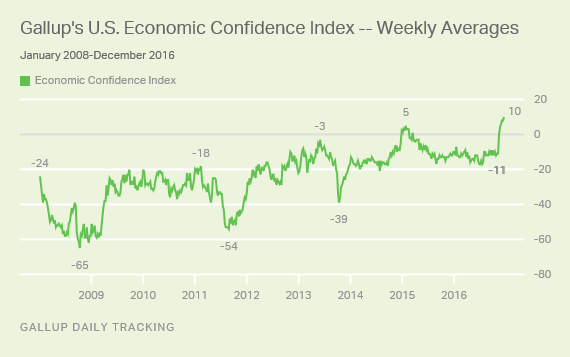
WASHINGTON, D.C. -- Americans' confidence in the economy continues to gradually strengthen after last month's post-election surge. Gallup's U.S. Economic Confidence Index averaged +10 for the week ending Dec. 18, marking another new high in its nine-year trend.
Gallup's U.S. Economic Confidence Index -- Weekly Averages
The latest figure is up slightly from the index's previous high of +8recorded in both of the prior two weeks. The first positive double-digit index score since the inception of Gallup Daily tracking in 2008 reflects a stark change in Americans' confidence in the U.S. economy from the negative views they expressed in most weeks over the past nine years.
Last month's election of Donald Trump not only marked a change in the country's political power structure but also significantly improved Republicans' economic confidence -- pushing the index into positive territory for the first time since March 2015.
Gallup's U.S. Economic Confidence Index is the average of two components: how Americans rate current economic conditions and whether they feel the economy is improving or getting worse. The index has a theoretical maximum of +100 if all Americans were to say the economy is doing well and improving, and a theoretical minimum of -100 if all Americans were to say the economy is doing poorly and getting worse.
Americans' assessments of current conditions and their outlook for the economy are the most positive they have been in nine years. Thirty-one percent of Americans rated the economy as "excellent" or "good" last week, while 22% said it was "poor," resulting in a current conditions score of +9.
Read the entire article

IBM unveils plan to hire 25,000 in US on eve of Trump meeting

Daily Mail
December 13, 2016


US technology giant IBM said Tuesday it would hire 25,000 people in the country over the next four years, a day before President-elect Donald Trump meets with tech industry leaders.
About 6,000 of those hirings will occur in 2017, IBM chief executive Ginni Rometty said in an opinion article published in the newspaper USA Today.
IBM, which has undertaken in recent years a restructuring of its activities, will invest $1 billion on employee training and development in the next four years, said the IBM president, chairman and CEO.

IBM, which has undertaken in recent years a restructuring of its activities, will invest $1 billion on employee training and development in the next four years ©Ethan Miller (Getty/AFP/File)
"We are hiring because the nature of work is evolving -- and that is also why so many of these jobs remain hard to fill," Rometty said, noting that many industries were being reshaped by data science and cloud computing.
"Jobs are being created that demand new skills -- which in turn requires new approaches to education, training and recruiting," she said.
"This is not about white collar vs. blue collar jobs, but about the 'new collar' jobs that employers in many industries demand, but which remain largely unfilled."
Rometty is a member of Trump's Strategic and Policy Forum, a group of US business leaders focused on boosting economic growth and jobs.
The IBM jobs investment news came before the highly anticipated meeting Wednesday of the Republican property tycoon-turned-next US president and the leaders of several major technology companies.
Among those expected to attend are Amazon's Jeff Bezos, Apple's Tim Cook, Satya Nadella of Microsoft, Larry Page of Alphabet (Google) and Elon Musk of Tesla and SpaceX, according to US media.
Trump is expected to push them to create jobs after saying last week that he would like Apple -- whose coveted iPhones are made in China -- to open a large factory in the United States.
Read the entire article

McDonald’s Response to $15 Minimum Wage: Automation in Every Store

The New American
December 6, 2016
McDonald’s Response to $15 Minimum Wage: Automation in Every Store
It’s official: McDonald’s says that every one of its 14,000 stores nationwide will be replacing cashiers with automated touch-screen kiosks. They’re starting with stores where minimum-wage laws mandate the highest rates, such as Florida, New York, San Francisco, Boston, Chicago, Washington, D.C., and Seattle.
According to CNNMoney:
So the fast food giant is rolling out self-order kiosks, mobile pay options, an updated interior design, even table service. The changes are already starting to show up at locations in Florida, New York and Southern California, where 500 restaurants have been updated. Restaurants in San Francisco, Boston, Chicago, D.C. and Seattle will get upgrades in early 2017. Now, McDonald's loyalists will be able to place their customized order on a touch screen, take a seat and have their meal brought right over. Next year, they'll even have the option of mobile ordering.
That means that, eventually, more than 20 million customers every day will place their own orders at a kiosk or on a mobile device and then have them delivered by a human to their table. And it’s just a matter of time before those humans will be replaced by machines as well.

Read the entire article