Showing posts with label bailout. Show all posts

GREEK BAILOUT DETAILS PORED OVER ACROSS EUROPE

Associated Press
August 13, 2015

Details of Greece’s latest bailout package were being pored over across Europe on Wednesday as Prime Minister Alexis Tsipras insisted the agreement with creditors would put “a definitive end” to the country’s economic uncertainty.
Tsipras has called an emergency session of parliament to discuss and vote on the bill, which includes painful tax hikes and spending cuts, in time for a possible meeting of the eurozone’s 19 finance ministers Friday.
The agreement must be finalized so funds on offer can be released in time for Greece to avoid defaulting on a big debt repayment to the European Central Bank on Aug. 20.

Martin Armstrong Warns Civil Unrest Is Rising Everywhere: "This Won't End Pretty"

Zero Hedge
June 28, 2014

The greatest problem we have is misinformation. People simply do not comprehend why and how the economic policies of the post-war era are imploding. This whole agenda of socialism has sold a Utopian idea that the State is there for the people yet it is run by lawyers following their own self-interest. The pensions created for those in government drive the cost of government up exponentially with time. The political forces blame the rich and this merely creates a class warfare with no resolution for the future. Even confiscating all the wealth of the so-called rich will not sustain the system. Consequently, we just have to crash and burn and start all over again.
The Guardian reported that some 50,000 people marched in London to protest against austerity. They cried: “Who is really responsible for the mess this country is in? Is it the Polish fruit pickers or the Nigerian nurses? Or is it the bankers who plunged it into economic disaster – or the tax avoiders? It is selective anger.”
The exploitation by the bankers has been really a disaster. They have been their own worst enemy and in the end, they have become the symbol that inspires class warfare if not revolution. They are not the representatives of those who produce jobs. They are merely those who wanted to trade with other people’s money for free. When they win, it is their’s, but any losses are passed to the taxpayers. Bankers should be bankers – not hedge fund managers who keep 100% of the profits using other people’s savings.
Glass-Steagall Signing-Repeal
The repeal of Glass Steagall was the final straw that broke the back of the world economy. That was the single worst act that could have ever been done and we are now paying the price in spades. The collapse from 2007 has wiped out even the liquidity of the markets. The second worst act was the creation of the euro when the real goal was the federalization of Europe from the outset. That undermined the entire European banking system and has led to a serious undermining of the entire global economy.
The solutions from politics will always be the same – grab more power. We are in a downward spiral of liberty and how far we go down this path to the future will be determined by the people and if they at least wise up and see this is not class warfare, it is the people against government. This is why I say career politicians are dangerous for they can be bought way too easily as Clinton was to open the flood gates for the bankers.
This is not going to end pretty. The question is when does society wake up? Just how high will this price be that we have to pay? They will blame the rich and the idiots will cheer – get them. What will happen when there is no more wealth to hunt? We end up with a communist state by default – no wealth, just career politicians who blame everyone but themselves.

Raising the "IOU" Ceiling

SIC SEMPER TYRANNIS!!!
Mark Matheny
October 17, 2013

Mark Matheny discusses the recent shutdown propaganda and the "Debt Slavery" system known as the U. S. Monetary system.


The Federal Reserve Is Bailing Out FOREIGN Banks … More than the American People or Economy

Washington’s Blog
July 28, 2013
Federal Reserve Policy Mainly Benefits Big Foreign Banks
We’ve extensively documented that the Federal Reserve is intentionally locking up bank money so that it is not loaned out to Main Street. Specifically – due to Fed policy – 81.5% of all money created by quantitative easing is sitting there gathering dust in the form of “excess reserves” … instead of being loaned out to help Main Street or the American economy.
And we’ve extensively documented that a large percentage of the bailouts went to foreign banks (and see this and this). (A 2010 Fed audit also revealed that of the $1.25 trillion of mortgage-backed securities the central bank purchased after the housing bubble popped, some $442.7 billion -  more than 35% – were bought from foreign banks.)
It turns out that these themes are all connected.
Specifically, most of the Fed-created money which is gathering dust is actually being held by foreign banks.
The Levy Economics Institute noted in May:
Excess reserves are the surplus of reserves against deposits and certain other liabilities that depository institutions (loosely called “banks”) hold above the amounts that the Board requires within ranges set by federal law. The general requirement is that covered institutions maintain reserves at least equal to ten percent of liabilities payable on demand. For the first time in history, there is statistical evidence that as much as one-half or more of excess reserves are held for United States banking offices offoreign banks.
Zero Hedge reports today:
As per last night’s [Federal Reserve] H.8 update, commercial bank deposits rose by $94 billion in the week ended July 17: the fourth largest weekly increase in history …. This took total commercial bank deposits to an all-time high of $9.54 trillion.
***
The entire difference can be attributed to the $2+ trillion in excess reserves created by the Fed since the start of the [global financial crisis] .
Speaking of Fed reserves with banks, the most recent number was $2.1 trillion, and its allocation breakdown by Domestic (small and large) and Foreign banks operating in the US is as follows:
Foreign banks continue to be the biggest beneficiary of the Fed’s monthly $85 billion liquidity largesse, just as they were the biggest winners during QE2.
In fact, the total reserve cash distribution continues to favor foreign banks, which now have a record $1.13 trillion in cash, or $9 billion more than all Domestically-chartered banks, at $1.122 trillion. The notable shift of cash reallocation from domestic to foreign banks since QE2 can be seen on the chart below.
To nobody’s surprise, global liquidity (as created by the Fed) continues to be infinitely fungible, and increasingly benefits offshore-based (mainly European) banks.
(And see this earlier report from Zero Hedge).
We’ve repeatedly noted that loose Federal Reserve policy benefits of the super-elite at the expense ofMain Street, the U.S. economy or the average American.
It now appears that the policy benefits foreign super-elite even more than the elites in the U.S.
The Federal Reserve – like many parts of the U.S. government – are sucking the prosperity out of America … and shipping it abroad.

German minister rejects more time for Greece


August 27, 2012

BERLIN (AP) — Germany’s economy minister has rejected calls for Greece to get more time to implement economic reforms, saying in an interview Sunday that Athens needs to respect the bailout deal reached with its international creditors.
Philipp Roesler’s comments to ZDF public television come after a visit by Greece’s prime minister to Berlin on Friday, during which Antonis Samaras told German Chancellor Angela Merkel that his country needs ‘‘time to breathe’’ before it can make all the budget cuts and reforms demanded as part of its €240 billion ($300 billion) bailout packages.
‘‘What the Greeks have asked for, half a year or two years, that’s not doable,’’ said Roesler, who is also the vice chancellor in Angela Merkel’s coalition government. He added that ‘‘time is always money’’ and all parties had agreed that additional funds for Greece weren’t up for debate.
Roesler, the leader of Germany’s pro-business Free Democratic Party, has long taken a hard line on Greece. Last month, he caused an outcry in Greece by suggesting the idea of the country leaving the 17-nation eurozone had ‘‘lost its horror.’’
Those comments appeared to put him at odds with Merkel, who has always insisted that Greece should remain in the euro.
But his latest views on the need for Greece to stick to the agreed time plan for reforms were echoed by German Finance Minister Wolfgang Schaeuble, who told a newspaper in comments published Sunday that ‘‘more time generally means more money and that quickly means a new (bailout) program.’’
Merkel has so far shied away from making new promises to Greece. On Sunday, she dodged questions on the subject during an interview with German public TV station ARD. Instead, she insisted that ‘‘we are at a crucial moment in the fight against the debt crisis and that’s why I think we should all weigh our words carefully.’’
The question of how to avert a Greek debt default, which could spark a chain reaction among other ailing European economies, has preoccupied EU leaders as they return from their traditional summer break.
French President Francois Hollande urged Greece on Saturday to do more to show its commitment to reforms, and offered the country no immediate hope for relief from its current regime of painful austerity measures. Like Merkel, Hollande said further decisions on Greece need to wait for a report next month by the country’s debt inspectors.
Meanwhile, the respected German weekly Der Spiegel reported in its latest edition that Merkel wants EU leaders to forge ahead with deeper political integration within the unwieldy 27-nation bloc.
Merkel has long advocated closer political integration as a means of preventing the European project from unraveling under the strain caused by the eurozone crisis.
Asked about her plans, the chancellor told ARD television Sunday: ‘‘Our task now is to remove the founding mistakes of the currency union, namely the lack of political cooperation, and that’s what we are going to discuss in the coming months.’’
She suggested that EU member state could be subject to closer budget scrutiny, and that measures such as tax harmonization could be up for discussion.end of story marker

Monti Calls For More Crisis-Fighting Urgency In ECB Standoff

Bloomberg
August 6, 2012
Spanish National Police face taxi drivers from several Spanish regions during a protest against a government plan to liberalize public transport in Madrid on July 27, 2012.

Italy’s Prime Minister Mario Monti warned of a potential breakup of Europe without greater urgency in efforts to lower government borrowing costs, as a standoff over European Central Bank help for Italy and Spain hardened.
Monti, in an interview with Germany’s Der Spiegel magazine published yesterday, said that disagreements within the 17- nation euro area are detracting from the policy response to the debt crisis and undermining the future of the European Union.

“The tensions that have accompanied the euro zone in the past years are already showing signs of a psychological dissolution of Europe,” Monti told Der Spiegel. While he backed the ECB’s willingness to address “severe malfunctioning” in the government bond market, Monti said the problems “have to be solved quickly now so that there’s no further uncertainty about the euro zone’s ability to overcome the crisis.”
Spain and Italy, whose surging borrowing costs have shunted them to the heart of the turmoil in the euro area, are resisting pressure from ECB President Mario Draghi to formally request aid in return for strict conditions before the central bank will buy their bonds. Monti and Spanish Prime Minister Mariano Rajoyhave both said they will await further details as the ECB works up its plan. The German government said for the first time today that Chancellor Angela Merkel supports Draghi’s proposals.
French President Francois Hollande is pushing Monti and Rajoy to request aid from Europe’s bailout fund to help ease markets and protect France from speculation, Italian newspaper la Repubblica reported, without citing anyone. Monti may speak with Draghi today, the newspaper said.

Spain And Italy Are Toast Unless Germany Allows The ECB To Print Trillions Of Euros


Michael Snyder
The Economic Collapse
Aug 3, 2012
The financial chess game in Europe is still being played out, but in the end it is going to boil down to one very fundamental decision. 

Is Germany going to allow the ECB to print up trillions of euros and use those euros to buy up the sovereign debt of troubled eurozone members such as Spain and Italy or not?  Nothing short of this is going to solve the problems in Europe.  You can forget the ESM and the EFSF.  Anyone that thinks they are going to solve the problems in Europe is someone that would also take a water pistol to fight a raging wildfire.  No, the only thing that is going to keep Spain and Italy from collapsing under the weight of a mountain of debt is a financial nuke.  The ECB needs to have the power to print up trillions of euros and use that money to buy up massive amounts of sovereign debt in order to guarantee that Spain and Italy will be able to borrow lots more money at very low interest rates.  In fact, this is probably what European Central Bank President Mario Draghi has in mind when he says that he is going to “do whatever it takes to preserve the euro”.  However, there is one giant problem.  The ECB is not going to be able to do this unless Germany allows them to.  And after enduring the horror of hyperinflation under the Weimar Republic, Germany is not too keen on introducing trillions upon trillions of new euros into the European economy.  If Germany allows the ECB to go down this path, Germany will end up experiencing tremendous inflation and the only benefit for Germany will be that the eurozone was kept together.  That doesn’t sound like a very good deal for Germany.
Right now, the yield on 10 year Spanish bonds is above 7 percent and the yield on 10 year Italian bonds is above 6 percent.
Those are unsustainable levels.
The only thing that is going to bring those bond yields down permanently to where they need to be is unlimited ECB intervention.
But that is not going to happen without German permission.

WORLD VIEW: IMF WILL END BAILOUT FOR GREECE

Breitbart
July 23, 2012


This morning's key headlines from GenerationalDynamics.com 

  • Food price surge expected after worst U.S. drought in 50 years
  • Food price surge may lead to global riots, as in 2008
  • IMF will end bailout for Greece, possibly forcing exit from euro currency
  • Analysis: Euro crisis is saving Germany tens of billions
  • Iran announces multiple currency exchange rates
  • Catholic Priests protest Church attacks in Vietnam

Food price surge expected after worst U.S. drought in 50 years

FAO Food Price Index through June, 2012


The FAO Food Price Index has been declining since a major spike up in 2010, but that's about to change. This summer's drought, now covering more than half of the United States, is the most widespread since 1956, and is likely to get worse. Record-setting triple-digit temperatures have already occurred across the country. The National Weather Service counted 86 records last month, including 118 degrees in Norton, Kan., on June 28. Other record highs included 111 degrees in Yuma, Colo., 106 degrees in St. Louis, and 105 in Logan, W. Va. Between the extreme heat and the lack of rain, corn yield projections have been slashed, and will be slashed again in August. Corn prices have risen to historic highs, and beef prices have been surging as well, as corn makes up about 95% of cattle feed grains. Toledo (OH) Blade 

Food price surge may lead to global riots, as in 2008

Damaged corn crop in Woodville, Ohio


The world price of food has been growing steadily since 2002, as the effects of the 1960s "Green Revolution" have petered out, and population growth has been exceeding growth in food production. Food price shocks in 2008 sparked a wave of riots in 30 countries around the world, from Haiti to Bangladesh, and rising food prices helped trigger the Arab Spring uprisings in 2011. The American drought is now expected to trigger a new world food price shock. According to one analyst: 

"Food riots are a real risk at this point. Wheat prices aren't up at the level they got to in 2008 but they are still very high and that will have an effect on those who are least able to pay higher prices for food."


Global corn prices have already shot up 40% since June to hit all-time highs, soy bean prices have jumped 30% to record levels, and wheat has surged 50%. Guardian and UN Food and Agriculture Organization (FAO) 

IMF will end bailout for Greece, possibly forcing exit from euro currency

According to reports from Germany's Der Spiegel, officials from the International Monetary Fund (IMF) are signaling that they will stop paying bailout money to Greece, because Greece has failed to meet its austerity commitments. Readers may recall that one of the conditions of the 130 billion euro bailout is that Greece must reduce its annual budget deficit from its current 160% of GDP to 120% of GDP by 2020. As I wrote in a lengthy analysis at the time ( "28-Oct-11 News -- Markets explode on crazy Rube Goldberg eurozone deal"), this demand was based on ridiculously impossible future economic assumptions that overlook the generational changes that are taking place. And now it's "already clear" that the "Troika" -- consisting of the European Commission (EC), European Central Bank (ECB), and the IMF -- will reach the conclusion, when it meets this week, that Greece's 120% commitment will not be met. It's already clear, for example, that the 3 billion euros that Greece was supposed to earn from asset sales this year will turn out to be only 300 million euros. 

Greece has been begging EU officials to get it more time to implement its austerity commitments, and this was a big discussion in Greece's recent election that brought Antonis Samaras to office. But the Troika has decided that giving Greece more time would mean that it would be necessary to increase Greece's bailout package by an additional 10-50 billion euros. German officials this weekend torpedoed any possibility of renegotiating Greece's austerity agreement. "That won’t work -- that’s a Rubicon we can’t cross," said German foreign minister Guido Westerwelle. 

The result is that Greece will go bankrupt next month, when it's due to make a 3.8 billion euro bond payment, and will be forced to leave the euro currency. 

This discussion comes at a time when the euro crisis is rapidly building in Spain and Italy, with 10-year bond yields (interest rates) well above 7% and 6%, respectively, after officials in those countries announced that they won't be able to meet their own deficit commitments. 

Last year I proposed the "Kick the Can Theory" for the European financial crisis. It says that if you want to know what's going to happen, just assume that European leaders will look for a way to "kick the can down the road," meaning that they'll do the minimum possible to postpone the crisis a little longer, to prevent a current disaster without fixing the problem, so that the crisis will recur in worse form weeks or months later. 

There's already a can-kicking solution being proposed for Greece next month. The Greek government will sell 3.8 billion euros in short-term government bonds known as T-bills, and sell them to Greek banks. The Greek banks would then deposit them with the ECB to be used as collateral for 3.8 billion euros of new ECB bailout money. Voilà! 3.8 billion euros created out of thin air! Problem solved! Der Spiegel -- Translation and Bloomberg 

Analysis: Euro crisis is saving Germany tens of billions

We've been reporting how yields (interest rates) for some bonds issued by Denmark and Germany have been falling and have actually gone negative, meaning that investors have to pay these countries to keep their money safe. This is a result of the euro crisis, and an analysis indicates that the euro crisis has thus earned Germany a windfall of about 100 billion euros, in all, with 10 billion euros saved in 2012 alone in reduced interest payments.Kathimerini 

Iran announces multiple currency exchange rates

With Western sanctions on Iran causing rapid domestic inflation, Iran's parliamentary economic commission announced on Saturday that there will now be three official exchange rates of exchange for the U.S. dollar: 12,260 rials per dollar for "the import of basic goods," 15,000 rials per dollar for import of "capital and brokered goods," and the open market rate, currently 19,100 rials per dollar, for luxury goods, like toys and foreign cars. The new plan is drawing severe criticism from the Ahmadinejad administration. Radio Zamaneh 

Catholic Priests protest Church attacks in Vietnam

Vietnamese Catholic priests have sent a letter to President Nguyen Tan Dung protesting against what they said were violent local government backed attacks on a church in a northern Vietnam province which have angered Christians in the communist state. A non-Catholic mob, paid by government officials to participate, occupied the church on July 1 and smashed property, before church members called for help from fellow Catholics in nearby parishes, who came in groups and overwhelmed the attackers. Radio Free Asia 

The Catholic Church has played a major role in Vietnam society for over two centuries, since the the Tay-Son rebellion, the most celebrated military event in Vietnamese history, united the north and south in 1789. The generational Awakening era that followed the Tay-Son rebellion changed Vietnam enormously, and became the high point of Vietnam's literary culture, thanks to the French, who also introduced the Catholic religion, converting hundreds of thousands from Confucianism and Buddhism. The Catholic religion was an important symbol in the 1950s, when Ho Chi Minh's violence forced over half a million Catholics to migrate from North to South. Vietnam's crisis civil war in the 1970s united the North and South again, but now the new attacks on the Catholic Church indicate that new, younger post-war generations are renewing the hostilities that occurred in the under Ho Chi Minh. 

Greece election vote leaves Euro in balance

Editor's Note: I said this would happen in a video update recently. I stated Greece would remain in the EU at the 16:40 mark of the video.


The Telegraph
June 18. 2012


The fate of the euro was hanging in the balance after a rerun of the Greek elections failed to produce a strong government with a mandate to deliver the country’s austerity programme.


UK over the barrel with Greece bailout

Editor's Note: I believe Greece will remain in the EU. The leaders in Athens will more than likely come up with an agreement with their creditors, as is suggested in the article below.


Mail&Guardian
June 5, 2012


Britain could be asked to underwrite up to 4.8-billion towards a bailout of Greece if the country exits the euro.


David Cameron may also face calls for concessions including a referendum on EU membership if a Greek exit prompts a full treaty change, a report by Open Europe said on Monday.

There are growing concerns about the consequences should Athens leave the euro in a so-called “Grexit”, which have escalated in the run-up to the Greek general election on June 17.

Raoul Ruparel, head of economic research at Open Europe, has predicted that the new government in Athens is likely to reach a deal with creditors, allowing the country to remain in the euro temporarily. “As Greece approaches a balanced budget and a more stable banking sector, though still messy, an exit will look increasingly attractive,” he said.

The total cost of supporting Greece if it left the currency could be anything between £55-billion and £211-billion in external and immediate short-term support – in addition to longer-term costs or contagion affecting markets – according to Open Europe.

“This support could potentially be split between the International Monetary Fund (IMF), the eurozone and non-euro countries, with the UK possibly underwriting between £3-billion and £5-billion of the entire rescue package,” the think-thank said.

British taxpayers have so far avoided any direct contribution to the temporary bailout fund, the European Financial Stability Facility and its imminent successor, the European Stability Mechanism.

Cameron has said that he has won assurances from the EU that Britain would not have to contribute to any fresh rescue for Greece.

But Open Europe argues the UK would be likely to take part through the IMF.

Inside RBS chief's very own Versailles: Hester opens his gardens to the public who bailed out his bank

Daily Mail
May 1, 2012


He has received at least £35million since joining the beleaguered Royal Bank of Scotland in 2008.
But while the taxpayer-owned bank continues to record hefty losses, Stephen Hester’s personal spending on his lavish 350-acre estate continues unabated.

And yesterday some of those taxpayers who helped bail out his bank got to see exactly how the chief executive is spending his riches.
Hester's house: The centrepiece of the bank chief's £7million estate - but visitors were not allowed inside the ivy-clad walls yesterday
At full gallop: This impressive life-size topiary figure is of a rider and horse caught mid-leap towards a fence
Stephen Hester: The RBS boss is a keen huntsman
Every child's dream: the magnificent tree house within the grounds
Stephen Hester: On the left Hester, once a keen huntsman, takes a group out on horses, while an impressive tree house would be any youngsters dream playground

Mr Hester invited the public to see the manicured grounds of his £7million home, which would not look out of place at the Palace of Versailles.


Read the entire article

The cascading waves of debt implosion – 5 charts looking at debt leverage, velocity of money, and contagion impacts from the European crisis.

MyBudget360
May 1, 2012


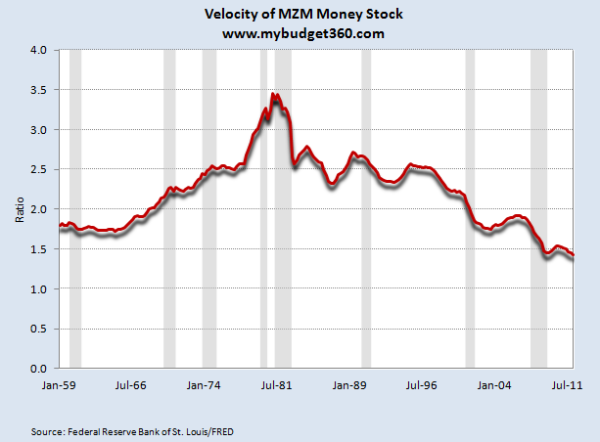
If you inject money out of thin air into thebanking sector but no quality jobs emerge, is the result a success?  The bailout mission statement revolved around keeping credit available for the American public.  The absolute opposite has occurred.  A massiveinternal credit deleveraging has been taking place but the banks have simply hoarded the money like a squirrel hogging all the nuts.  The public is dealing with a great deal of austerity in the form of higher inflation in daily good items and an employment market that is extremely constricted.  The issue continues to be that we are treating this crisis as one of liquidity when it has always been one of solvency.  What function is it giving a bank billions of additional dollars if there are so few qualified people to lend to?  We even see this restriction of money circulation when we examine the velocity of money.  We are simply injecting more debt into the economy with decreasing results.  Higher energy, food, healthcare, and other daily goods have risen beyond the average paycheck of most Americans as a consequence.
 Chart #1 – Velocity of money
velocity of money
We are getting less bang for each buck that is being injected into the economy.  Sure, we can promise unlimited amounts of debt to the public but you have to have actual production to back this up.  Need we remind you of the people with $20,000 annual incomes buying $500,000 and $600,000 homes?  Being able to finance your debts is core to our global economy.  You see what happens when this breaks down.  Banks are willing to lend in today’s market but they are now performing due diligence.  And guess what?  Not many are qualified to borrow.  So the money sits earning interest for banks while more debt is chasing the same amount of goods.  If simply printing money was a good thing the Fed’s trillion dollar spending spree would have made this nation much richer instead of bankrupting the middle class through a hidden tax with inflation.  If you examine the above chart, the velocity of money has come to a screeching halt yet here we are bailing out banks only so they can give each other multi-million dollar bonuses for essentially passing on bad losses to taxpayers.
Economist Paul Samuelson was quoted as saying:
“In terms of the quantity theory of money, we may say that the velocity of circulation of money does not remain constant. “You can lead a horse to water, but you can’t make him drink.” You can force money on the system in exchange for government bonds, its close money substitute; but you can’t make the money circulate against new goods and new jobs.”
Read the entire article 

Tarp Overseer Debunks Bailout Myths: Big Companies HAVEN’T Repaid Tarp Funds


…And Funds to Help Homeowners HAVEN’T Been Paid
Zero Hedge
April 29, 2012
Apologists for government bailouts push two main myths:
  • That all of the bailout funds have been repaid
  • That the bailouts helped the average American
But the official government overseer of the Tarp bailout program – the special inspector general for TARP, Christy L. Romero – has debunked both myths.
Today, Romero wrote the following to Congress:
After 3½ years, the Troubled Asset Relief Program (“TARP”) continues to be an active and significant part of the Government’s response to the financial crisis. It is a widely held misconception that TARP will make a profit. The most recent cost estimate for TARP is a loss of $60 billion. Taxpayers are still owed $118.5 billion (including $14 billion written off or otherwise lost).
A fund to support homeowners in the communities hit hardest by the collapse of the housing bubble has disbursed just 3 percent of its budget and aided only 30,640 homeowners in the two years since its creation, according to a report released on Thursday by a federal watchdog office.

The Hardest Hit Fund, which was created in the spring of 2010, grants money to state housing finance agencies for efforts to help families that are facing foreclosure. It has “experienced significant delay” because of “a lack of comprehensive planning” by the Treasury Department and limited participation by Fannie Mae, Freddie Mac and the large mortgage servicers, said the report by the special inspector general for the Troubled Asset Relief Program.
“Look at the TARP money that goes out to the banks,” said Special Inspector General Christy Romero in an interview with The Huffington Post. “That goes out in a matter of days. This has been two years and only 3 percent of these funds have trickled out to homeowners.”
Indeed, bailing out the big banks hurts – rather than helps – the American economy.  See this,this and this.   (And it doesn’t take a PhD economist to guess that using bailout funds to buygold toilet seats and prostitutes is probably not the best way to stimulate the economy as a whole).
The only way to really stimulate the economy would be for the government to give money to the little guy on Main Street – instead of the big boys on Wall Street.  And see this.
Yet the big banks continue today to be bailed out through a wide variety of overt and hidden schemes … while the little guy gets nothing.
As I’ve noted since 2008, Americans are united in their overwhelming disapproval for bailouts to the big banks.

This has remained true right up to today.
Read the entire article