Showing posts with label budget. Show all posts

The new American retirement plan equates to working forever: Nonexistent nest eggs and most Americans are bad at planning as to how long they will live.

MyBudget360
April 24, 2015

The idea of retirement is a modern one especially when it comes to saving and having a nest egg.  In the past, retirement was only a luxury afforded to a small number of wealthy families.  The rest of the population was destined to work until they died.  That may seem harsh but that is historical fact.  After World War II the idea of mass retirement started to take hold.  Even Social Security was merely a safety net to keep you from starving or being homeless.  Social Security was never designed as the main source of income for retirees but that is what it has become.  Many older Americans simply did not prepare adequately.  The taking away of pension plans was supposed to usher in the era of the self-directed 401k.  One generation later the results are in and Americans are looking into the new retirement plan.  The new retirement plan is working forever (in other words, until people can no longer physically hold down a job).  This certainly doesn’t coincide with the brochures we see of older Americans galloping across the beach with cocktails in their hands.
The retirement savings crisis
Saving for retirement is flat out unsexy.  Advertising is designed to separate Americans from their money even if it involves them going into massive levels of debt.  Is it better to squirrel $500 a month away for 30 years in a boring index fund or is it better to lease a brand new shiny car?  Most opt for the car.  Also, with the median household income of $50,000 and the cost of living soaring, many Americans just don’t have money to set aside after all the bills are paid.
One scary fact is 30 percent of Americans flat out have zero dollars in retirement savings:
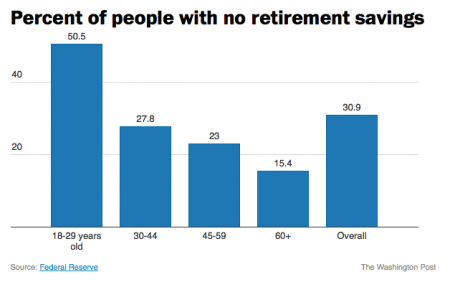
retirement-savings
And according to Census data the typical American household (bias by older families) has something like $17,000 to their name when we remove housing equity.  In other words, most Americans are not prepared for a long retirement.  And old age for many will be many years.  This is why you see many older Americans working deep into old age.  They simply need the money.  Food costs are high.  Housing costs are high.  And for this age group, healthcare costs are soaring.  Because of these changes people are pushing retirement age deeper into the future.
Average age of when people will retire and life prediction
Even as the economy recovered, the average age of expected and actual retirement has jumped up:
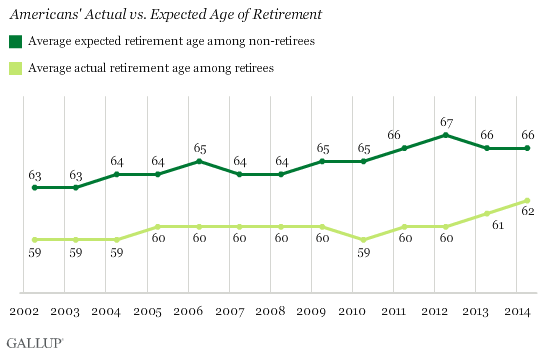
average age of retirement moving up
Americans are working more years than they once would have expected.  Having a nest egg is crucial to being able to retire.  And many Americans simply do not have adequate savings.  Planning for the future is difficult.  Many Americans are bad at planning how long they will live:
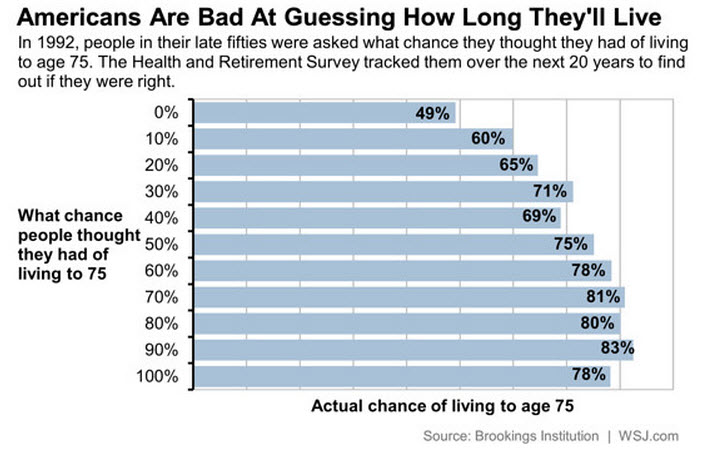
predictinghowlonglive
What does the chart above show?  That people over estimate how long they will live.  But this is also telling regarding psychology.  If people are so confident they will live late into life (75+) why are they planning so poorly when it comes to retirement?  The answer is the cost of living is soaring, inflation really does exist, and people still want to pretend like they are millionaires even though they are broke without debt.
Retirement money held in the hands of the few
Half of Americans don’t own one stock.  And the bulk of wealth is in the hands of a few.  84 percent of the nation’s wealth is held in the hands of the top 20 percent:
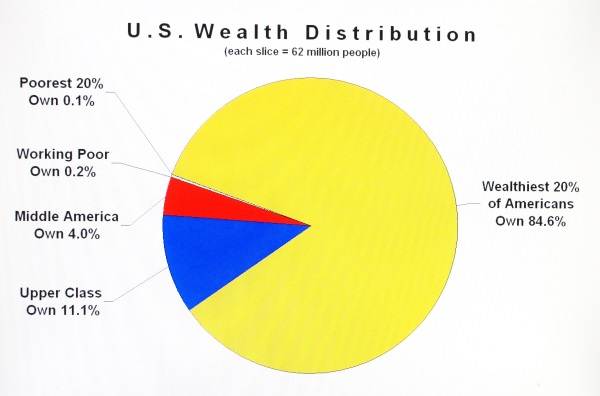
wealthdistribution
The rest whether they admit it or not, are going to rely on Social Security.  Most retired Americans rely on Social Security as their primary source of income.  Half of people on Social Security would be out on the streets if it were not for their monthly payment.  As far as retirement planning goes, there very little retirement or planning going on.  And we have 10,000 Americans hitting retirement age per day for the next decade.

China to Increase Military Budget by About 10%

Wall Street Journal
March 4, 2015

China's military spending will grow by about 10% in the coming year, a senior Chinese official said, despite slowing economic growth. Mark Kelly reports.

The Reason Small Businesses Are Disappearing, As Explained By A Small Business Owner

Zero Hedge
November 14, 2014

Confused why despite endless daily propaganda that the US economy is getting better - after all "just look at the record high S&P 500" - fewer and fewer Americans believe the narrative, as the Democrats and Obama found out the very hard way in last week's midterm elections? Then the following explanation written by the owner of a small business - the segment of the US economy that has historically led every single recovery but this time was left behind - should help answer some questions.
The reason small businesses are disappearing written by a small business owner.
I want to start out by saying that i am a 27 year old male with a small business in Sacramento CA. I started this business a few years ago with savings of 15k. With a lot of hard work and determination i have succeeded, but it sure as hell was not easy. I am a long time lurker and have never seen anyone go in depth about what its like to own a small business and the reason why they are disappearing. Without going into to much detail, i own a furniture store so obviously things are different then other businesses but a lot of the things are the same. I wanted to begin with the things that are killing small businesses. Also only my opinion.
  1. Small Business Loans - Although they are not killing small business they sure as hell don't help anyone. Unless you are opening a unique small business you are not going to get any funding. By unique i mean something along the lines of creating solar panels. According to a recent investigation by the SBA Inspector General (ill post the article if you would like), over 75% of SBA loans went to large businesses. So basically if you want to open a normal business you need a ton of collateral and a miracle to get a loan.
  2. Permits and Licensing - In opening my specific business the first year totaled about $2000.00.
  3. Advertising - Many small business's cant afford to take out pages or flyers in the news paper or TV ads so they only have a few choices such as Yelp or the Penny-saver. (Don't get me started in Yelp).
  4. Street Advertising - While this used to be a good portion of how you get business it is now off limits. Code enforcement will not allow you to put anything outside. No balloons, signs, anything with your store name, window paint more than 50%, or any mattresses. Also delivery vehicles can not be closer than 50 feet from the curb. In my case that means behind the building.
  5. Board of Equalization - Cant go into to much detail here but they sure as hell aren't here to help.
  6. Health Insurance - Now obviously with the people that have a large work force working full time they will be hit hard by obamacare, but i wanted to give you a perspective on a single person. The cheapest rate for myself and me only, and believe me i have looked around, is $250.00/month. Some might say oh that's not bad, but let me explain what that covers, NOTHING lol. Basically if something happens to me i have to shell out 6K before insurance gets involved. Also 100 dollar co pay every time i go.
  7. The economy - While many know that when the President comes on TV and says the economy is doing great, we all know it is not, some people don't. Every month more people drop out of the Labor Force and the number of families on food stamps is sky rocketing. So for those of you who don't know the economy is terrible because of all the top stories of Kim Kardashian and whoever else, lots of people in america are struggling.
  8. Merchant Fees - This is for credit card processing machines. The machine itself costs 600.00 plus the percentages on sales and cards. Companies such as BofA charge once a year on top of the regular fees $150.00 to protect you from fraud (which they can't even stop) and yes its mandatory. Paypal or Square seem to be the best options these days.
  9. Fire Department - Yes even the Fire Department wants a piece. Starting last year you must do your own visual inspection and send them a check for 150! Basically if you don't they will come to your store and give you a million violations for wasting there time.
Something to watch out for is people who check fire extinguishers in business's. This is a huge scam where they come in without permission to inspect your extinguisher, get you a new one and bill you like 200 the following month. They have no right or permission to enter your business and jump all over you. You can simply tell them politely to get out. They dress like they are fire fighters but they are not.

The stock market is finally recognizing severe global volatility: Stock market has worst performance in two years.

MyBudget360
October 13, 2014

Volatility in the market came roaring back this week.  Stocks had their worst weekly performance in two years.  It was hard to understand given the interconnected nature of the markets how little of an impact was being had in US stocks when global markets and governments are facing dramatic challenges.  The markets are slowly coming to the realization that the Federal Reserve simply does not have all the answers to every crisis that arises.  A low interest rate is not going to stall geo-political risk or the spread of infectious diseases.  There are more complicated forces at work here especially when the biggest consumer economy in the US is seeing those exact consumers lose purchasing power with inflation.  There wasn’t any significant news that set the markets off this week aside from trends that have been ongoing for some time now.  It just appears that the markets are reflecting a more realistic position of what is happening around the world.
Volatility is back
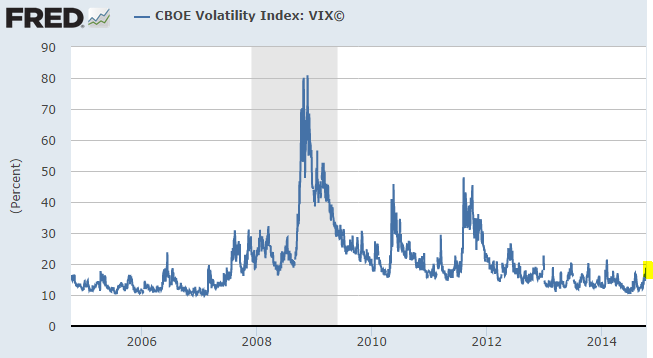
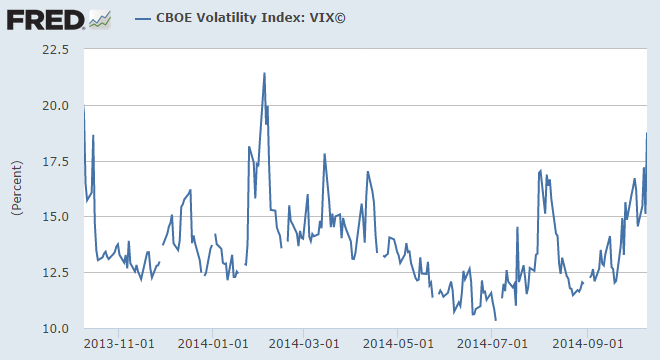
One of the most surprising things in this historic stock rally going back to 2009 is that there has been relatively low volatility.  It has been one giant bounce from the bottom.  That is atypical in many recoveries especially after a crisis like the Great Recession.  The world has become a very complicated place with risk running wild in many areas.  It looks like volatility is now being recognized once again:
vix
vix short-term
Those participating in the markets, not your average worker, are much more disconnected from the micro economic trends that impact those working citizens in many countries around the world.  If we look at Europe, they continued to be mired in heavy unemployment and slow growth.  Our battle is with stagnant wages and a growing number of those simply not participating in the labor force.
Yet it is important to note that many simply do not own stocks.
Many don’t own stocks
Most realize there are heavy crosscurrents hitting our economy at a structural level.  The middle class is shrinking.  Benefits are declining.  The ability to purchase a home is getting tougher.  Debt is the new way of buying items for working Americans, not savings.  These have major impacts on where things go.
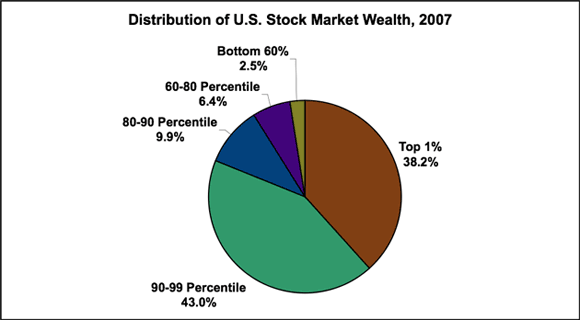
But even in the US, the wealthiest nation, many Americans simply do not own stocks:
us-stock-wealth
80 percent of all stock wealth is held with the top 10 percent of the population.  So most people have very little at play when it comes to owing stocks.  When you see a selloff as we did last week, bigger hands are viewing something significant in the markets.
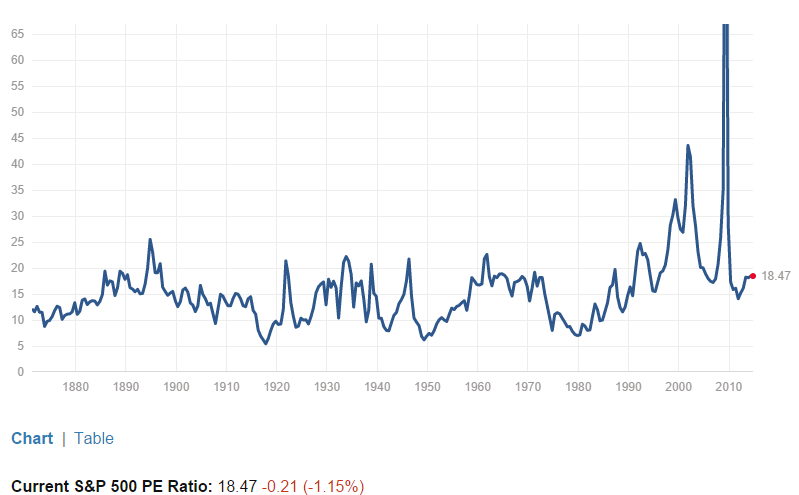
It also creates a disenfranchisement by the public with the economy since their voices are simply not being heard.  Stocks overall are valued too high:
pe ratio
Even looking at conservative pricing models, the S&P 500 is overvalued by 20 percent.  Unless earnings can justify higher prices, it is reasonable to expect a correction given the 200 plus percent run in the stock market.  At a certain point, something will need to give.  It seems like this past week at least, the market is starting to realize that there are many unknowns in the world economy ahead.  Markets abhor information vacuums and that is exactly what we have.

Pentagon plans to shrink US Army to pre-WWII level

Yahoo News
February 24, 2014

Washington (AFP) - The Pentagon plans to scale back the US Army by more than an eighth to its lowest level since before World War II, signaling a shift after more than a decade of ground wars.

Saying it was time to "reset" for a new era, Defense Secretary Chuck Hagel recommended shrinking American forces from 520,000 active duty troops to between 440,000 and 450,000.
In a speech outlining the proposed defense budget, he said Monday that after Iraq and Afghanistan, US military leaders no longer plan to "conduct long and large stability operations."
If approved by Congress, the Pentagon move would reduce the army to its lowest manning levels since 1940, before the American military dramatically expanded after entering World War II.
The proposed 13 percent reduction in the army would be carried out by 2017, a senior defense official, who spoke on condition of anonymity, told AFP.

Spend or be financially doomed: Idolizing the gods of consumption and stoking the fires of debt based speculation. Has the Fed crossed the line of no return?

MyBudget360
May 21, 2013


The Federal Reserve has created the perfect environment where savers are chastised and debt based spending is glorified.  Our economic engine is powered by the fires of consumption.  This has been true for many decades.  What is different about our current space in time is the punishment savers are taking.  Many banks through savings or even CDs offer rates that are hovering around the zero percent mark.  Add in inflation of about three percent and you are actually losing money.  The system is designed to punish any sort of conservative saving.  The stock market continues to move up but it clear that most Americans simply do not have the funds to participate in this party.  The current financial environment is really a perfect brew of punishing savers and encouraging debt based consumption.  Will the elixir work this time around?
Spending into prosperity
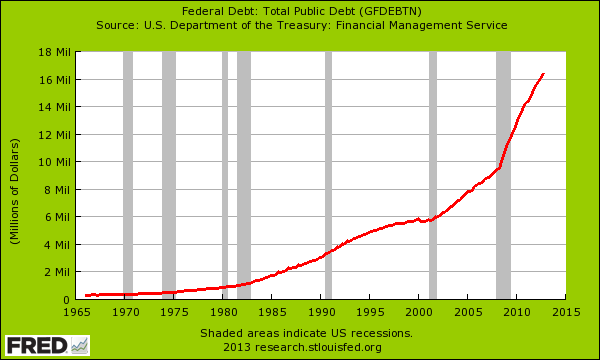
The US public debt is now above $16.73 trillion and continues to grow:
Fed total debt
Spending more than is earned is a time honored tradition and it would appear but the Fed this time around has ballooned its balance sheet to well over $3.3 trillion.  Banks are the primary beneficiaries here since they can leverage the low rates and speculate in the stock market and now the rental property market.
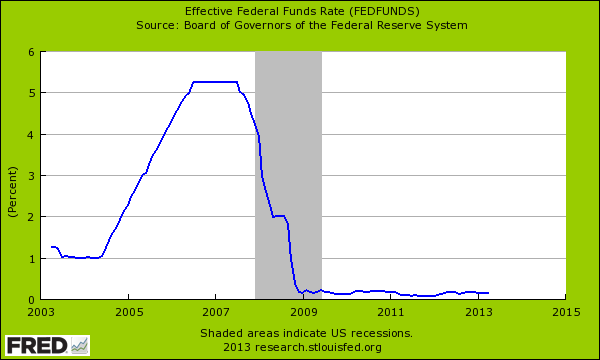
The Fed’s strategy on the interest rate front is rather obvious:
fed funds
Zero or the highway.  Unfortunately many are now accustomed to these low rates and an addiction has set foot.  Short-term bursts of euphoria are somehow mistaken for success.  For example, the Bank of Japan has taken quantitative easing to the next level by directly investing in stocks and stoking the fires of inflation.  The short-term result?  A massive stock market rally and inflation emerging.  Yet one year or even two does not reverse more than two lost decades all the while quantitative easing was being implemented.
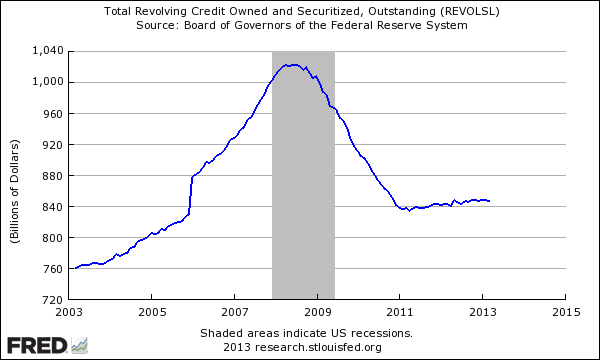
It doesn’t seem that US consumers are taking on much of this newly found cheap debt:
revolving credit
Americans are still pulling back from the recent financial crisis spurred on by our economic system taking on too much debt to begin with.  The problem with this approach of course is what we are seeing with Japan.  At a certain point, you run out of momentum and need to take things to another level.  So in Japan, this has involved flat out stock market intervention by the Bank of Japan.  The Fed has provided very easy liquidity to banks and this has filtered into the stock market and real estate once again.  It isn’t entirely clear that Americans overall are benefitting.  It is very clear however that savers are being punished.
There are few places to save and ride out this structure if you are conservative with your investments.  US Treasuries, CDs, and money market accounts are basically losing value each year courtesy of inflation.  The Fed wants you to spend whether you have the money or need to go into debt to accomplish the task.  It is an interesting experiment since we have never been in this kind of uncharted waters.
There seems to be this idolization of debt based spending.  The fact that some people don’t even blink when someone takes on $100,000 in student debt to go to college tells you a deeper story.  Debt is the only way out.  Saving in a bank is modern way of stuffing money under your tomatoes in your garden.  Slowly time will chip away at the value of your dollars since the Fed is printing digital dollars and speculation erodes the “worth” of any money in its present form.
What is problematic of course is that it almost seems impossible for the Fed to move away from this low rate policy similar to Japan.  The only course of action would be to continue down this road or to become more aggressive when easy money is played out.  One thing is certain and that is we live in a time when debt is idolized and savers are shunned.

Pentagon prepares to ask Congress for break from 'sequester'

Reuters
May2, 2013


U.S. Defense Secretary Chuck Hagel speaks during a joint news conference with Japanese Defense Minister Itsunori Onodera at the Pentagon in Washington April 29, 2013. REUTERS/Kevin Lamarque
WASHINGTON | Wed May 1, 2013 7:14pm EDT
(Reuters) - The Pentagon is preparing to ask Congress soon for more authority to shift funds to cope with automatic spending cuts, confronting lawmakers with another exception to the "sequester" just days after they gave a break to the flying public and the airline industry.
The request may be sent to the House of Representatives' Appropriations Committee as early as next week, a House Republican aide said on Wednesday.
The Pentagon won increased budget flexibility in March, but officials have told members of Congress they believe it was insufficient to cover shortfalls in training and operations.
The Defense Department move would follow closely the fix last week to ease airline flight delays caused by the temporary furloughs of air-traffic controllers by the Federal Aviation Administration.
The cuts, known as "sequestration," were originally hatched by Washington in 2011 as a way to force the White House and Congress to find an alternative budget deal rather than have spending cuts kick in automatically.
But policymakers failed to reach such a deal earlier this year and the cuts - totaling $109 billion for the current fiscal year - took effect on March 1

EU Leaders Work on Seven-year Budget

The New American
November 23, 2012


EU Leaders Work on Seven-year Budget
The European Council meeting in which EU leaders will attempt to reach an agreement on the multi-annual financial framework (MFF) for 2014-2020 began in Brussels on November 22 and EU leaders continue in their struggle to find common ground to set a budget.
BBC News reported that UK Prime Minister David Cameron told reporters in Brussels on Friday that this was not "a time for tinkering" with the EU's 2014-2020 budget, and "unaffordable spending" should be cut. "It isn't the time for moving money from one part of the budget to another," Cameron said. Cuts are "what's happening at home and that's what needs to happen here."
Cameron was reacting to a proposal from summit chairman Herman Van Rompuy (who is also President of the European Council and a former prime minister of Belgium) that keeps the spending ceiling in place but reallocates funds.  
During the early stages of the summit, Cameron met with French President François Hollande and Dutch Prime Minister Mark Rutte. Citing German Chancellor Angela Merkel's statement that she doubts the summit will reach a deal and President Hollande's warning that an agreement might not be possible, the BBC's Matthew Price reported from Brussels that "the chances of success do not look great."
A Reuters news report noted that Cameron seeks a real-terms freeze in EU spending between 2014 and 2020, and also is pressuring the EU to cut its salary expenses by 10 percent, raise EU officials' retirement age from 63 to 68, and reduce their generous pensions benefits — measures that would cut about €6 billion from the seven-year budget, largely a symbolic reduction. The report noted that Cameron's position is geared to capitalize on an increasing anti-EU mood in Britain, where even the media has become skeptical of the EU and has portrayed the budding regional government as a wasteful bureaucracy overloaded with staff receiving overly generous compensation packages. Reuters notes that Cameron's stance may also appease the anti-EU camp in his ruling Conservative Party.
A more detailed financial analysis of the EU budget negotiations from Bloomberg said that the spending plan under discussion represents about one percent of the EU-wide gross domestic product, which is small in comparison to the average 50 percent of GDP that member states spend internally. However, in tough economic times, there is political pressure for European nations to cut their contributions to the EU. Bloomberg notes:
Wealthier countries such as Germany, the U.K., Denmark, Sweden and the Netherlands have banded together to cut what they pay in to the budget, pounding away at the original proposal of 1.033 trillion euros ($1.3 trillion) that came out in mid-2011.
Early negotiations have already reduced the proposed EU budget to about €950 billion. (The euro is currently valued at about $1.29.)
European Parliament President Martin Schulz, in a move to convince the wealthier countries to pay more into the EU budget, asserted that it is less expensive for them to promote European projects, since contracts in Latvia or Slovenia go to companies in places such as Germany and Sweden, reported Bloomberg.
"Every euro invested by the EU attracts an average of between 2 and 4 euros in additional investment," Schulz told the leaders. "The EU budget is not a zero-sum game in which one country wins what another loses. Synergies are generated which benefit the net contributors as well."

White House to miss deadline for report on 'fiscal cliff' budget cuts

The Hill
September 7, 2012


The White House on Friday said it will miss the legal deadline for delivering a report to Congress on the spending cuts from sequestration that are scheduled to take effect in 2013.
Spokesman Jay Carney told reporters on Air Force One that the report will be coming next week.
Under the terms of the Sequestration Transparency Act signed in August, President Obama was to tell Congress by Friday how the administration plans to implement the $109 billion in automatic cuts mandated by the Budget Control Act.
The Office of Management and Budget has repeatedly failed to make legal deadlines. It delivered its presidential budget proposals and mid-session updates late both this year and last year. 
Republicans have tried to tie the tardiness to the failure of the Senate to pass a budget resolution for the last three years.

Shortfall in California’s Budget Swells to $16 Billion


ADAM NAGOURNEY
NY Times
May 13, 2012
LOS ANGELES — The state budget shortfall in California has increased dramatically in the last six months, forcing state officials to assemble a series of new spending cuts that are likely to mean further reductions to schools, health care and other social programs already battered by nearly five years of budget retrenchment, state officials announced on Saturday.

Gov. Jerry Brown, disclosing the development in a video posted on YouTube, said that California’s shortfall was now projected to be $16 billion, up from $9.2 billion in January. Mr. Brown said that he would propose a revised budget on Monday to deal with it.
“We are now facing a $16 billion hole, not the $9 billion we thought in January,” Mr. Brown said. “This means we will have to go much further and make cuts far greater than I asked for at the beginning of the year.”
Mr. Brown disclosed the news in a video that had all the trappings of a campaign announcement. In it, he aggressively accounted for the steps he said he had taken to try to scale back a $26 billion deficit he found upon taking office. And he urged viewers to back an initiative he is putting on the November ballot that would increase sales taxes by 0.25 percent and impose an income tax surcharge on wealthy Californians to try to stave off more cuts.

Sen. McCain: ‘Unless We Enact Draconian Measures,’ America Faces a ‘Fiscal Meltdown’

CNSNews.com
Tuesday, April 12, 2011


(CNSNews.com) – Senator John McCain (R-Ariz.) said that “unless we enact draconian measures,” America is headed for a “fiscal meltdown.”
“We are at a critical juncture in American history that unless we enact draconian measures, then the results are very obvious, and that is a fiscal meltdown. No country can borrow 40 cents out of every dollar it spends – even the largest and most powerful nation in the world. No nation can continue on that track. So, tough medicine is required,” McCain said during a press conference at the U.S. Capitol on Tuesday.
McCain said the United States faces a fiscal situation similar to Greece, Spain and Ireland.
“I noted with some interest when Greece and Spain and now Ireland and other countries faced a severe financial meltdown,” he said. “The first thing that had to be cut was entitlements and benefits. What’s the difference between the United States and these countries? We’re just not there yet but we’re headed on that path.”
Read the entire article