Showing posts with label central bank. Show all posts

MEET THE SECRETIVE GROUP THAT RUNS THE WORLD

Zero Hedge
April 12, 2015

Nothing comes closer to the stereotypical, secretive group determining the fate of over 7 billion people, than the Bank of International Settlements
Meet The Secretive Group That Runs The World
Over the centuries there have been many stories, some based on loose facts, others based on hearsay, conjecture, speculation and outright lies, about groups of people who “control the world.” Some of these are partially accurate, others are wildly hyperbolic, but when it comes to the historic record, nothing comes closer to the stereotypical, secretive group determining the fate of over 7 billion people, than the Bank of International Settlements, which hides in such plain sight, that few have ever paid much attention.
This is their story.
First unofficial meeting of the BIS Board of Directors in Basel, April 1930
The following is an excerpt from TOWER OF BASEL: The Shadowy History of the Secret Bank that Runs the World by Adam LeBor.  Reprinted with permission from PublicAffairs.
The world’s most exclusive club has eighteen members. They gather every other month on a Sunday evening at 7 p.m. in conference room E in a circular tower block whose tinted windows overlook the central Basel railway station. Their discussion lasts for one hour, perhaps an hour and a half. Some of those present bring a colleague with them, but the aides rarely speak during this most confidential of conclaves. The meeting closes, the aides leave, and those remaining retire for dinner in the dining room on the eighteenth floor, rightly confident that the food and the wine will be superb. The meal, which continues until 11 p.m. or midnight, is where the real work is done. The protocol and hospitality, honed for more than eight decades, are faultless. Anything said at the dining table, it is understood, is not to be repeated elsewhere.
Few, if any, of those enjoying their haute cuisine and grand cru wines— some of the best Switzerland can offer—would be recognized by passers-by, but they include a good number of the most powerful people in the world. These men—they are almost all men—are central bankers. They have come to Basel to attend the Economic Consultative Committee (ECC) of the Bank for International Settlements (BIS), which is the bank for central banks. Its current members [ZH: as of 2013] include Ben Bernanke, the chairman of the US Federal Reserve; Sir Mervyn King, the governor of the Bank of England; Mario Draghi, of the European Central Bank; Zhou Xiaochuan of the Bank of China; and the central bank governors of Germany, France, Italy, Sweden, Canada, India, and Brazil. Jaime Caruana, a former governor of the Bank of Spain, the BIS’s general manager, joins them.
In early 2013, when this book went to press, King, who is due to step down as governor of the Bank of England in June 2013, chaired the ECC. The ECC, which used to be known as the G-10 governors’ meeting, is the most influential of the BIS’s numerous gatherings, open only to a small, select group of central bankers from advanced economies. The ECC makes recommendations on the membership and organization of the three BIS committees that deal with the global financial system, payments systems, and international markets. The committee also prepares proposals for the Global Economy Meeting and guides its agenda.
That meeting starts at 9:30 a.m. on Monday morning, in room B and lasts for three hours. There King presides over the central bank governors of the thirty countries judged the most important to the global economy. In addition to those who were present at the Sunday evening dinner, Monday’s meeting will include representatives from, for example, Indonesia, Poland, South Africa, Spain, and Turkey. Governors from fifteen smaller countries, such as Hungary, Israel, and New Zealand are allowed to sit in as observers, but do not usually speak. Governors from the third tier of member banks, such as Macedonia and Slovakia, are not allowed to attend. Instead they must forage for scraps of information at coffee and meal breaks.
The governors of all sixty BIS member banks then enjoy a buffet lunch in the eighteenth-floor dining room. Designed by Herzog & de Meuron, the Swiss architectural firm which built the “Bird’s Nest” Stadium for the Beijing Olympics, the dining room has white walls, a black ceiling and spectacular views over three countries: Switzerland, France, and Germany. At 2 p.m. the central bankers and their aides return to room B for the governors’ meeting to discuss matters of interest, until the gathering ends at 5.
King takes a very different approach than his predecessor, Jean-Claude Trichet, the former president of the European Central Bank, in chairing the Global Economy Meeting. Trichet, according to one former central banker, was notably Gallic in his style: a stickler for protocol who called the central bankers to speak in order of importance, starting with the governors of the Federal Reserve, the Bank of England, and the Bundesbank, and then progressing down the hierarchy. King, in contrast, adopts a more thematic and egalitarian approach: throwing open the meetings for discussion and inviting contributions from all present.
The governors’ conclaves have played a crucial role in determining the world’s response to the global financial crisis. “The BIS has been a very important meeting point for central bankers during the crisis, and the rationale for its existence has expanded,” said King. “We have had to face challenges that we have never seen before. We had to work out what was going on, what instruments do we use when interest rates are close to zero, how do we communicate policy. We discuss this at home with our staff, but it is very valuable for the governors themselves to get together and talk among themselves.”
Those discussions, say central bankers, must be confidential. “When you are at the top in the number one post, it can be pretty lonely at times. It is helpful to be able to meet other number ones and say, ‘This is my problem, how do you deal with it?’” King continued. “Being able to talk informally and openly about our experiences has been immensely valuable. We are not speaking in a public forum. We can say what we really think and believe, and we can ask questions and benefit from others.”
The BIS management works hard to ensure that the atmosphere is friendly and clubbable throughout the weekend, and it seems they succeed. The bank arranges a fleet of limousines to pick up the governors at Zürich airport and bring them to Basel. Separate breakfasts, lunches, and dinners are organized for the governors of national banks who oversee different types and sizes of national economies, so no one feels excluded. “The central bankers were more at home and relaxed with their fellow central bankers than with their own governments,” recalled Paul Volcker, the former chairman of the US Federal Reserve, who at- tended the Basel weekends. The superb quality of the food and wine made for an easy camaraderie, said Peter Akos Bod, a former governor of the National Bank of Hungary. “The main topics of discussion were the quality of the wine and the stupidity of finance ministers. If you had no knowledge of wine you could not join in the conversation.”
And the conversation is usually stimulating and enjoyable, say central bankers. The contrast between the Federal Open Markets Committee at  the US Federal Reserve, and the Sunday evening G-10 governors’ dinners was notable, recalled Laurence Meyer, who served as a member of the Board of Governors of the Federal Reserve from 1996 until 2002. The chairman of the Federal Reserve did not always represent the bank at the Basel meetings, so Meyer occasionally attended. The BIS discussions were always lively, focused and thought provoking. “At FMOC meetings, while I was at the Fed, almost all the Committee members read statements which had been prepared in advance. They very rarely referred to statements by other Committee members and there was almost never an exchange between two members or an ongoing discussion about the outlook or policy options. At BIS dinners people actually talk to each other and the discussions are always stimulating and interactive focused on the serious issues facing the global economy.”
All the governors present at the two-day gathering are assured of total confidentiality, discretion, and the highest levels of security. The meetings take place on several floors that are usually used only when the governors are in attendance. The governors are provided with a dedicated office and the necessary support and secretarial staff. The Swiss authorities have no juridisdiction over the BIS premises. Founded by an international treaty, and further protected by the 1987 Headquarters Agreement with the Swiss government, the BIS enjoys similar protections to those granted to the headquarters of the United Nations, the International Monetary Fund (IMF) and diplomatic embassies. The Swiss authorities need the permission of the BIS management to enter the bank’s buildings, which are described as “inviolable.”
The BIS has the right to communicate in code and to send and receive correspondence in bags covered by the same protection as embassies, meaning they cannot be opened. The BIS is exempt from Swiss taxes. Its employees do not have to pay income tax on their salaries, which are usually generous, designed to compete with the private sector. The general man- ager’s salary in 2011 was 763,930 Swiss francs, while head of departments were paid 587,640 per annum, plus generous allowances. The bank’s extraordinary legal privileges also extend to its staff and directors. Senior managers enjoy a special status, similar to that of diplomats, while carrying out their duties in Switzerland, which means their bags cannot be searched (unless there is evidence of a blatant criminal act), and their papers are inviolable. The central bank governors traveling to Basel for the bimonthly meetings enjoy the same status while in Switzerland. All bank officials are immune under Swiss law, for life, for all the acts carried out during the discharge of their duties. The bank is a popular place to work and not just because of the salaries. Around six hundred staff come from over fifty countries. The atmosphere is multi-national and cosmopolitan, albeit very Swiss, emphasizing the bank’s hierarchy. Like many of those working for the UN or the IMF, some of the staff of the BIS, especially senior management, are driven by a sense of mission, that they are working for a higher, even celestial purpose and so are immune from normal considerations of accountability and transparency.
The bank’s management has tried to plan for every eventuality so that the Swiss police need never be called. The BIS headquarters has high-tech sprinkler systems with multiple back-ups, in-house medical facilities, and its own bomb shelter in the event of a terrorist attack or armed conflagration. The BIS’s assets are not subject to civil claims under Swiss law and can never be seized.
The BIS strictly guards the bankers’ secrecy. The minutes, agenda, and actual attendance list of the Global Economy Meeting or the ECC are not released in any form. This is because no official minutes are taken, although the bankers sometimes scribble their own notes.Sometimes there will be a brief press conference or bland statement afterwards but never anything detailed. This tradition of privileged confidentiality reaches back to the bank’s foundation.
“The quietness of Basel and its absolutely nonpolitical character provide a perfect setting for those equally quiet and nonpolitical gatherings,” wrote one American official in 1935. “The regularity of the meetings and their al- most unbroken attendance by practically every member of the Board make them such they rarely attract any but the most meager notice in the press.”8 Forty years on, little had changed. Charles Coombs, a former foreign exchange chief of the New York Federal Reserve, attended governors’ meetings from 1960 to 1975. The bankers who were allowed inside the inner sanctum of the governors’ meetings trusted each other absolutely, he recalled in his memoirs. “However much money was involved, no agreements were ever signed nor memoranda of understanding ever initialized. The word of each official was sufficient, and there were never any disappointments.”
What, then, does this matter to the rest of us? Bankers have been gathering confidentially since money was first invented. Central bankers like to view themselves as the high priests of finance, as technocrats overseeing arcane monetary rituals and a financial liturgy understood only by a small, self-selecting elite.
But the governors who meet in Basel every other month are public servants. Their salaries, airplane tickets, hotel bills, and lucrative pensions when they retire are paid out of the public purse. The national reserves held by central banks are public money, the wealth of nations. The central bankers’ discussions at the BIS, the information that they share, the policies that are evaluated, the opinions that are exchanged, and the subsequent decisions that are taken, are profoundly political. Central bankers, whose independence is constitutionally protected, control monetary policy in the developed world. They manage the supply of money to national economies. They set interest rates, thus deciding the value of our savings and investments. They decide whether to focus on austerity or growth. Their decisions shape our lives.
The BIS’s tradition of secrecy reaches back through the decades. During the 1960s, for example, the bank hosted the London Gold Pool. Eight countries pledged to manipulate the gold market to keep the price at around thirty-five dollars per ounce, in line with the provisions of the Bretton Woods Accord that governed the post–World War II international financial system. Although the London Gold Pool no longer exists, its successor is the BIS Markets Committee, which meets every other month on the occasion of the governors’ meetings to discuss trends in the financial markets. Officials from twenty-one central banks attend. The committee releases occasional papers, but its agenda and discussions remain secret.
Nowadays the countries represented at the Global Economy Meetings together account for around four-fifths of global gross domestic product (GDP)— most of the produced wealth of the world—according to the BIS’s own statistics. Central bankers now “seem more powerful than politicians,” wrote The Economist newspaper, “holding the destiny of the global economy in their hands.” How did this happen? The BIS, the world’s most secretive global financial institution, can claim much of the credit. From its first day of existence, the BIS has dedicated itself to furthering the interests of central banks and building the new architecture of transnational finance. In doing so, it has spawned a new class of close-knit global technocrats whose members glide between highly-paid positions at the BIS, the IMF, and central and commercial banks.
The founder of the technocrats’ cabal was Per Jacobssen, the Swedish economist who served as the BIS’s economic adviser from 1931 to 1956. The bland title belied his power and reach. Enormously influential, well connected, and highly regarded by his peers, Jacobssen wrote the first BIS annual reports, which were—and remain—essential reading throughout the world’s treasuries. Jacobssen was an early supporter of European federalism. He argued relentlessly against inflation, excessive government spending, and state intervention in the economy. Jacobssen left the BIS in 1956 to take over the IMF. His legacy still shapes our world. The consequences of his mix of economic liberalism, price obsession, and dismantling of national sovereignty play out nightly in the European news bulletins on our television screens.
The BIS’s defenders deny that the organization is secretive. The bank’s archives are open and researchers may consult most documents that are more than thirty years old. The BIS archivists are indeed cordial, helpful, and professional. The bank’s website includes all its annual reports, which are downloadable, as well as numerous policy papers produced by the bank’s highly regarded research department. The BIS publishes detailed accounts of the securities and derivatives markets, and international banking statistics. But these are largely compilations and analyses of information already in the public domain. The details of the bank’s own core activities, including much of its banking operations for its customers, central banks, and international organizations, remain secret. The Global Economy Meetings and the other crucial financial gatherings that take place at Basel, such as the Markets Committee, remain closed to outsiders. Private individuals may not hold an account at BIS, unless they work for the bank. The bank’s opacity, lack of accountability, and ever-increasing influence raises profound questions— not just about monetary policy but transparency, accountability, and how power is exercised in our democracies.
Read the entire article

Even Central Bankers Now Admit QE Doesn’t Work

Washington's Blog
January 21, 2015


Even As European Central Bank Is Set to Unleash a Massive Round of Quantitative Easing, Central Bank Heads Admit QE Doesn’t Work

The former head of the Bank of England – Mervyn King – said today that more QE will not help the economy:
We have had the biggest monetary stimulus that the world must have ever seen, and we still have not solved the problem of weak demand. The idea that monetary stimulus after six years … is the answer doesn’t seem (right) to me.
Also today, William White – the brilliant economist who called the 2008 crisis well ahead of time, who is head of the OECD’s Review Committee and former chief economist for BIS (the central banks’ central bank)  slammed QE:
QE is not going to help at all. Europe has far greater reliance than the US on small and medium-sized companies (SMEs) and they get their money from banks, not from the bond market.
***
Even after the stress tests the banks are still in ‘hunkering down mode’. They are not lending to small firms for a variety of reasons. The interest rate differential is still going up.
***
Mr White said QE is a disguised form of competitive devaluation. “The Japanese are now doing it as well but nobody can complain because the US started it,” he said.
“There is a significant risk that this is going to end badly because the Bank of Japan is funding 40pc of all government spending. This could end in high inflation, perhaps even hyperinflation.
“The emerging markets got on the bandwagon by resisting upward pressure on their currencies and building up enormous foreign exchange reserves. The wrinkle this time is that corporations in these countries – especially in Asia and Latin America – have borrowed $6 trillion in US dollars, often through offshore centres. That is going to create a huge currency mismatch problem as US rates rise and the dollar goes back up.”
***
He deplores the rush to QE as an “unthinking fashion”. Those who argue that the US and the UK are growing faster than Europe because they carried out QE early are confusing “correlation with causality”. The Anglo-Saxon pioneers have yet to pay the price. “It ain’t over until the fat lady sings. There are serious side-effects building up and we don’t know what will happen when they try to reverse what they have done.”
The painful irony is that central banks may have brought about exactly what they most feared by trying to keep growth buoyant at all costs, he argues, and not allowing productivity gains to drive down prices gently as occurred in episodes of the 19th century. “They have created so much debt that they may have turned a good deflation into a bad deflation after all.”
The former long-term head of the Federal Reserve (Alan Greenspan) says that QE has failed to help the economy.
Numerous academic studies confirm this. And see this.
Indeed, many high-level economists – including Federal Reserve economists and the main architect of Japan’s QE program – now say that QE may cause deflation and harms the economy in the long run.
Economists also note that QE helps the rich … but hurts the little guy. QE is one of the main causes ofinequality (and see this and this). And economists now admit that runaway inequality cripples the economy. So QE indirectly hurts the economy by fueling runaway inequality.
A high-level Federal Reserve official says QE is “the greatest backdoor Wall Street bailout of all time”. And the “Godfather” of Japan’s monetary policy admits that it “is a Ponzi game”.

Central Banks Now Dominate Stock Market, Study Finds

The New American
June 23, 2014
Central Banks Now Dominate Stock Market, Study Finds
Central banks and government entities around the world are now dominant players in the stock market with some $30 trillion invested in equities and other assets, according to a new survey released this week offering the first comprehensive analysis of public-sector investments. About half of that is from central banks. In other words, monetary authorities, which conjure fiat currency into existence out of thin air, are using much of that “funny money” to gobble up real assets — propping up stock prices but eroding the value of people’s savings through inflation of the currency supply. The significance of the findings is monumental. 
By far the largest overall central bank-controlled investor is the Communist Chinese dictatorship’s “State Administration of Foreign Exchange (SAFE),” which is part of the regime’s central bank known as the “People’s Bank of China.” According to the survey, SAFE has almost $4 trillion under management, including massive stakes in publicly traded European companies. Beyond SAFE, Beijing’s central bank has also been directly scooping up minority positions in key European companies and industries. Other Asian central banks are becoming giant players in equities, too.   
While the privately owned U.S. Federal Reserve System has apparently been sticking with government bonds and mortgage-backed securities, its own massive role in distorting markets and central planning has been documented extensively by this magazine and countless analysts. Among other radical measures, the U.S. central bank has showered trillions of dollars on crony megabanks around the world. Since the economic crisis, the Fed has also engaged in currency printing on an unprecedented scale, euphemistically referred to as “quantitative easing,” or QE. Its balance sheet is now over $4 trillion and still growing.  

Sterling to go plastic, Bank of England decides....the end of Paper notes

The Guardian 
December 17, 2013

Matheny's Note: this is getting a step closer to the goal of a paperless currency. We are sure to possibly see other nations doing the same thing if this is successful. They will implant micro censors in these bills no doubt to track them and verify their authenticity, if they haven't already done so.


Polymer banknote
A sample polymer ten pound banknote. Photograph: Chris Ratcliffe/Press Association
The Bank of England will announce plans on Wednesday to press ahead with switching to plastic banknotes, starting with the new Sir Winston Churchill £5 note in 2016.
The decision on polymer notes will mark the beginning of the end for 320 years of paper notes from the Bank. The move by Threadneedle Street follows Bank governor Mark Carney's native Canada, where plastic notes are being rolled out, and Australia, where they have been in circulation for more than two decades.
Carney launched a public consultation on polymer banknotes, seen as cleaner and more durable, shortly after arriving at the Bank this summer. However, the Bank's notes division has been considering plastic money for several years.

Quantitative Easing has become heroine to the financial markets: Federal Reserve balance sheet hits $4 trillion this week.

MyBudget360
December 16, 2013

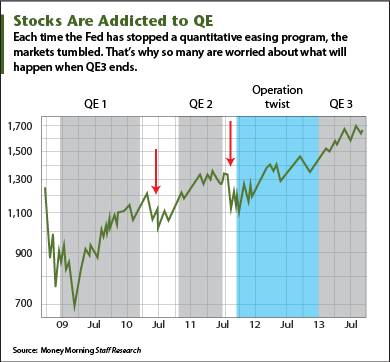
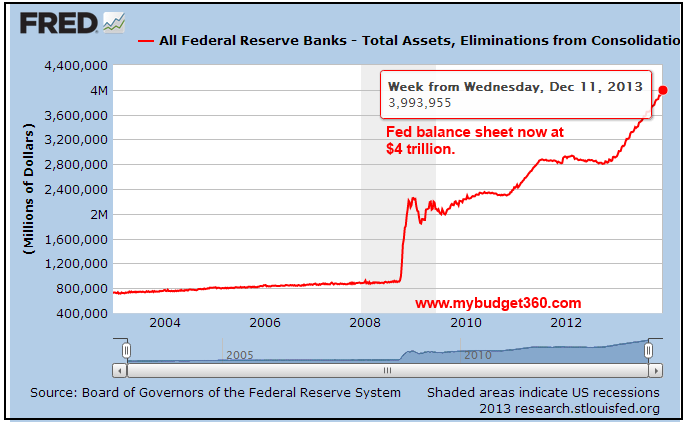
Addiction is never an easy battle to overcome.  This also applies to easy money addiction that is now part of the Quantitative Easing economy.  The Fed’s extraordinary measures are now appearing to be more permanent measures.  Every time the whispers of tapering are made the markets respond accordingly signifying that the stock market is fully addicted on easy money.  There is really no backing out of QE without some sort of pain.  Any addict pulling themselves away from a drug suffers some brief or long period of withdrawal.  Yet the long-term benefits are obvious.  In this case, the Fed is not only avoiding tapering but getting more aggressive in their QE heroine.  This week, the Fed’s balance sheet crossed the $4 trillion barrier.  Of course few people pay attention to the Fed’s balance sheet but the fact that the Fed has created a second housing mania fueled by investor money is startling.
QE forever
It is interesting that each time the hint of a taper was made the market responded by pulling back.  The markets are fully addicted to this low rate environment brought on by the Fed buying up long-term MBS on the cheap.  Who in the world would take on a 4 percent mortgage in this kind of market?  Apparently only the Fed.  So it is no surprise that the markets respond with pain each time the QE taper is announced:
When-QE-ends
Source:  Money Morning
It is fairly clear that pulling back on QE will have an impact on stocks. The entire financial edifice is now building off of the assumption that QE will last forever.  This has created deep distortions in wealth and has also created a secondary housing mania where big funds are rushing out to buy real assets with artificially low rates.
It is comical to hear that the Fed is tapering because looking at the Fed balance sheet we see absolutely no signs of any sort of tapering:
fed balance sheet
To the contrary, the Fed has become more aggressive in buying up MBS via their QE operations.  The Fed is now essentially the mortgage market.  In spite of this poor allocation of resources, wealth inequality in the US has only become more pronounced.  As we have highlighted before most Americans have very little invested in the stock market so the gains here are of little consequence to the vast majority.  Companies have used the economy to cut wages and also to slam employee benefits.  Behind the scenes however high level executives especially in the financial industry have used easy money handouts from the Fed to lever up once again in the real economy.
Don’t forget the debt
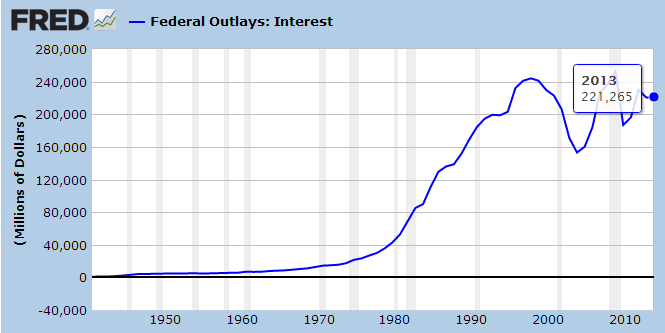
We are now paying a substantial sum in interest payments on our debt:
fed interest costs on debt
The only thing keeping things down is the low rate we are able to garner around the world.  The Fed is aware of this and realizes any sizeable moves in interest rates will cause a dramatic rise in interest payments on debt.  Better to inflate away our debt so long as we can find a market for this.  Yet that is the problem with QE since the Fed is essentially the only player.  There is virtually no market for 30 year mortgage rates at current price levels.  The market is fully addicted on QE.
Getting off QE heroine does not look like it will happen.  So why the constant discussions of tapering?  The Fed is a giant confidence game and many are starting to realize this.  Banks understand that any sort of unwind will impact the stock market so better to chase yields in real assets and crowd out regular households.  This is why inequality keeps getting worse in the US in spite of the stock market being near a record high.  The financial industry is fully addicted to this QE heroine and will say anything to keep their pusher providing this easy money.  $4 trillion will not be the only milestone that is crossed even though the taper is always being mentioned.

Central Bankers Prepare to Flood the World with More Funny Money

The New American
November 1, 2013
Central Bankers Prepare to Flood the World with More Funny Money
Recent comments by the head of the Bank of England, the U.K.’s powerful central bank, offered further evidence that Western central bankers are preparing to shower even greater quantities of fiat currency on private banks and financial institutions — all at public expense. Already, tens of trillions of dollars’ worth of debt-based currency has been created out of thin air by the Federal Reserve, the BoE, the European Central Bank, and other central banks to prop up private mega-banks and wild spending sprees by government amid the economic crisis. With help and guidance from the BoE’s new governor, Mark Carney, analysts say all of that appears set to accelerate.

Charged with conjuring currency into existence at interest and centrally planning broad swaths of the economy, the controversial British monetary-policy institution is currently overhauling its policies to make it even easier for banks to tap the people’s wealth on demand. BoE boss Carney, a Goldman Sachs veteran from Canada with impeccable establishment credentials who has vowed to keep interest rates at rock bottom, announced some of the radical reforms during what was described in media reports as his first major speech on British financial regulation.  

Among other changes, the central banker said that the BoE would start accepting lower-grade collateral from banks in exchange for fiat-currency loans. In other words, after Western central banks already came under fire for such wealth-redistribution schemesthroughout the most recent financial crisis, the BoE will soon allow lenders seeking cash to unload even more dubious assets on the public. “None of this means financial institutions are excused from the need to manage their balance sheets prudently,” Carney claimed, denying that he was serving as a “cheerleader” for big banks.  

US President Barack Obama quietly signed his name to an Executive Order on Friday, allowing the White House to control all private communications in the country in the name of national security

12160.info
July 6, 2013

Executive Order -- Assignment of National Security and Emergency Preparedness Communications Functions
July 6, 2013
US President Barack Obama quietly signed his name to an Executive Order on Friday, allowing the White House to control all private communications in the country in the name of national security.
President Obama released his latest Executive Order on Friday, July 6, a 2,205-word statement offered as the “Assignment of National Security and Emergency Preparedness Communications Functions.” And although the president chose not to commemorate the signing with much fanfare, the powers he provides to himself and the federal government under the latest order are among the most far-reaching yet of any of his executive decisions.

This Is the First Time In History that All Central Banks Have Printed Money at the Same Time … And They’re Failing Miserably


Simultaneous Global Printing Is Failing Miserably
Mainstream Keynesian economists argue that the failure of the European austerity measures to pull Europe out of the doldrums proves that more stimulus is needed, and that austerity is poison at this stage.
But Martin Weiss noted last month:
Four of the world’s largest central banks have gone absolutely berserk, running the money printing presses like never before in history:
This Is the First Time In History that All Central Banks Have Printed Money at the Same Time … And They’re Failing Miserably  chart
Source: Chart lines — Pimco
The Bank of Japan (BOJ) had already been printing money like crazy ever since their bubble economy burst in the early 1990s.
So when the debt crisis struck in 2008, the size of their balance sheet assets, which measure the cumulative total of a central bank’s money printing operations, wasalreadythe biggest in the world: About 20% of their economy.
Then, when the shock waves of the Lehman Brothers collapse struck Japan, what did they do?
They stepped up their money printing operations EVEN further — to about 30% of GDP. (See yellow line in chart above.)
Other than Brazil in the 1970s or Germany in the 1920s, no other major nation — or group of nations — on the planet had ever gone that far! (Until, that is, Europe, which I’ll get to in a moment.)
Meanwhile …
At the U.S. Federal Reserve, no Fed Chairman in history — not even notorious easy-money advocates like Arthur Burns or Allen Greenspan — had EVER run the money printing presses for any extended period of time.
But Fed Chairman Bernanke changed all that. Soon after the debt crisis hit in 2008, he nearly TRIPLED the size of the Fed’s balance sheet from about 6% of GDP to almost 17% of GDP.
And in the years since, he has pumped it up even further to about 20% of GDP! (Red line in chart.)
The Bank of England (BOE) has mostly been expanding its balance sheet in lock step with the Fed (green line).
But in the global race to print money, it’s the European Central Bank (ECB) which has been leading the pack in the past year or so, suddenly expanding their balance sheet from about 20% of GDP to close to 30% GDP (blue line).
This is absolutely massive!
Heck, in the 1990s and 2000s, just the money-printing operations by ONE central bank (the Bank of Japan) changed the world:
Global investors borrowed abundant amounts of cheap money in Japan and poured it into risky investments around the world, helping to create some of the largest bubbles — and busts — in history.
Now, imagine FOUR central banks doing the same thing at the same time!
Read the entire article 

US faces brewing battle for World Bank job


Yahoo News
March 8, 2012

The United States faces a brewing battle over who will lead theWorld Bank as one of its reported candidates ruled the job out and insurgent candidate Jeffrey Sachs won developing country support.
With the March 23 deadline looming for nominations to succeed president Robert Zoellick, Washington -- which has always put an American at the helm -- had narrowed the field to three, according to a source close to the Bank.
The administration of President Barack Obama is considering US Senator John Kerry, United Nations ambassador Susan Rice and economist Lawrence Summers, the source said.
But Kerry, the Democratic senator who was defeated in a run for the White House by then-president George W. Bush in 2004, says he does not want the job

Analysis: New central bank cash glut risks "monetary anarchy"

Various Euro notes are pictured laying on a table in Warsaw February 24, 2012.
Credit: Reuters/Kacper Pempel
Reuters
February 28, 2012


(Reuters) - The scale of money printing in the West has become so massive that the world may fall prey to "monetary anarchy," with traces of bubbles appearing everywhere.
At least that's what some critics see in the latest round of cash pumping by major central banks.
It is also an eerily reminiscent of 2011, when similarly generous monetary easing sparked higher oil prices, slowed the recovery and stoked speculative hot money flows into vulnerable emerging markets.
The European Central Bank alone is expected to lend another half trillion euros or more of super-cheap money to banks on Wednesday, followingJapan and Britain which have already injected fresh cash. The Federal Reserve has promised to keep interest rates low until 2014 and act further if needed.
There is a sense of deja-vu in financial markets. Just like the last time a wave of money was pumped into the world financial systems in 2011, crude oil - fuelled also this time by Middle East tensions - has jumped 15 percent this year.
As a result, riskier assets such as equities are already coming off new year highs. Rising emerging market currencies are forcing some central banks there to intervene.
The scale of money creation since the onset of the global credit shock can be seen in the size of central banks' balance sheet expansion.
JP Morgan says G4 central bank balance sheets have more than doubled since 2007 to 24 percent of combined gross domestic product and will reach 26 percent this year.
"We have Monetary Anarchy running riot, where the elastic band between the real economy and the current liquidity-fuelled markets is stretched further and further beyond credulity," Bob Janjuah, head of tactical asset allocation at Nomura, noted.
He said bubbles were visible in all asset classes because central bank balance sheets are at the core.
"If/when the current cycle implodes, central banks which have seen explosive balance sheet growth will add to the problems, rather than being able to act as credible lenders of last resort," he said.

U.S. wants to ‘close down the Central Bank of Iran’ over nuclear concerns


National Post
 Jan 12, 2012 – 4:14 PM ET | Last Updated: Jan 12, 2012 4:16 PM ET
BEHROUZ MEHRI/AFP/Getty Images
WASHINGTON — The latest round of American sanctions are aimed at shutting down Iran’s central bank, a senior U.S. official said Thursday, spelling out that intention directly for the first time.
“We do need to close down the Central Bank of Iran (CBI),” the official told reporters on condition of anonymity, while adding that the United States is moving quickly to implement the sanctions, signed into law last month.
The sanctions, broadly aimed at forcing Tehran to shift course on its nuclear program, targeted Iran’s crucial oil sector and required foreign firms to make a choice between doing business with Iran or the United States.
Foreign central banks that deal with the Iranian central bank on oil transactions could also face similar restrictions under the new law, which has sparked fears of damage to U.S. ties with nations like Russia and China.