Showing posts with label quantitative easing. Show all posts

Fed doublespeak and the dismantling of the middle class: Fed states dropping “patient” word doesn’t mean it is impatient on rates. In 1970 roughly 7 percent of all income was earned by the top 1 percent. Today it is closer to 20 percent.

MyBudget360
March 18, 2015

The Fed has taken a page out of George Orwell’s 1984.  Doublespeak is all the rage and the Fed’s statements are analyzed as if sifting for gold.  Even when they don’t do anything markets jump.  The Fed sets the tone on our debt addiction.  The Fed dropped the word “patient” in terms of increasing interest rates but then goes on to say this doesn’t mean that it will be impatient.  Say what?  The Fed hints at tapering and balks because it claims there is “low inflation” but when we look at real inflation, the price of many items is shooting up dramatically.  Many of these items were staples of the middle class including an affordable college education, a home, and being able to earn a good wage.  Back in 1975 roughly 7 percent of all income earned went to the top 1 percent.  Today it is closer to 20 percent.  The last time it was this high was during the years prior to the Great Depression.
Share of income
The middle class is being dismantled by economic forces.  More Americans find that they are working in the low wage economythat is booming.  For most households income does matter because this is how you finance your life.  The Fed has created a system where savers are punished.  Negative interest rates punish traditional savings.  It makes stocks, junk bonds, and other speculative items seem more lucrative.  Those that take on big levels of debt are encouraged.  So it is no surprise then that all items financed by debt are suddenly going up in price: housing (mortgages), college (student debt), and cars (auto debt).  Yet the larger gains are not trickling down to workers.
Take a look at this chart showing the share of income earned by the top 1 percent:
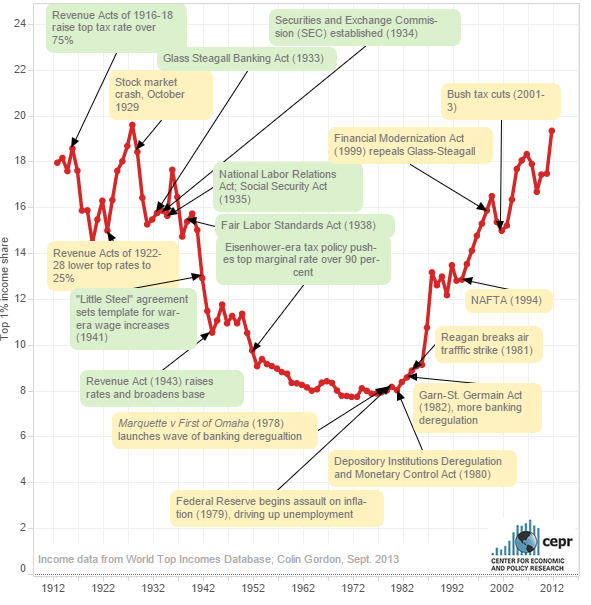
share of income top 1 percent
It is no coincidence that after World War II in 1945 all the way to 1980 was the time the US middle class thrived the most.  It was also a time when the top 1 percent were earning roughly 7 percent of all total income.  When you put more dollars into the hands of middle class Americans, that money will get spent.  However, aggregate the money into fewer hands and you see what we have today.  An army of struggling Americans while a smaller group is pushing up the price on luxury goods and in finance, is creating a new rentier class.
The Fed realizes how addicted Americans are to debt.  This headline speaks of 1984:
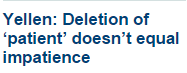
fed speak
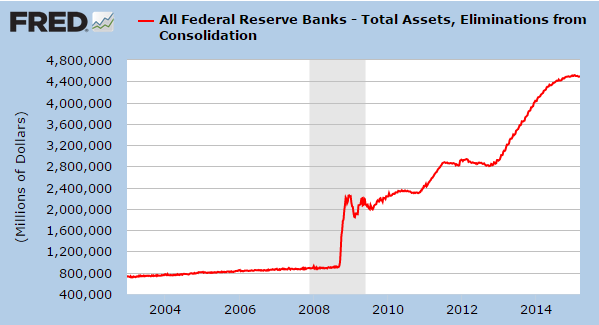
The markets of course responded positively to this.  It only adds to the confusion.  The Fed has kept rates in negative territory for many years now.  Those saying there is no inflation are failing to look in obvious places.  All you need to do is look at the Fed balance sheet and you realize there is no pulling back in this trend:
fed balance sheet
The Fed is playing the confidence card.  They are trying to sway markets with anticipation.  Like the man always telling his anxious girlfriend that “someday” in the future he will pop the question but never does.  Actions speak louder than words.  Look at the Fed balance sheet.  The balance sheet tells us the Fed is incredibly impatient in restoring balance and is doubling-down on this debt based rally.
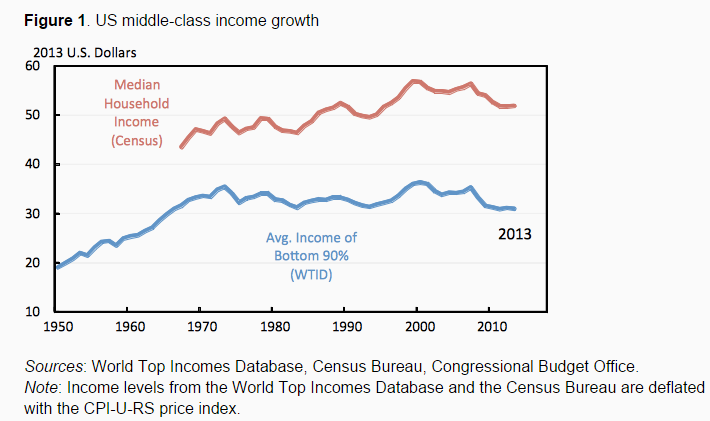
The middle class is falling behind:
middle class us
Incomes have gone stagnant for well over a decade for middle class families.  During this time, the share of income going to the top 1 percent has more than doubled.  Those with the ability to leverage debt or more importantly, create money by full on monetization are the power brokers in this system.  The Fed is out of tricks and is now resorting to doublespeak.  The public is left dealing with a trend of low wage jobs and is being pushed into utilizing debt to chase the artifacts of middle class life.  The market is severely under pricing the risk of too much debt once again.

Even Central Bankers Now Admit QE Doesn’t Work

Washington's Blog
January 21, 2015


Even As European Central Bank Is Set to Unleash a Massive Round of Quantitative Easing, Central Bank Heads Admit QE Doesn’t Work

The former head of the Bank of England – Mervyn King – said today that more QE will not help the economy:
We have had the biggest monetary stimulus that the world must have ever seen, and we still have not solved the problem of weak demand. The idea that monetary stimulus after six years … is the answer doesn’t seem (right) to me.
Also today, William White – the brilliant economist who called the 2008 crisis well ahead of time, who is head of the OECD’s Review Committee and former chief economist for BIS (the central banks’ central bank)  slammed QE:
QE is not going to help at all. Europe has far greater reliance than the US on small and medium-sized companies (SMEs) and they get their money from banks, not from the bond market.
***
Even after the stress tests the banks are still in ‘hunkering down mode’. They are not lending to small firms for a variety of reasons. The interest rate differential is still going up.
***
Mr White said QE is a disguised form of competitive devaluation. “The Japanese are now doing it as well but nobody can complain because the US started it,” he said.
“There is a significant risk that this is going to end badly because the Bank of Japan is funding 40pc of all government spending. This could end in high inflation, perhaps even hyperinflation.
“The emerging markets got on the bandwagon by resisting upward pressure on their currencies and building up enormous foreign exchange reserves. The wrinkle this time is that corporations in these countries – especially in Asia and Latin America – have borrowed $6 trillion in US dollars, often through offshore centres. That is going to create a huge currency mismatch problem as US rates rise and the dollar goes back up.”
***
He deplores the rush to QE as an “unthinking fashion”. Those who argue that the US and the UK are growing faster than Europe because they carried out QE early are confusing “correlation with causality”. The Anglo-Saxon pioneers have yet to pay the price. “It ain’t over until the fat lady sings. There are serious side-effects building up and we don’t know what will happen when they try to reverse what they have done.”
The painful irony is that central banks may have brought about exactly what they most feared by trying to keep growth buoyant at all costs, he argues, and not allowing productivity gains to drive down prices gently as occurred in episodes of the 19th century. “They have created so much debt that they may have turned a good deflation into a bad deflation after all.”
The former long-term head of the Federal Reserve (Alan Greenspan) says that QE has failed to help the economy.
Numerous academic studies confirm this. And see this.
Indeed, many high-level economists – including Federal Reserve economists and the main architect of Japan’s QE program – now say that QE may cause deflation and harms the economy in the long run.
Economists also note that QE helps the rich … but hurts the little guy. QE is one of the main causes ofinequality (and see this and this). And economists now admit that runaway inequality cripples the economy. So QE indirectly hurts the economy by fueling runaway inequality.
A high-level Federal Reserve official says QE is “the greatest backdoor Wall Street bailout of all time”. And the “Godfather” of Japan’s monetary policy admits that it “is a Ponzi game”.

When the housing market is owned by Fed banks: Federal Reserve went from holding zero in mortgage-backed securities to over $1.5 billion.

MyBudget360
February 16, 2014

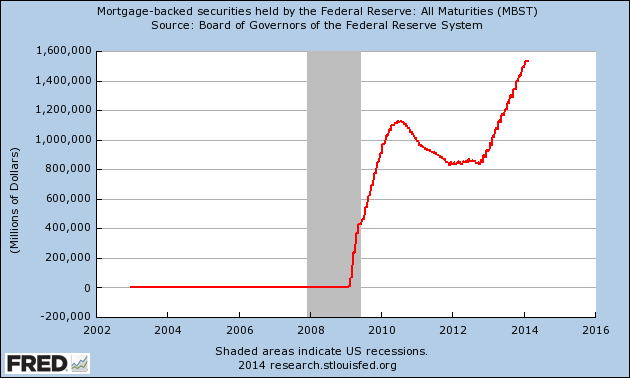
There are significant consequences with the Fed continuing on course with Quantitative Easing.  On paper, it may seem that all is fine on the home front.  However, many regular Americans are finding it harder to purchase a home in spite of a low interest rate environment.  The Fed has created perverse incentives where big banks are leveraging low rates to invest in single family homes.  This used to be a staple of asset growth for Americans but that is now waning.  American households are cash strapped and having a lower rate does very little if incomes are not growing.  Yet banks suddenly have a giant interest in being involved in the housing market.  Why stop at being satisfied with an inflated stock market?  The ability to access debt has been key to the re-inflation of this bubble.  If you look at the mortgage-backed securities (MBS) market you will clearly see that the Fed is now the major player in this segment of the market.
Fed is the housing market
Simply put, the Fed is the housing market.  They are driving the biggest asset class in America by their manipulation of interest rates but also the amount of MBS they own.  The results have been to increase the massive inequality in the nation.  Sure, most Americans don’t own stocks but housing was one area where most Americans did own.  And many Americans did not have to worry about competing with investors or big banks in their neighborhoods when trying to purchase a home.
The market, if we can even call it that, is now dominated by the Fed and big banks are using this crony system to buy up large pieces of American real estate.  Take a look at the growth of MBS on the Fed’s balance sheet:
mbs debt held by fed
The Fed went from owning zero in MBS all the way to the current $1.5 trillion.  The Fed is a massive portion of the market and is buying up nearly 100 percent of all issued MBS.  This has also caused massive volatility in the bond market.  Yet the end result is that homeownership overall is actually down for Americans because a large portion of the buying is going to Wall Street and big banks.
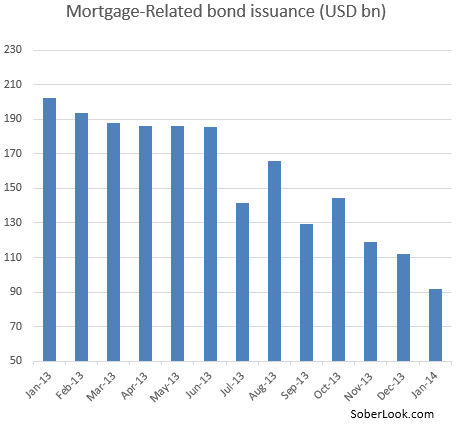
You can even see this on the private side with MBS issuances:
MBS
What need is there to grow this portion of the market if the Fed is dominating it so dramatically?  There is little incentive to make this more competitive when banks instead of helping American homeowners are actually buying up massive amounts of homes with the corporate financial welfare of the Fed.  Driving up prices with no subsequent growth in incomes is not a healthy policy.
Since the Fed has intervened we have seen roughly 30 percent of all home purchase going to investors:
“(NAR) All-cash sales comprised 32 percent of transactions in December, unchanged from November; they were 29 percent in December 2012. Individual investors, who account for many cash sales, purchased 21 percent of homes in December, up from 19 percent in November, but are unchanged from December 2012.”
This has created a new form of a Gilded Age society because inequality continues to rise and home prices rising with no real substantive growth in income is not useful.  What does it matter if a regular home buyer has access to a mortgage at a 4 percent interest rate when connected banks can leverage debt at close to zero percent?
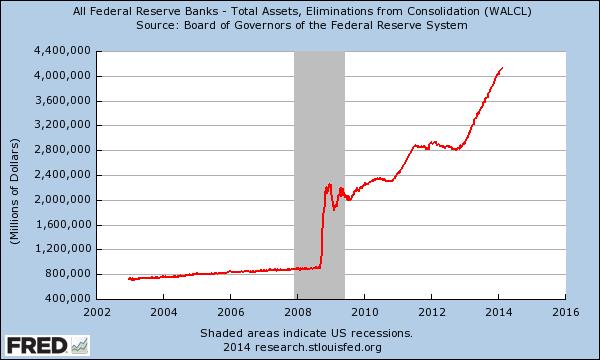
The Fed’s balance sheet continues to grow out of control because this entire market is built on access to cheap debt, debt that is largely going to a select few:
fed balance sheet
A drop in homeownership, massive investor buying, a re-inflation of the housing bubble.  Glad the Fed is looking out for regular Americans.

Comparing the inflated cost of living today from 1938 to 2013: How the US Dollar has lost incredible purchasing power since 1938.

MyBudget360
December 23, 2013

Money is only as useful as to what it can purchase.  The Fed has created a system where debt is now equal to money.  This is why big purchases like cars, housing, and even going to college are only feasible by mortgaging your future for many decades.  Since the payments are broken down into tiny monthly installments many people pay little attention to the true cost of things over their lifetime.  Yet over this time, the U.S. dollar has lost a tremendous amount of purchasing power due to inflation.  Inflation slowly eats away at your purchasing power yet having access to debt has given the middle class the false impression that they are still protected from the unraveling impacts of inflation.  Someone sent over a photo posted over on the popular Reddit website that shows the cost of living for people back in 1938.  You would think that people in 2013 would have more purchasing power than those living through the Great Depression.  Adjusting for inflation you would be surprised what has happened in the last 75 years.
The cost of living between 1938 and 2013
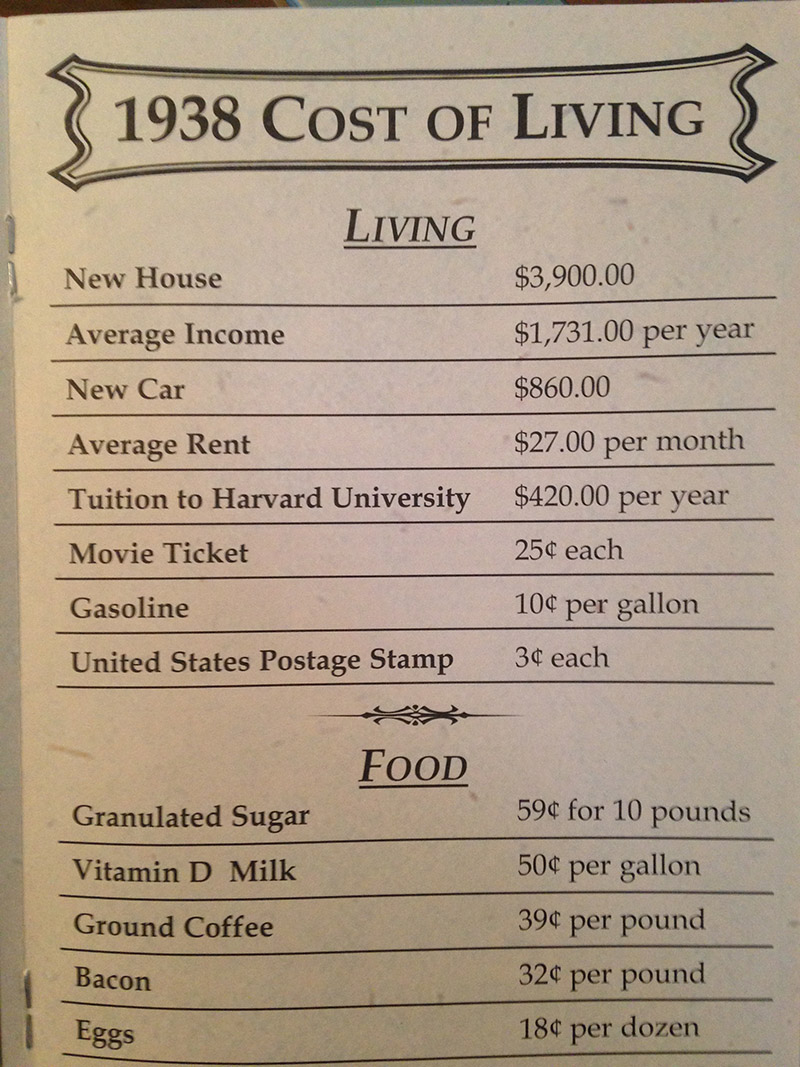
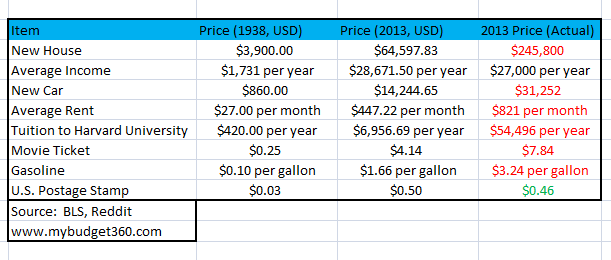
The picture in question has prices for living from 1938.  It includes important items like a new home, income, new car, rent, and extreme purchasing examples like tuition for Harvard:
cost of living
Source:  Reddit
You can normalize costs over time through adjusting for inflation.  Back in 1938 a new home cost about two times the annual average income.  A new car was only about one-third the cost of the annual average income.  These figures are important because back in 1938, using credit was only a small factor in purchasing goods.  The middle class didn’t start blossoming until after World War II so you would expect that things were still tough for regular households.  What we find though is that compared to the typical income, buying a new home or buying a car was relatively doable for most households.
Now adjusting all these figures for inflation shows how much more expensive things have become and how dependent we now are to financing purchases with debt (created by the banking system):
inflation and actual prices
This chart shows the impact of inflation and the declining purchasing power of the US dollar.  For example, a new home adjusting for inflation (using the BLS calculator) should cost around $64,597 per year.  The current cost of a new home?  $245,800.  The average income has stayed about the same normalizing for inflation (doesn’t say much since we are going back to the Great Depression here).  A new home today costs nearly 10 times the annual average income of a worker.  The two income trap has largely hidden this inflation since it now takes two households to accomplish what one income was able to do 75 years ago.  On top of that, people now need to go into massive debt just to purchase a home.  
Take a look at the cost of a new car as well.  In 1938 a worker was able to purchase a new car with one-third of their annual income.  Today a new car is more expensive than the annual average income.  This is why in 2013 one of the top growing consumer debt sectors was with automobile loans.  If things stayed the same, the cost of attending Harvard for one year in 2013 would be closer to $7,000 per year (the current tuition is $54,496 per year).  It isn’t only Harvard charging incredibly high tuition around the country.  Of course the higher education bubble is one of the most pressing issues around creating a $1.2 trillion student debt market.  
Rent, movie tickets, and even gasoline are much more expensive today adjusting for inflation.  This puts a heavier strain on the pocketbook of most Americans.  It also has created a dependency on debt.  We do have stronger safety nets so we don’t have the “in your face” poverty of the Great Depression.  Yet we still have close to 48 million Americans on food stamps.  The area that has seen prices become more affordable is with food.  This however is largely derived from better access to food and products and the mass production of this commodity.  Yet the bigger costs of living in housing, cars, rent, and going to college are all much more expensive today.  It may feel cheaper to some if they only look at their monthly debt payment but the true costs have increased.
The impact of a falling dollar
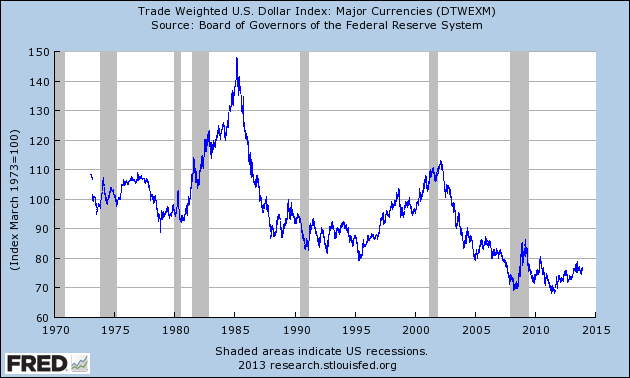
The trend of the US dollar is pretty clear since the Federal Reserve took the helm of the ship:
us dollar
Without a doubt, life has gotten better since 1938 in terms of healthcare, technology, cars, sanitation, and overall quality of life.  Yet this may be a false comparison argument assuming that this only came about because of the Fed.  Quality of life had already started improving before this as well via the Industrial Revolution and these things were happening regardless of the money system.  What this current debt based system has created is a massive increase in the price of goods through long-term financing.  Should people only have the ability to go to college if they assume mountains of debt?  For the average worker this may be the only road.
The US dollar even in the past few decades has taken a big hit:
us dollar
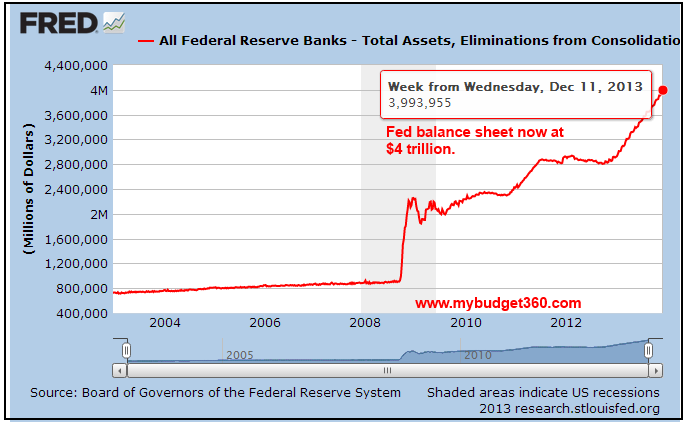
Why does it feel like things are more expensive?  Because they are.  You may not feel the impact of inflation in one year but over time, it has a dramatic and obvious effect.  The fact that the Fed now has $4 trillion on their balance sheet and continues this QE experiment reflects an addiction to easy debt.  The addiction now truly benefits a very small segment of our society and that is why inequality is worse today than it was in 1938.  It should tell you something where regular purchases from 1938 are now only feasible by going into massive debt.

Quantitative Easing has become heroine to the financial markets: Federal Reserve balance sheet hits $4 trillion this week.

MyBudget360
December 16, 2013

Addiction is never an easy battle to overcome.  This also applies to easy money addiction that is now part of the Quantitative Easing economy.  The Fed’s extraordinary measures are now appearing to be more permanent measures.  Every time the whispers of tapering are made the markets respond accordingly signifying that the stock market is fully addicted on easy money.  There is really no backing out of QE without some sort of pain.  Any addict pulling themselves away from a drug suffers some brief or long period of withdrawal.  Yet the long-term benefits are obvious.  In this case, the Fed is not only avoiding tapering but getting more aggressive in their QE heroine.  This week, the Fed’s balance sheet crossed the $4 trillion barrier.  Of course few people pay attention to the Fed’s balance sheet but the fact that the Fed has created a second housing mania fueled by investor money is startling.
QE forever
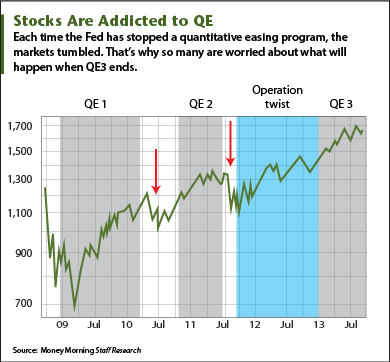
It is interesting that each time the hint of a taper was made the market responded by pulling back.  The markets are fully addicted to this low rate environment brought on by the Fed buying up long-term MBS on the cheap.  Who in the world would take on a 4 percent mortgage in this kind of market?  Apparently only the Fed.  So it is no surprise that the markets respond with pain each time the QE taper is announced:
When-QE-ends
Source:  Money Morning
It is fairly clear that pulling back on QE will have an impact on stocks. The entire financial edifice is now building off of the assumption that QE will last forever.  This has created deep distortions in wealth and has also created a secondary housing mania where big funds are rushing out to buy real assets with artificially low rates.
It is comical to hear that the Fed is tapering because looking at the Fed balance sheet we see absolutely no signs of any sort of tapering:
fed balance sheet
To the contrary, the Fed has become more aggressive in buying up MBS via their QE operations.  The Fed is now essentially the mortgage market.  In spite of this poor allocation of resources, wealth inequality in the US has only become more pronounced.  As we have highlighted before most Americans have very little invested in the stock market so the gains here are of little consequence to the vast majority.  Companies have used the economy to cut wages and also to slam employee benefits.  Behind the scenes however high level executives especially in the financial industry have used easy money handouts from the Fed to lever up once again in the real economy.
Don’t forget the debt
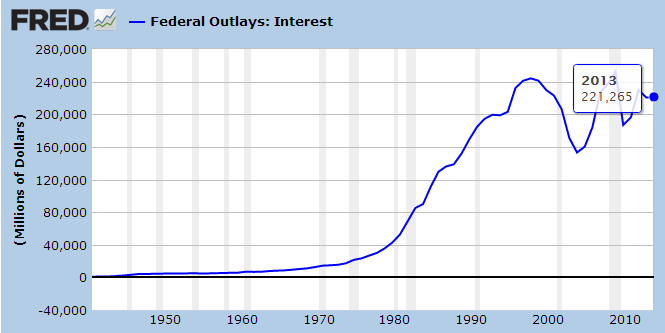
We are now paying a substantial sum in interest payments on our debt:
fed interest costs on debt
The only thing keeping things down is the low rate we are able to garner around the world.  The Fed is aware of this and realizes any sizeable moves in interest rates will cause a dramatic rise in interest payments on debt.  Better to inflate away our debt so long as we can find a market for this.  Yet that is the problem with QE since the Fed is essentially the only player.  There is virtually no market for 30 year mortgage rates at current price levels.  The market is fully addicted on QE.
Getting off QE heroine does not look like it will happen.  So why the constant discussions of tapering?  The Fed is a giant confidence game and many are starting to realize this.  Banks understand that any sort of unwind will impact the stock market so better to chase yields in real assets and crowd out regular households.  This is why inequality keeps getting worse in the US in spite of the stock market being near a record high.  The financial industry is fully addicted to this QE heroine and will say anything to keep their pusher providing this easy money.  $4 trillion will not be the only milestone that is crossed even though the taper is always being mentioned.

The real winners from Quantitative Easing

SIC SEMPER TYRANNIS!!!
Mark Matheny
November 22, 2013

Mark Matheny discusses the real winners of Quantitative easing.
Tune in!


Risk of Global Financial Freeze-up Rising

August Forecast & Review
November 15, 2013

If you thought it couldn’t happen again, get ready: A new global finan­cial freeze-up could be straight ahead.
It’s too bad that eco­nomics, trade, finance, etc., are such boring topics to most people. Well, they actu­ally are boring because they are hard to under­stand, fraught with erro­neous data, and dif­fi­cult to relate to per­sonal circumstances.
By neces­sity, most Amer­i­cans are con­cerned with their own crit­ical prob­lems, like paying the mort­gage, keeping their job and holding their fam­i­lies together. That’s under­stand­able. In spite of the rosy spin on eco­nomic data, the middle class con­tinues to get squashed.
In Jan­uary 2013, 23,087,866 house­holds received food stamps. That’s 889,154 more house­holds than Jan­uary 2012. Given that there are some 115,310,000 house­holds in the U.S., it means that a full 20 per­cent of America cannot ade­quately feed itself.
lfpr
The above chart shows the Labor Force Par­tic­i­pa­tion Rate (LFPR) since 2000, when the baby-boomer demo­graphic dynamic kicked in. The red line is simply the demo­graphic ele­ment, while the blue line is the actual par­tic­i­pa­tion rate. Since 2000, the actual rate has declined from 67.3 per­cent to 63.3 and since the reces­sion, has sig­nif­i­cantly plunged below the “norm.” The LFTR has fallen back to a level not seen since 1980.
What­ever the reason might be for someone who leaves the work­force (retire­ment, gave up looking, dis­ability) the fact is that since the reces­sion, there has been no real employ­ment recovery, and things con­tinue to get worse, not better.
Not unex­pect­edly, the increase in food stamp recip­i­ents just about matches employ­ment dropouts. If this is the case, then there are a mul­ti­tude of other sta­tis­tics that would follow along: Med­ical pay­ments, unem­ploy­ment, wel­fare pay­ments, etc.
What­ever fragile uptick in eco­nomic activity that might have occurred in the last 24 months, it hasn’t been been enough to reverse the dete­ri­o­ra­tion of the middle class and the swelling of those on poverty roles.
America is not iso­lated in this expe­ri­ence. Europe, China, Aus­tralia, India, Brazil, Japan, etc., are gen­er­ally worse off than we are. Ambrose Evans-Pritchard writes in The Tele­graph (UK):
The closely-watched ISM index of US fac­to­ries tum­bled through the “boom-bust line” of 50 to 49, far below expec­ta­tions. It is the lowest since the depths of the crisis in mid-2009 and a clear sign that US budget cuts are starting to squeeze the economy. New orders plunged 3.5 to 48.8 on weak for­eign demand and reduced fed­eral contracts.
The news came hours after HSBC said its index for China also fell below 50, a major inflexion point for the world’s indus­trial workshop.
“This is not a good moment for the world economy,” said David Bloom, cur­rency chief at HSBC. “The man­u­fac­turing indices came in weaker than expected in China, Korea, India and Russia, and then we got America’s ISM.
“We thought we had a clear pic­ture that the US was recov­ering, Japan was printing money and were we’re back to happy days, and now sud­denly a huge spanner [wrench] has been thrown in the works.”
On June 2, Bloomberg reported that “Global Inter­bank Lending Falls to Record Low, BIS Reports.” The fra­ternal global banking com­mu­nity is har­boring a mutual dis­trust as they wonder who will implode and leave them with huge losses. It’s get­ting pro­gres­sively worse as cur­rency and interest rate wars heat up. The liq­uidity crisis of 2007 – 2008 was caused by the same type of dis­trust, when banks refused to lend to each other.
Liq­uidity in the global finan­cial system is like oil to a car engine: If it drains out, the engine will freeze up and burn. With eco­nomic malaise infecting the entire global economy, the entire engine of the global economy is at risk of seizing up, which could push the entire system into deep reces­sion or even depression.
Adding to the strain is the sharp rise in interest rates on a global basis, and espe­cially in the U.S. The Fed’s policy of lower interest rates is being tor­pe­doed by market forces, putting it at risk for huge port­folio losses. Why? because all of its Quan­ti­ta­tive Easing pro­gram involves pur­chasing and holding Trea­sury bonds, bills, notes and mortgage-backed secu­ri­ties, in return for which the Trea­sury received cash. When rates go up, the value of bonds declines. As of June 5, 2013, the Fed’s com­bined bal­ance sheet was valued at $3.43 trillion.
Here’s the dilemma: The Fed is trapped. If it were to stop pur­chasing addi­tional Trea­sury oblig­a­tions, then QE would be offi­cially over and the mar­kets would crash. If it con­tinues its pur­chasing pro­gram and swells its bal­ance sheet, it is guar­an­teeing itself even more future losses. If it were to sell any por­tion of its port­folio, it would suck liq­uidity (cash) out of the banking system and cause the mar­kets to crash even harder.
The global banks are in a sim­ilar dilemma since they are also hold huge amounts of gov­ern­ment debt that will decline in value as rates rise. Banks have ignored this risk since the last finan­cial crisis of 2007 – 2008, but it will bite them hard this time around. If major banks start dumping their bonds into the open market, it will risk causing a panic sell-off with other bond owners.
Those policy-makers who think that we will “grow our way out” of this will soon come face to face with the hard data of reces­sion – there isn’t going to be any growth! To the con­trary, the global economy is con­tracting. Any fur­ther decrease in liq­uidity, for what­ever reason, may well cause another “Lehman Brothers moment” where the whole finan­cial system simply freezes up.

Central Bankers Prepare to Flood the World with More Funny Money

The New American
November 1, 2013
Central Bankers Prepare to Flood the World with More Funny Money
Recent comments by the head of the Bank of England, the U.K.’s powerful central bank, offered further evidence that Western central bankers are preparing to shower even greater quantities of fiat currency on private banks and financial institutions — all at public expense. Already, tens of trillions of dollars’ worth of debt-based currency has been created out of thin air by the Federal Reserve, the BoE, the European Central Bank, and other central banks to prop up private mega-banks and wild spending sprees by government amid the economic crisis. With help and guidance from the BoE’s new governor, Mark Carney, analysts say all of that appears set to accelerate.

Charged with conjuring currency into existence at interest and centrally planning broad swaths of the economy, the controversial British monetary-policy institution is currently overhauling its policies to make it even easier for banks to tap the people’s wealth on demand. BoE boss Carney, a Goldman Sachs veteran from Canada with impeccable establishment credentials who has vowed to keep interest rates at rock bottom, announced some of the radical reforms during what was described in media reports as his first major speech on British financial regulation.  

Among other changes, the central banker said that the BoE would start accepting lower-grade collateral from banks in exchange for fiat-currency loans. In other words, after Western central banks already came under fire for such wealth-redistribution schemesthroughout the most recent financial crisis, the BoE will soon allow lenders seeking cash to unload even more dubious assets on the public. “None of this means financial institutions are excused from the need to manage their balance sheets prudently,” Carney claimed, denying that he was serving as a “cheerleader” for big banks.  

Destroying the U.S. Economy: A Prelude to World Government

SIC SEMPER TYRANNIS!!!
Mark Matheny
October 30, 2013


Mark Matheny discusses the systematic destruction of the middle class in the United States, as Maurice Strong stated, being necessary for World Government to take shape.....
 Tune in....


Peter Schiff: Fed Will Do The Opposite Of Tapering - More Money Printing!

The Street
Bussiness News Network
October 27, 2013


Source

Peter Schiff appeared on BNN to discuss the Fed's plan to keep printing money....

Hiding Inflation: Paying more -Getting Less

SIC SEMPER TYRANNIS!!!
Mark Matheny
June 24, 2013

Have you noticed the size of the packages at your local food store lately? In order for companies to hide the effects of inflation (the printing and adding of money into the supply of money), companies are simply reducing the amount of ounces given, and still charging the same price. This hides the price increase of the product, which is really just due to the fact that the Dollar is being destroyed through the printing press that runs day and night at the Federal Reserve........


This from Dallas News:


While some people may believe printing money is creating wealth for free, it is not. Somebody has to pay.
To deny that “would imply revenues could be raised for free, which would imply that wealth could be created by printing more money,” Grice said. If someone were to just drop dollars from a helicopter, those closest to the helicopter would feel richer.
They would take the money and buy more goods and services, which would in turn increase demand for those goods and services and result in higher prices. In other words, those farthest from the helicopter would pay the price through reduced spending power.
Eventually, the money dropped from the Federal Reserve into the financial system will push up the prices for the goods and services we all need. Those closest to the money — banks, financiers and hedge fund managers — feel richer, but the rest of us wouldn’t because we eventually will have to pay for it with higher prices.
“Impoverishing a group in such an opaque, clandestine and underhanded way … is not only unjust but dangerous and potentially destructive,” Grice writes. -  March 31, 2013

Libertarianism 101:Taxation + Money Creation = Legalized Robbery

SIC SEMPER TYRANNIS!!!
Mark Matheny
June 2, 2013

1+1=2
and
Taxation +Money Creation=Legalized robbery.

So says  Dutch libertarian leader Toine Manders, in an interview on RT.


So what did the Founding Fathers of the United States think of  taxation?

This from (Before It's News)
During the framing of the Constitution, the founding fathers quarreled over many issues. The issue of taxation was no different. The two main schools of thought, in regards to taxation, resided between Federalists and anti-Federalist parties. Federalists pushed for national authority over the power to tax, in addition to state proposals. Anti-Federalists objected to federal authority to tax, feeling the power would be illiberally abused.[1] There were, however, issues in which the majority of the founding fathers agreed upon. Contrary to today’s popular beliefs, many of the founding fathers believed the poor should be taxed at a higher rate, in an attempt to motivate them to work thus propelling them out of their poverty.  Also conflicting with modern beliefs, they felt those who worked should be taxed less heavily so as to remunerate them for their endeavors: “To take from one, because it is thought that his own industry and that of his fathers has acquired too much, in order to spare to others, who, or whose fathers have not exercised equal industry and skill, is to violate arbitrarily the first principle of association.”[2] These views are found in the founding fathers private papers as well as delineated throughout the Constitution. 
As previously mentioned, the amount of power in which the Federal Government should be granted regarding taxes, was a major altercation amid Federalist and anti-Federalist parties. To further explain these viewpoints, however, one must first understand the difference between external and internal taxation.  An external tax was a duty on any item which was being shipped to a specific colony or state. The tax would be originally paid by the shipper, but then imposed unto the item itself. This is known in present day terms as a tariff. An internal tax, however, was a tax which was imposed directly upon an item, such as a sales tax. The anti-Federalists made a clear distinction between these two types of taxes, which they argued the Federalists grouped into one category. Richard Henry Lee, a renowned anti-Federalist, argued that external taxes were safe because their abuses were minimal and bounded. In regards to internal taxation, he felt the national government would gradually shift tax policy in order to favor their personal prosperity.[3] He explained: “…the power would be improperly lodged in congress, and that it might be abused by imprudent and designing men.”  Lee also questioned the authority of those in power, and made arguments for the power to be left with the people.  “Why give the power to the few, who, when possessed of it, may have address enough to prevent the increase of representation? Why not keep the power, and, when necessary, amend the constitution”[4]
The Federalists tried the best they could to compromise on the issues being voiced at the time. Alexander Hamilton directly addressed the issue in the New York Packet writing:“There is a simple point of view in which this [tax dispute] may be placed that must be altogether satisfactory. The national legislature can make use of the system of each state within that state. The method of laying and collecting taxes in each State can, in all its parts, be adopted and employed by the federal government.”[5]
Hamilton felt the power should reside in the Federal Government first, and then distributed throughout each state. Lee on the other hand, believed the power should reside in the state first, and maintained by the government. The preeminent argument of the Federalists remained in the belief that one could have a ‘rule of the people’ through representation of the government. Alexander Hamilton argued: “whether the representation of the people be more or less numerous, it will consist almost entirely of proprietors of land, of merchants, and of members of the learned professions, who will truly represent all those different interests and views.”  While authority cannot reside directly in the hands of each individual, he believed that within a state, but both the state and the individual are indirectly granted power by means of representation. 
            In regards to the amount which one should be taxed, Federalists, those in between, and even some anti-Federalists all thought the like. If those who were out of work are taxed a low amount, they would feel only a small need to try and get a job. If the taxes were higher, ample enough to cause burdensome upon the individual, they would need to find work in order to survive. This was the view of Thomas Jefferson, James Madison, George Washington, John Adams, and Benjamin Franklin alike.  While this seems an extreme position to take, Benjamin Franklin argues: I am for doing good to the poor, but I differ in opinion of the means. — I think the best way of doing good to the poor, is not making them easy in poverty, but leading or driving them out of it. In my youth I travelled much, and I observed in different countries, that the more public provisions were made for the poor, the less they provided for themselves, and of course became poorer. And, on the contrary, the less was done for them, the more they did for themselves, and became richer.[6] 
While the poor would clearly object to higher taxes, Franklin argues that those poor who have harder initial burdens, do better on average verses those having money given to them or deducted from payments by a higher authority. Thus, clearly objecting to tax cuts and extreme national help on low-income families. 
            When it came down to the specific arguments that were made, Federalist and anti-Federalists parties were not in disagreement of national verses no national authority. Rather, what and how much power should be given to the national authority in order to assure it would not be abused nor mistreated. Internal Taxes were one of the issues which the anti-Federalists felt would be abused. Although their opinions were different, the Founding Fathers were able to work together and compromise on the issue of taxation. As can be seen by the wording of the Constitution, which addresses the needs of both parties: “The Congress shall have Power to lay and collect Taxes, Duties, Imposts and Excises…Representatives and direct taxes shall be apportioned among the several States which may be included within this Union, according to their respective numbers”[7]

 What did the Founding Fathers of the United States think of  money creation?


NEW YORK–If a time machine whisked Americas Founding Fathers from Philadelphia on July 4, 1776 to Washington, D.C.’s Bureau of Engraving and Printing on Independence Day, 2011, what might they think? Watching high-speed presses spew giant sheets of greenbacks would dazzle the eyes of even Benjamin Franklin, a professional printer. Beyond that, though, they would be disgusted.They would be appalled, says Dr. Judy Shelton, Ph.D, co-director of the Sound Money Project at the Atlas Economic Research Foundation, with which I am a Senior Fellow. The integrity of the dollar has been utterly compromised by fiscal malfeasance, Shelton adds. Monetary policy has become the default mechanism for budgetary irresponsibility.Shelton echoes the Framers words:As George Washington wrote Thomas Jefferson on August 1, 1786, Paper money has had the effect in your state that it will ever have, to ruin commerce, oppress the honest, and open the door to every species of fraud and injustice.Paper is poverty, Jefferson, in turn, observed in 1788. It is only the ghost of money, and not money itself. In 1817, the author of the Declaration of Independence wrote that paper moneys abuses also are inevitable and, by breaking up the measure of value, make a lottery of all private property.Paper money is unjust, declared James Madison, chief architect of the Constitution. It is unconstitutional, for it affects the rights of property as much as taking away equal value in land.The Founders recognized the perils of legal-tender paper money, which coerces people to accept something that may be inherently worthless   as is the case with our paper money today, says Dr. Lawrence M. Parks, Ph.D., executive director of the Foundation for the Advancement of Monetary Education (FAME) in New York City.Why did the men who launched this nation disdain paper money? They had watched British-colonial governments debauch their currencies and, consequently, impoverish their citizens including some Founders.During the American Revolution, Virginia also issued paper money. Its unbearable lightness eventually made Madison and Washington wince as their tenants paid for leased land with worthless currency. For his part, Virginia’s devaluation left Jefferson on the losing end of a large bond transaction. He then lived impecuniously and died broke.Jefferson’s experience with fiat currency surely influenced his views. If we determine that a Dollar shall be our Unit, he wrote in 1784, we must then say with precision what a Dollar is. Indeed, the Coinage Act of 1792 declared each dollar worth 371.25 grains of pure silver or 24.75 grains of pure gold.For 179 years, the dollar and gold remained linked. But on August 15, 1971, President Richard Milhous Nixon ordered the Treasury to suspend temporarily the dollar-gold connection. Since then, Washington has created cash as easily as saying, Shazzam! The M3 money-supply measure soared from $688.4 billion in 1971 to $10.3 trillion in March 13, 2006, whereupon the Fed suddenly stopped publishing these inconvenient truths. This loose cash has helped Washington boost the national debt, from $398.13 billion in 1971 to $14.34 trillion today. The dollars purchasing power has slid, meanwhile, even as gold has climbed from $35 per ounce in 1971 to $1,511 on Thursday.Federal Reserve Chairman Ben Bernanke once marveled at the Feds nearly supernatural powers. It has a technology called a printing press (or, today) its electronic equivalent) that allows it to produce as many U.S. dollars as it wishes at essentially no cost.From his lair high above Manhattans Midtown East, FAMEs Dr. Lawrence M. Parks monitors all of this with a single-mindedness that skirts obsession. As the repercussions of letting politicians invent money simmer in Washington and boil in Athens, Parks sees the path to economic sanity as clearly in 2011 as the Founders did in 1776.All we need to do is reassert the monetary powers and disabilities of the Constitution, Dr. Parks says, which require that America re-monetize gold and silver as money.

The Fed's Advisory Council Admits We're Hit!!!! - Like a Soup Sandwich!!!

SIC SEMPER TYRANNIS!!!
Mark Matheny
June 1, 2013

Peter Schiff explains how the so-called "recovery" being pushed by the administration, through the media is really just an illusion.


Schiff Report

A rise in the stock market gives Americans the illusion that recovery is here, but printing money by the Fed does not constitute a healthy recovery in the real sense of the word.

Real data is showing a weakening in the U.S. economy.

The Federal Advisory Council published a report stating essentially that the Fed's monetary policy has not been effective, and that it has only inflated asset bubbles that have given the illusion of a healthy and recovering economy. Once the money printing stops, it will bring on disaster.

So basically folks - WE'RE HIT!!! LIKE A SOUP SANDWICH!!!

Why inflation matters: How the Fed is creating real estate inflation and hiding behind inflation data to continue their expansionary ways. OER and Case Shiller divergence.

Mybudget360
May 28, 2013


Inflation matters.  It matters a lot.  Contrary to what you may hear in the mainstream press the Federal Reservehas done everything to stoke the fires of inflation.  The reasons for this include creating asset inflation that is understated in CPI data and also setting up a system where consumption is almost forced upon consumers.  How so?  With negative interest rates consumers are losing money by simply having their money in a savings account.  Even a modest rate of inflation will erode purchasing power when banks are paying zero percent on your hard earned deposits.  Yet this is all part of the design.  Inflation matters because it does encourage spending.  You want to spend today given that your current dollars will lose value tomorrow.  The Fed likes inflation so much that it has reignited the housing market once again while it has expanded its balance sheet to over $3.3 trillion.  Inflation absolutely matters.
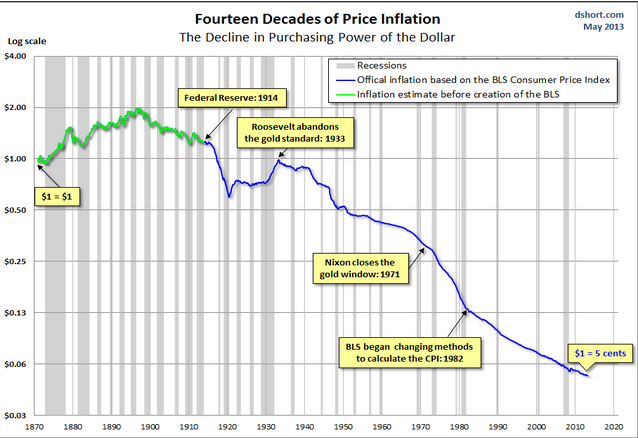
 A brief history of inflation on the dollar
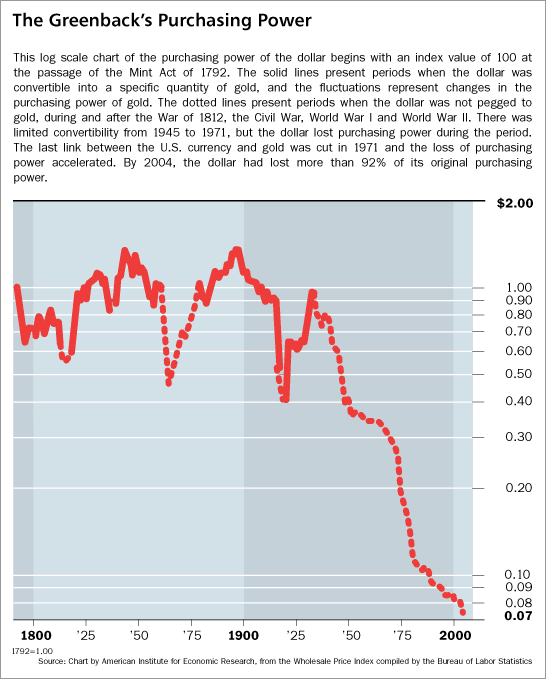
What is interesting is the US dollar held steady for nearly 60 years between 1870 and 1933:
inflation on prices
Once the gold standard was abandoned, the US dollar has been on a steady decline since the 1930s.  It is an interesting trajectory including the era when Nixon closed the gold window.  We are merely making an observation of the data here.  Without a doubt the US dollar has lost its purchasing power over the decades.  This matters because it has also had a major impact on wages and the standard of living especially for the US middle class.
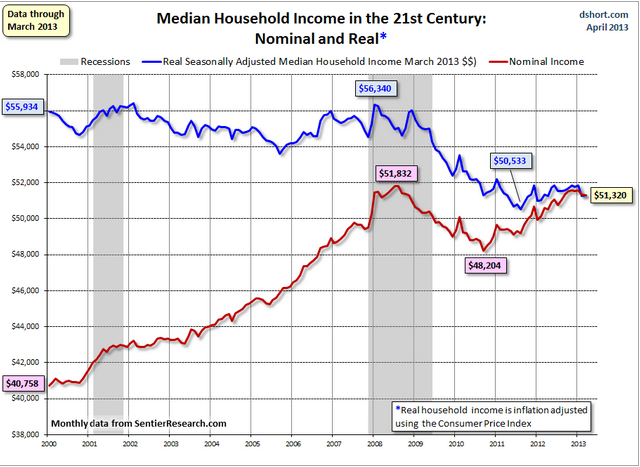
Adjusting for inflation household wages are back to levels last seen in 1995:
inflation adjusted income
This matters because gas is no longer $1 a gallon and no longer can you work part-time at a minimum wage job and put yourself through college.  Those days are gone.  The cost of living for most Americans has gotten more expensive.  We found out this week that home values are increasing at their fastest pace since 2006.  The annual increase in prices is over 10 percent.  Of course much of this is not coming from wage growth and this should be obvious because of the previous chart.  This is largely coming from the actions being taken on by the Fed which is funneling trillions of dollars into the housing market via negative rates and encouraging the financial sector to speculate once again in housing.
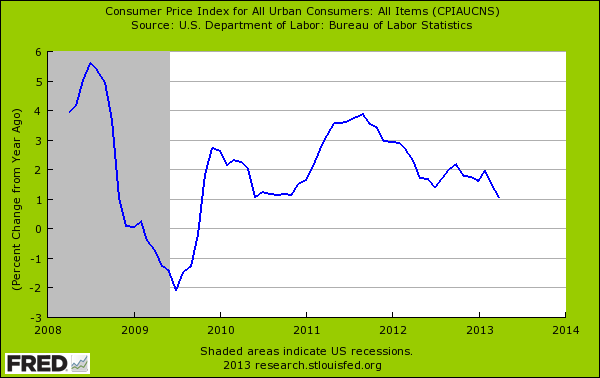
The Fed which relies heavily on CPI data is likely to continue on this road given that inflation as measured by this metric is looking rather timid:
cpi
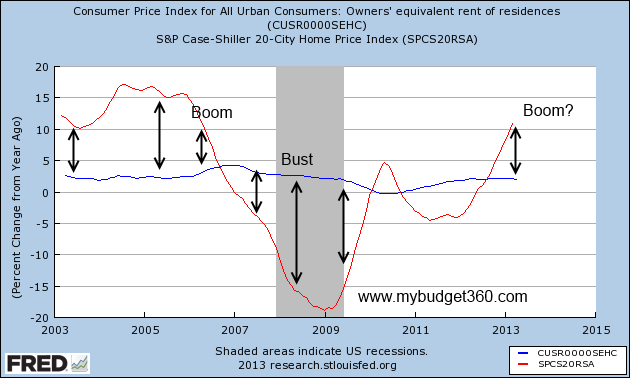
According to the latest data the annual change in inflation is only moving at 1 percent.  But if housing is the biggest line item for Americans and just went up by 10 percent, why is this not reflected in the CPI?  Once again we run into the problem of the CPI using the owners’ equivalent of rent (OER) measure.  This measure missed the last housing bubble and is going to miss it once again.
Just to exemplify how poorly a job OER does on measuring price changes in the housing market let us examine annual changes of OER versus those in the Case Shiller Index:
oer and case shiller
As you would expect, rents are fairly stable over time since they reflect the actual ability of someone to pay out of net income.  Yet home values can be manipulated by the Fed by the tweaking of interest rates to make housing payments more affordable yet home prices more expensive.  Or in this case, a flurry of investors from Wall Street buying up rentals.  At the end of the day, you are paying more for less.
Inflation absolutely matters and you need to know where to look to see these changes.  The fact that the Fed is pushing on the housing angle again yet is ignoring the divergence between OER and the Case Shiller is troubling.  The lessons should be clear and housing is the biggest expense for Americans.  They fully understand this and continue to stoke thefires of inflation.