Showing posts with label inflation. Show all posts

Venezuela’s Socialist Hyperinflation Turned People Back To Barter System

Mac Slavo
SHTFplan.com
July 12, 2018

In the wake of socialist Venezuela’s massive hyperinflation, citizens have returned to the original monetary system in order to survive.  The barter system is now prevalent in the collapsed economy of the authoritarian dictator, Nicolas Maduro.
Barter is one of the best ways to trade goods, considering its almost impossible to tax those transactions and since money in Venezuela is as difficult to come by as food and medicine, that’s now the preferred method of trading goods and services. Women in Venezuela have been turning to prostitution and asking for payment in food instead of cash for a while now, and as the regime tightens its grip on the private sector, more will have to turn to trade to survive.
Once the richest country of Latin America, Venezuela, which sits on world’s largest oil reserves, now has a bleak future. People in this oil-rich country are scrambling for money, food and basic necessities. They have taken to swapping different items and even doing chores in exchange for packages of flour, rice, and cooking oil.
“There is no cash here, only barter,” said Mileidy Lovera, who is a 30-year-old mother of four. Lovera spoke with Economic Times while hoping to trade a cooler of fish that her husband had caught for food to feed her children or medicine for her son who has epilepsy.
Venezuela has experienced the death of cash. Payment for even the cheapest of goods and services would require unwieldy piles of banknotes or fiat currency, and there simply are not enough of those in circulation.  While wealthy formal businesses in cities can get by on bank transfers and debit cards, such operations are largely out of the question in rural areas.
The economic collapse, which began under socialist President Nicolas Maduro’s government, has driven nearly one million people to migrate to other places in search of food, medicine, or other basic life necessities. Others have stayed and fight each other with machetes for some “quality garbage” that is thrown out.
Economists have even begun placing the blame on the current government – a socialist regime which actually leans more towards communism (and the two are almost the same thing anyway). Many economists say the central bank has not printed bills fast enough to keep up with inflation, which according to the opposition-run congress, reached an annual rate of almost 25,000 percent in May.  “It’s a very primitive payment system but it’s also very primitive for a country not to have enough cash available,” said Luis Vicente Leon, an economist.

Our Economic Protector: The Penny

SIC SEMPER TYRANNIS!!! News
January 24, 2016
Yahshua Matheny
The penny has a critical role as an economic vanguard against inflation.

We've all been through it: fumbling around with pennies when your cart costs one last cent or slightly more. Most of us have resigned to simply telling the cashier to "keep the change" whenever the price point doesn't end in a neat zero or five. Escalating the matter even further, some have been calling for the U.S. to drop the penny from mint, just as Canada did in 2013. However, despite the initial benefits retiring the penny would seemingly give, there is substantial evidence against this change of economic policy. For everyone interested in a strong economy, the answer is simple: the United States should not get rid of the penny.

The penny has a critical role as an economic vanguard against inflation. According to the Scholastic article,"Should the U.S. get rid of the penny?" the price of minting a penny now costs "almost two cents to make one." This means that inflating the penny via increased minting of the coin would be much more difficult financially than, say, minting a coin with a lower cost to ratio, like the dime or quarter. The cost prevents mass minting and therefore resulting inflation that also brings economic havoc, as seen in the inflation of the German Reichsmark after World War I. In order to pay war reparations from the Treaty of Versailles, the Mark was printed in massive quantities, devaluing it greatly. Wheel barrels of Marks would only afford a single loaf of bread. In order to avoid such an economic crisis in the United States, a stable currency without a potential ro be inflated is needed. Therefore, the penny should be kept.

Another benefit of keeping the penny would be the avoidance of rising prices caused by losing the coin. Without pennies, stores would have to round up to the nearest 5 or 0 cent mark in order to support customers paying in cash and coins. This could have an impact on consumers. According to Forbes, research suggests that consumers could spend an additional $600 million a year if the penny was dropped out of mint. This could severely hurt families, as the collective ride of prices would begin to take a toll on budgets. The penny, along with the nickel, is the last line of defense against a devestating price increases such as the one described.In today's economy, losing such a valuable advantage would, and could, be disastrous nationwide.

One of the most potent aftereffects from dropping the penny would be a rise in government spending, something that is already a catastrophic problem today. According to Forbes, an economic study, found that the resulting inflation from dropping the penny could result in an extra $1 Billion in federal spending. With government spending already at ** $3.5 Trillion and a deficit at $486 Billion, another billion to the pile might not sound like much, but it is still impactful. Getting another billion deeper into the deficit is not a productive economic outlook, especially if it is easily avoidable. Thusly, keeping the penny is what anyone seeking to reduce federal spending would desire.

The common, popular, and main talking point in favor of ridding the penny is the aforementioned production to value ratio described earlier. Since pennies cost more to mint than they are worth, cutting them out of production would save the government money, reducing federal spending, as the anti-penny argument goes. However, as illustrated above, retiring the penny would simply encourage inflation, raise prices, and as a result, increase government spending. Introducing such a slew of economic problems based upon a flimsy preposition would be a recipe for financial misconduct. Any economic gain that would result from getting rid of the penny would be near - immediately countermanded by the effects.

Aside from cutting down on the annoying penny hassling, getting rid of the coin would just cause more problems than it is worth, quite literally. Seeing even more inflation added to our current economic status, along with higher prices from rounding up, and lastly, government spending increasing by another billion, is just unwise to needlessly cause. If we just decide to keep the penny, not only will we prevent such financial troubles, but we'll also save ourselves the extra costs on both a local and nationwide level.

Who doesn't want to keep more change in their pocket?

***

**Federal Spending by the Numbers, 2014

Yahshua Matheny is 14 years old, and likes studying economics, history and politics. He is a contributor to SIC SEMPER TYRANNIS!!! News.

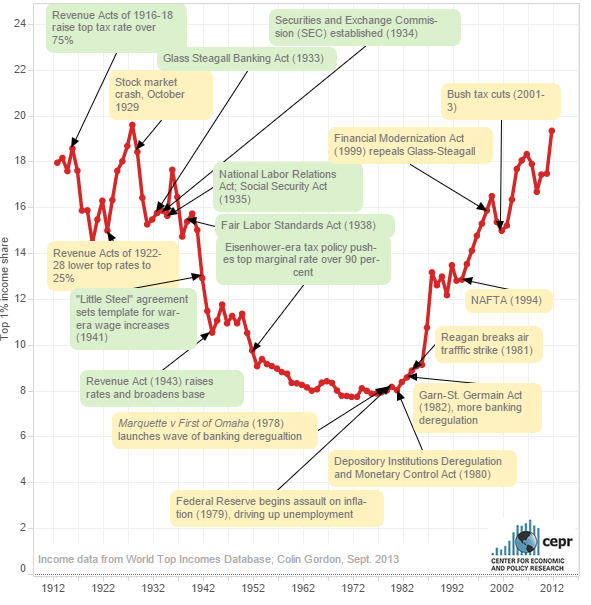
Fed doublespeak and the dismantling of the middle class: Fed states dropping “patient” word doesn’t mean it is impatient on rates. In 1970 roughly 7 percent of all income was earned by the top 1 percent. Today it is closer to 20 percent.

MyBudget360
March 18, 2015

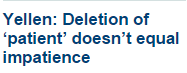
The Fed has taken a page out of George Orwell’s 1984.  Doublespeak is all the rage and the Fed’s statements are analyzed as if sifting for gold.  Even when they don’t do anything markets jump.  The Fed sets the tone on our debt addiction.  The Fed dropped the word “patient” in terms of increasing interest rates but then goes on to say this doesn’t mean that it will be impatient.  Say what?  The Fed hints at tapering and balks because it claims there is “low inflation” but when we look at real inflation, the price of many items is shooting up dramatically.  Many of these items were staples of the middle class including an affordable college education, a home, and being able to earn a good wage.  Back in 1975 roughly 7 percent of all income earned went to the top 1 percent.  Today it is closer to 20 percent.  The last time it was this high was during the years prior to the Great Depression.
Share of income
The middle class is being dismantled by economic forces.  More Americans find that they are working in the low wage economythat is booming.  For most households income does matter because this is how you finance your life.  The Fed has created a system where savers are punished.  Negative interest rates punish traditional savings.  It makes stocks, junk bonds, and other speculative items seem more lucrative.  Those that take on big levels of debt are encouraged.  So it is no surprise then that all items financed by debt are suddenly going up in price: housing (mortgages), college (student debt), and cars (auto debt).  Yet the larger gains are not trickling down to workers.
Take a look at this chart showing the share of income earned by the top 1 percent:
share of income top 1 percent
It is no coincidence that after World War II in 1945 all the way to 1980 was the time the US middle class thrived the most.  It was also a time when the top 1 percent were earning roughly 7 percent of all total income.  When you put more dollars into the hands of middle class Americans, that money will get spent.  However, aggregate the money into fewer hands and you see what we have today.  An army of struggling Americans while a smaller group is pushing up the price on luxury goods and in finance, is creating a new rentier class.
The Fed realizes how addicted Americans are to debt.  This headline speaks of 1984:
fed speak
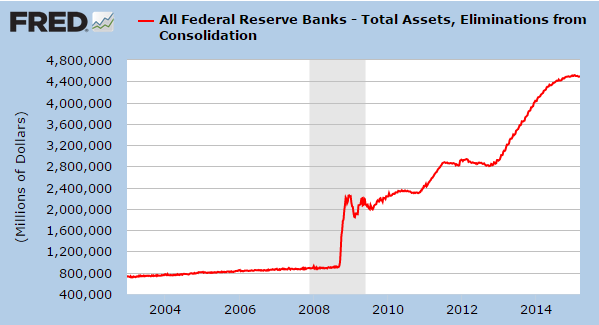
The markets of course responded positively to this.  It only adds to the confusion.  The Fed has kept rates in negative territory for many years now.  Those saying there is no inflation are failing to look in obvious places.  All you need to do is look at the Fed balance sheet and you realize there is no pulling back in this trend:
fed balance sheet
The Fed is playing the confidence card.  They are trying to sway markets with anticipation.  Like the man always telling his anxious girlfriend that “someday” in the future he will pop the question but never does.  Actions speak louder than words.  Look at the Fed balance sheet.  The balance sheet tells us the Fed is incredibly impatient in restoring balance and is doubling-down on this debt based rally.
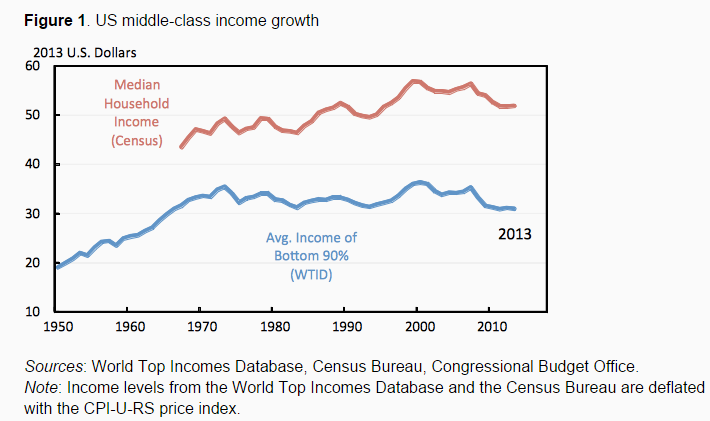
The middle class is falling behind:
middle class us
Incomes have gone stagnant for well over a decade for middle class families.  During this time, the share of income going to the top 1 percent has more than doubled.  Those with the ability to leverage debt or more importantly, create money by full on monetization are the power brokers in this system.  The Fed is out of tricks and is now resorting to doublespeak.  The public is left dealing with a trend of low wage jobs and is being pushed into utilizing debt to chase the artifacts of middle class life.  The market is severely under pricing the risk of too much debt once again.

The long inflation con on the public: How the CPI severely underreports inflation and the slow erosion in the American standard of living.

MyBudget360
February 28, 2015

The Consumer Price Index (CPI) is supposed to give us a good barometer of price changes in the economy.  Unfortunately the CPI misses many big items like housing and college tuition.  The latest report shows that the economy had a taste of deflation for the first time since the Great Recession hit.  Of course this is going to provide more ammunition to the Federal Reserve to maintain negative interest rates that clearly are having an impact on the standard of living of Americans.  Subprime lending is already booming again as banks chase after cash strapped Americans.  You need to step back to understand the impact inflation is having on the economy overall.  Blindly accepting that prices “need” to go up is easier than understanding how the Federal Reserve impacts the dollars in your wallet.  The CPI is the official metric for price changes but if we look at it from a broader perspective, like looking at a forest from a plane versus looking at one tree on the ground, we realize the landscape is dramatically changing.  Inflation is eroding the quality of life for most Americans.
The long inflation con on the public
Inflation wasn’t always a necessary part of our economy.  The machinery of inflation came in dramatically with the founding of the Federal Reserve.  The Federal Reserve controls the mechanism behind interest rates.  It is the bank of all banks.  The Fed with the Great Recession has had to dip into a multitude of archaic financial gimmicks to save banks and ultimately pass the cost onto Americans.
First, let us look at some history here:
inflation
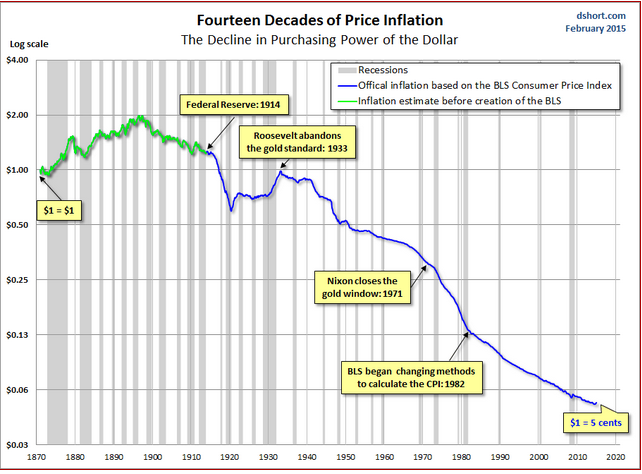
From 1870 to 1930, a span of 60 years $1 US dollar held its value nicely.  That is one full generation.  But after abandoning the gold standard it is pretty clear what has happened.  That $1 in 1930 is now the equivalent of five cents.  That is the long-term impact of inflation.  But you don’t need to go so far back to see this eroding power.  Just go back to 2000:
cost of goods since 2000
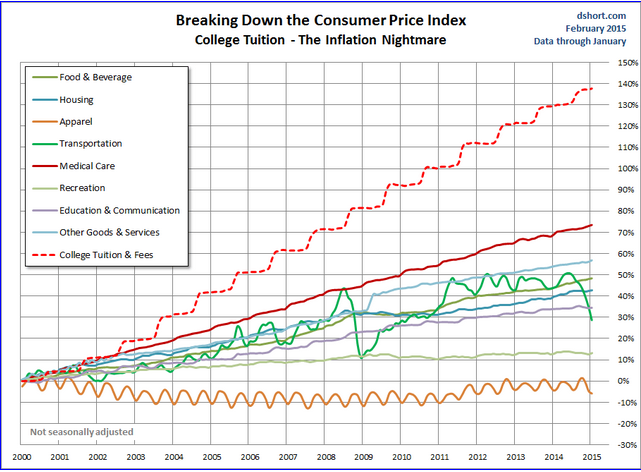
From 2000, college tuition is up nearly 140 percent, housing is up nearly 60 percent, and medical care is up over 70 percent.  Those are real significant changes.  And this is being felt by most working Americans because wages have remained stagnant.  The above changes are dramatic and are being felt throughout the economy.  This is why today, we have $1.2 trillion in student debt outstanding.  Many of the new jobs that pay a solid wage require a college education or credentialing.  Unfortunately more jobs are being added in the low wage service sectors.
The Americans worker is being sacrificed here.  Even if we look at where the Fed is spending their time, we are seeing more reliance on our international lenders:
Yellen
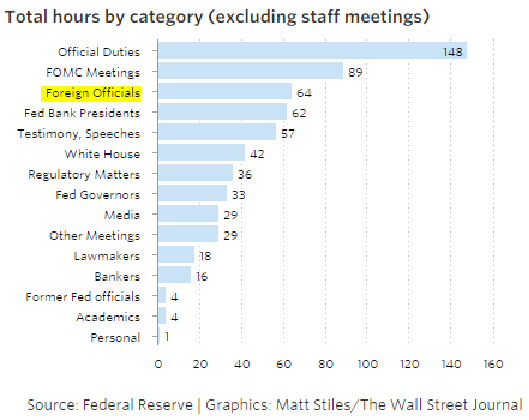
Janet Yellen at the Fed is spending a significant amount of time with foreign officials in high level meetings.  That should tell you where priorities are shifting.  The Fed continues to hint at tapering and moderating their balance sheet growth but there are little signs of that.  In the eyes of big money, the Fed is doing a superb job and the wealthiest in our world are doing fantastically well.  Yet a large part of this comes in the rentier system that is being built.  A perfect example is Wall Street diving into single family homes and turning them into rentals.  The end result has been higher rents, less supply of homes for regular families, and ultimately having more money funneled back to investment banks for producing nothing new.  Also, the CPI looks at the owners’ equivalent of rent (OER) which fails to account for actual mortgage payments – this is how the first housing bubble was missed and also missed the massive rise in home prices in 2013.
Inflation is a very real event yet very little of this is discussed in the mainstream press.  Every month we get a muted CPI report and people go on with their business.  But over time, the aggregate impact is very dramatic (just look at the price changes going back to 2000).  If you don’t believe the above data, just look at your budget and where your spending has gone over the last 15 years.  You’ll realize the CPI data is a big deception.

The Legacy of Debt: Interest Costs Poised to Surpass Defense and Nondefense Discretionary Spending

Wall Street Journal
February 3, 2015

The U.S. has come a long way since the days of trillion-dollar deficits, just a few years ago. The White House projects 2016 will have the smallest budget deficit in eight years. Yet the budgetary impact of the debt that’s been accumulated–$18 trillion in total, $13 trillion of that owed to the public–will reassert itself.
Currently, the government’s interest costs are around $200 billion a year, a sum that’s low due to the era of low interest rates. Forecasters at the White House andCongressional Budget Office believe interest rates will gradually rise, and when that happens, the interest costs of the U.S. government are set to soar, from just over $200 billion to nearly $800 billion a year by decade’s end.
By 2021, the government will be spending more on interest than on all national defense. according to White House forecasts. And one year later, interest costs will exceed nondefense discretionary spending–essentially every other domestic and international government program funded annually through congressional appropriations. (The largest part of the budget is, and will remain, the mandatory spending programs of Social Security, Medicare and Medicaid. Mandatory spending is over $2 trillion and is set to double to $4 trillion by 2025.)
The total dollars spent on defense and nondefense discretionary spending will continue to rise, albeit slowly, in the coming decade. But as a share of the economy, both categories of spending are poised to shrink for the next decade, squeezed down as interest rates rise. Mandatory spending will rise from 12.4% of GDP to about 14.5% of GDP over this period.
By 2025, the White House projects interest costs will be 2.8% of GDP. The CBO is somewhat less optimistic and expects it will be 3%. Most economists and budget experts would agree that interest payments at 3% of GDP are manageable for an economy. The true cost may be the squeeze to other places the government could be spending a decade from now.

Even Central Bankers Now Admit QE Doesn’t Work

Washington's Blog
January 21, 2015


Even As European Central Bank Is Set to Unleash a Massive Round of Quantitative Easing, Central Bank Heads Admit QE Doesn’t Work

The former head of the Bank of England – Mervyn King – said today that more QE will not help the economy:
We have had the biggest monetary stimulus that the world must have ever seen, and we still have not solved the problem of weak demand. The idea that monetary stimulus after six years … is the answer doesn’t seem (right) to me.
Also today, William White – the brilliant economist who called the 2008 crisis well ahead of time, who is head of the OECD’s Review Committee and former chief economist for BIS (the central banks’ central bank)  slammed QE:
QE is not going to help at all. Europe has far greater reliance than the US on small and medium-sized companies (SMEs) and they get their money from banks, not from the bond market.
***
Even after the stress tests the banks are still in ‘hunkering down mode’. They are not lending to small firms for a variety of reasons. The interest rate differential is still going up.
***
Mr White said QE is a disguised form of competitive devaluation. “The Japanese are now doing it as well but nobody can complain because the US started it,” he said.
“There is a significant risk that this is going to end badly because the Bank of Japan is funding 40pc of all government spending. This could end in high inflation, perhaps even hyperinflation.
“The emerging markets got on the bandwagon by resisting upward pressure on their currencies and building up enormous foreign exchange reserves. The wrinkle this time is that corporations in these countries – especially in Asia and Latin America – have borrowed $6 trillion in US dollars, often through offshore centres. That is going to create a huge currency mismatch problem as US rates rise and the dollar goes back up.”
***
He deplores the rush to QE as an “unthinking fashion”. Those who argue that the US and the UK are growing faster than Europe because they carried out QE early are confusing “correlation with causality”. The Anglo-Saxon pioneers have yet to pay the price. “It ain’t over until the fat lady sings. There are serious side-effects building up and we don’t know what will happen when they try to reverse what they have done.”
The painful irony is that central banks may have brought about exactly what they most feared by trying to keep growth buoyant at all costs, he argues, and not allowing productivity gains to drive down prices gently as occurred in episodes of the 19th century. “They have created so much debt that they may have turned a good deflation into a bad deflation after all.”
The former long-term head of the Federal Reserve (Alan Greenspan) says that QE has failed to help the economy.
Numerous academic studies confirm this. And see this.
Indeed, many high-level economists – including Federal Reserve economists and the main architect of Japan’s QE program – now say that QE may cause deflation and harms the economy in the long run.
Economists also note that QE helps the rich … but hurts the little guy. QE is one of the main causes ofinequality (and see this and this). And economists now admit that runaway inequality cripples the economy. So QE indirectly hurts the economy by fueling runaway inequality.
A high-level Federal Reserve official says QE is “the greatest backdoor Wall Street bailout of all time”. And the “Godfather” of Japan’s monetary policy admits that it “is a Ponzi game”.

Price of Meat ,Poultry, Fish, and Eggs Goes Higher

CNS News
January 16, 2015

(CNSNews.com) -- Despite a decline in the overall Consumer Price Index (CPI) in December, the food index increased and the price index for meats, poultry, fish and eggs hit a record high, according to data released todayfrom the Bureau of Labor Statistics (BLS).
food
A basket of grocery goods. (AP)
According to the BLS, “The Consumer Price Index for All Urban Consumers (CPI-U) declined 0.4 percent in December on a seasonally adjusted basis. Over the last 12 months, the all items index increased 0.8 percent before seasonal adjustment.”
“The gasoline index continued to fall sharply, declining 9.4 percent and leading to the decrease in the seasonally adjusted all items index,” said the BLS.
“The fuel oil index also fell sharply, and the energy index posted its largest one-month decline since December 2008, although the indexes for natural gas and for electricity both increased,” said the BLS.
“The food index, in contrast, rose 0.3 percent, its largest increase since September.”
meat
(AP Photo)
“The food index rose 0.3 percent in December after a 0.2 percent increase in November,” stated the BLS. “The index for meats, poultry, fish, and eggs increased 0.3 percent as the index for beef and veal continued to rise, advancing 0.7 percent.”
In addition to rising 0.3 percent over the month, the index for meats, poultry, fish and eggs also hit a record high in December.
In January 1967, when the BLS started tracking this measure, the index for meats, poultry, fish, and eggs was 38.1. As of last December 2013, it was 239.151. In November 2014 it hit 260.247. And in December 2014 it hit a record high of 261.002, an increase of 9.1 percent in one year.
The price of ground beef, which hit a record high in November of $4.201, declined in December to $4.156.
While the price of beef declined, the price of fresh whole chicken per pound increased 0.5 percent, and grade A eggs hit a record high price.
eggs
(AP Photo)
In January 1980, when the BLS started tracking the price of this commodity, Grade A eggs cost $0.879 per pound. By this December 2014, Grade A eggs cost $2.21 per pound. A decade ago, in December 2004, Grade A eggs cost $1.199 a pound. Since then, the price has increased 84.3%.
Each month, the BLS employs data collectors to visit thousands of retail stores all over the United States to obtain information on the prices of thousands of items to measure changes for the Consumer Price Index (CPI). The CPI is simply the average change over time in prices paid by consumers for a market basket of goods and services.
The business and economic reporting of CNSNews.com is funded in part with a gift made in memory of Dr. Keith C. Wold.

Sliding oil prices leave socialist Venezuela on brink of financial collapse

Washington Times
December 25, 2014
President Nicolas Maduro — the hand-picked successor to the late socialist Hugo Chavez — faces mounting international criticism for jailing opposition figures after months of street protests. (Associated Press) more >

The ongoing plunge in global oil prices is pushing Venezuela toward economic collapse just as President Nicolas Maduro — the hand-picked successor to the late socialist Hugo Chavez — faces mounting international criticism for jailing opposition figures after months of street protests.
Where Chavez once drew praise from the world’s leftist elite for using the high price of crude oil during the 2000s to underwrite a socialist revolution, a growing number of analysts in Washington say Mr. Maduro is clinging to power in a country on the edge of becoming a failed state.
Venezuela still boasts some of the world’s largest known crude reserves, but it has continued for too long spending more on government programs than it has collected in oil revenue, analysts say. The average price of oil has dropped from more than $100 a barrel to less than $60 during recent weeks, only adding to Venezuela’s woes.

Inflation where it matters: Close to 50 percent of Americans indicate spending more on groceries and fuel this summer. Nearly one third indicate more spending on rent and mortgage payments.

MyBudget360
July 22, 2014

The stock market continues to move upwards ambivalent to economic indicators and the reality that inflation is permeating throughout our economy. The Fed continues to point at CPI as evidence that inflation remains subdued and this gives them the motivation to move forward with monetary policies that we have never embarked upon. We are already getting a taste of the bigger consequences including a growing low wage labor force. A recent Gallup survey found that Americans are spending more money on items that actually matter and items that consume a large portion of a household’s budget. This is key here in understanding the nature of inflation. Items like housing, healthcare, food, and energy make up a large portion of spending. Yet the Fed looks at other items that consume a small part of a household’s budget and balance out the overall picture. What you get is a massive understating of inflation and a stock market heavily juiced on easy money.Large pools of money are chasing real assets and crowding out regular Americans from the market.
Where inflation matters
It is interesting to see how people react to a constant feed of distorted information. The message is clear and it is one that is underplaying inflation. The tone set by the Fed is one in which monetary easing should continue to go on because inflation is simply not happening in the real economy. This could not be further from the truth.
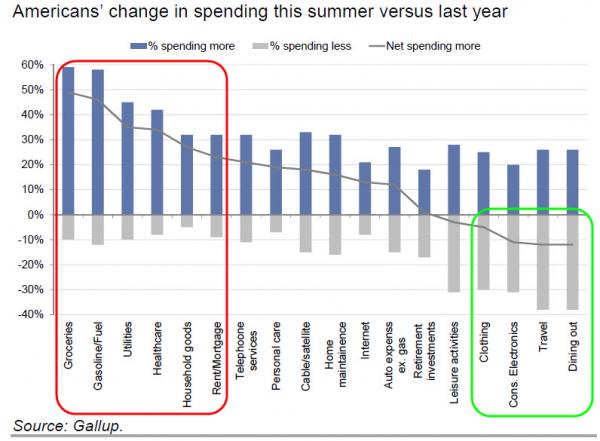
Looking at the Gallup survey, you can find that Americans are spending more on the items that already consume a large part of their budgets:
Inflation
Source: Gallup, GS
The data?
-Half of Americans indicate they are spending more this year on groceries
-Over 40 percent indicate they are spending more on gas/fuel
-Over 35 percent indicate more is being spent on utilities
-Roughly 35 percent indicate more spending on healthcare
-Nearly 30 percent indicate spending more on rent/mortgage payments
Does this seem like a market where inflation is actually muted? The Fed continues to mention what little inflation is out there is merely background noise like a cricket in the night. The above survey completely shatters that reality. Americans are spending more on items that actually matter and consume a large portion of their household income. Take a look at this data:
costoflivingxpenses-7-1-14
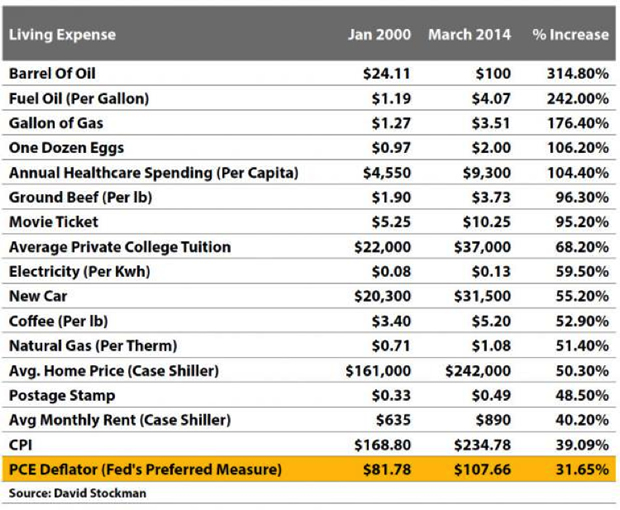
You will find that inflation is very much a real thing if we go back to 2000. A gallon of gas is up 176 percent since 2000. Ground beef is up 96 percent. Your typical college tuition is up 68 percent. A new car will now cost you 55 percent more than it would have in 2000. Your average home is now up 50 percent even though we went through the biggest housing bubble our nation has faced (largely driven by cheap and dangerous banking policy). Yet the overall CPI is only registering a 39 percent increase. The Fed looks at the PCE Deflator and this is only up 31 percent. So it is no surprise why the Fed has aggressively ramped up monetary policy.
Yet many people feel that as long as they can service their debt, all is well. They continue to listen to the mainstream press that rarely discusses incomes or inflation. So in the end, this information is largely left unexamined and many walk through life as financial zombies. Yet people are feeling the pinch and this is because monetizing debt and bailing out banks does have real world consequences. The end result is higher prices for those actually working in the real economy versus speculating in the financial sector. Since low wage jobs are becoming the norm, things are simply going to feel more expensive because they are. Inflation is hitting where it matters.

Peter Schiff :Fed Policies Are Creating Another Bubble Which Can't Last

SIC SEMPER TYRANNIS!!! News
Mark Matheny
July 8, 2014


Before the econimic crisis of 2007-8, Peter Schiff was one of the few voices crying out, warning Americans that there was a crisis coming. He warned that the Fed Stimulus from 2001 and on at that time was one of the main factors which would and did bring on the crisis in late 2007 and into 2008. At that time several other strategists and investors laughed at his predictions.


Once again, Peter is warning that the Fed has not done anything different in order to correct the economy and bring true, sound growth, but instead has continued to inflate the stock market while devaluing the dollar, which ultimately steals from the lower and middle class in order to prop the Stock market which primarilly ingratiates only the mega rich and corporations, yet once again, the shills for the Fed and Wall Street are scorning his predictions of a future bubble burst and possible major decline of the dollar.

Peter Schiff on Fox Business (7/8/2014)

  • Peter Schiff Believes the Dow should be more at 12,000 currently and not 17,000. He argues that if the Fed was doing the right thing by removing all the monetary financial props, and let interest rates rise, then the market would fall substantially.
  • He believes, however, that the Fed will instead, sacrifice the dollar in order to continue propping up the Stock Market, and the housing market in order to perpetuate the current phony recovery.
  • He believes foreign investing and gold are safer havens against long term inflation, and is doubtful of U.S. stocks.
  • He charges that the Fed blew up the real estate bubble that caused the 2008 housing crisis,
  • Now the Fed is compounding the current problem by keeping interest rates at the artificially low rate of 0%
  • America is not saving enough, and not investing enough, and not producing enough, but only borrowing, consuming, and speculating, and so the U.S. economy is weakening.
  • He believes the stimulus of 2008 has only prolonged the impending crisis that will come again in the future, and will in fact be much worse than the last crisis in 2008.
We will see if he is again correct. I personally believe he will be, unfortunately.

Rising inequality and greater investment risks

Financial Times
July 8, 2014

Matheny's Note: The old saying of "follow the money" in this case shows that middle class families are feeling the pain of government intervention in the economic sector. Families are paying in higher taxes while corporations get a pass. This is not a recovery, but a restructure of our country, consolidating power into the hands of a few and securing of Elite family "Dynasties" who really run things here in the U.S. and around the world....


Households are bearing the weight of austerity, while corporate taxes are reduced. This can't last, says Luca Paolini, chief strategist at Pictet Asset Management. He tells John Authers why emerging market government debt is a risk worth considering.


For more video content from the Financial Times, visithttp://www.FT.com/video

Being young increases your odds of being unemployed in the US: 40 percent of unemployed workers are Millennials. The long-term impact of young unemployment.

MyBudget360
July 5, 2014

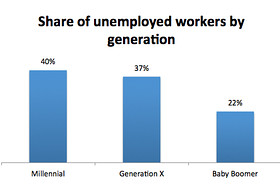
Young Americans continue to carry a heavy burden brought on by the Great Recession. A recent analysis conducted on US Census data found that 40 percent of unemployed workers are Millennials. Many young workers are simply trying to start their careers and each year that passes is a year where retirement planning is delayed, savings are put on the shelf, and the machinery of spending is put on ice. Young Americans are a key spending demographic. Many will look to purchase their first home. Many are out in the market to purchase cars. Vacations and spending are common characteristics of this group assuming they have the money to spend. Unfortunately with such a large portion of our unemployed coming from the young, we are seeing new demographic trends hitting the market. The housing market is seeing a smaller number of first time home buyers in spite of very low mortgage interest rates. Many are saddled with back breaking levels of student debt and default rates are highest among this debt class. In the US, being young increases your odds of being unemployed.
Young and unemployed
The Great Recession has had a far reaching impact on all age cohorts. But it is undeniable that the impact it has had on young Americans has been disproportionately large. So it should not come as a surprise that Millennials make up the bulk of those currently unemployed in the US:
“(MarketWatch) Some 40% of unemployed workers are millennials, according to an analysis of U.S. Census data by the Georgetown University Center on Education and the Workforce released to MarketWatch, greater than Generation X (37%) and baby boomers (23%). That equates to 4.6 million unemployed millennials — 2 million long-term — 4.2 million unemployed Xers and 2.5 million jobless baby boomers.”
Generation X isn’t fairing so much better either making up 37 percent of the unemployed:
share of boomers
Young Americans are very likely going to see a decline in their standard of living relative to that of their parents. Keep in mind that many older Americans are fully unprepared for retirement so we are looking at those financially unprepared to those with absolutely no savings. The end result is that economic struggles continue to impact the country.
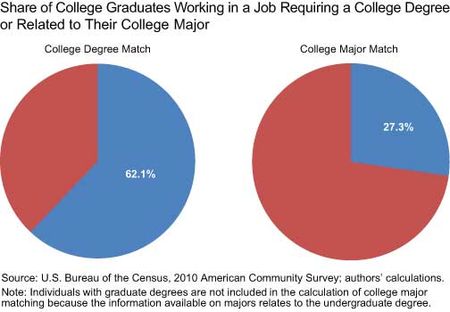
At the core, we are facing an unemployment crisis of the young. Many are giving up and simply taking on low wage jobs if they can find one to pay the bills. We continue to tout that we have a record level of college educated Americans but then we see stats showing that only 27 percent of college grads work in fields that relate to their degree:
college degree
When you are paying the current sticker price for college, you should expect better results.
Young and unemployed impacting housing market
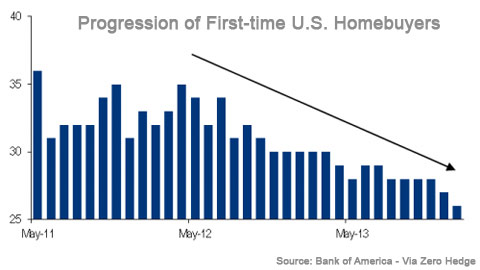
This is a bigger issue because many young workers are also first in line to purchase homes. Purchased homes usually need to be filled with furniture and other consumer items (i.e., fridges, ovens, sofas, etc). You also need to build those homes which means jobs for construction, plumbing, and all the other ancillary services that go into putting together a property. Because young Americans are having such a tough time, first time home buyers are not leading the charge in a housing recovery:
first time home buyers
Where is the housing recovery here? Investors are buying in droves but regular families are not buying at a historical rate. Until young workers have steadier work and healthier paychecks, expect to see this trend continue.
Having this many young Americans unemployed is not good. We need to remember that 70 percent of our economy is built on consumption and because of life stages, young Americans will spend more if they can do so. Those entering retirement age simply spend less (i.e., they might already own their home, no need for large purchases, shifting spending to healthcare, etc). The longer this goes on, the harder it will be to reset the timing on this big cohort of Americans.
We have yet to see a steady healthy growth of good paying jobs for Americans. And when the young make up the bulk of your unemployed, you know you will have problems down the road.

The loud noise of inflation: Fed underplays current rise in inflation as noise while Americans see higher home prices, tuition, food costs, and energy prices.

MyBudget360
June 22, 2014

It was interesting to hear the Federal Reserve mention that the higher than expected inflation numbers are merely noise. It is highly unlikely that most Americans feel the current rise in prices as noise. Inflation has a way of eating into every penny that you have especially when the market is flooded with debt. Just think of the price of items ten years ago and you will realize that practically everything has increased in cost including; housing, rents, college tuition, healthcare, food, and energy. It is also the case that wages have simply not kept up with price hikes. In other words, the cost of important items is trailing the growth of wages. What we have is a decline in the standard of living brought on by inflation. It happens slowly and many fail to realize it is happening. You see it over the last few years with banks flooding the housing market and crowding out regular families. The Fed has been the number one buyer of mortgage-backed securities and the repercussions are very noticeable in the housing market. The markets saw a stiff rise in commodities recently as people suddenly realize that the Fed is fully addicted to debt and is disconnected from what is happening with average families.
The noise of inflation
The Fed is hungry for inflation. Trying to control inflation is like trying to control a wild tiger. The Fed’s recent comments on inflation are largely disconnected from the lives of working families:
“(WSJ) Recent readings on, for example, the CPI index have been a bit on the high side,” but the data are “noisy,” Ms. Yellen said at a press conference following a meeting of the Fed’s policymaking committee. “I think it’s important to remember that, broadly speaking, inflation is evolving in line with the committee’s expectations. The committee has expected a gradual return in inflation toward its 2% objective, and I think the recent evidence that we’ve seen, abstracting from the noise, suggests that we are moving back gradually, over time, toward our 2% objective.”
This is an odd target here. The reason this is odd is that wages are not increasing and the Fed certainly doesn’t mention targeting wage growth. So even targeting a 2 percent inflation rate is destructive to households not seeing jumps in wages. Take a look at the noise below:
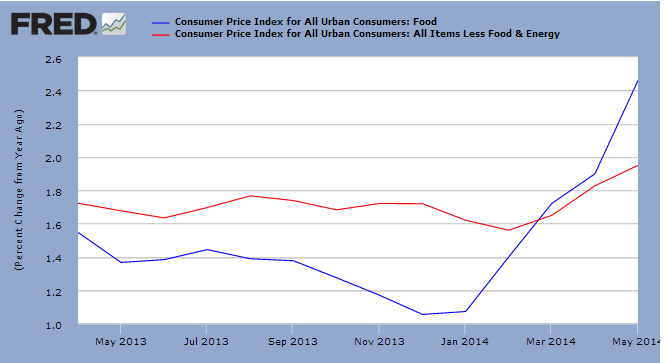
food and energy
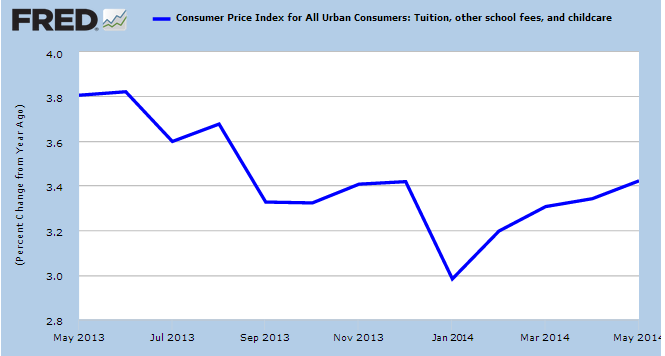
Food and energy costs are increasing at the fastest rate in over a year. These are costs that fall on the backs of Americans on a daily basis. You also have tuition increasing at a rate above 3 percent:
tuition
This looks like more than noise to me. We have a generation of Americans now unable to buy homes and going with rentals. Call them Generation R. Now why is homeownership such a hard task to accomplish for younger Americans? The answer involves depressed wages, high student debt, and housing prices going up thanks to investor demand. In the end, more disposable income is being siphoned away (this is how inflation feels in the long-term if wages don’t keep up).
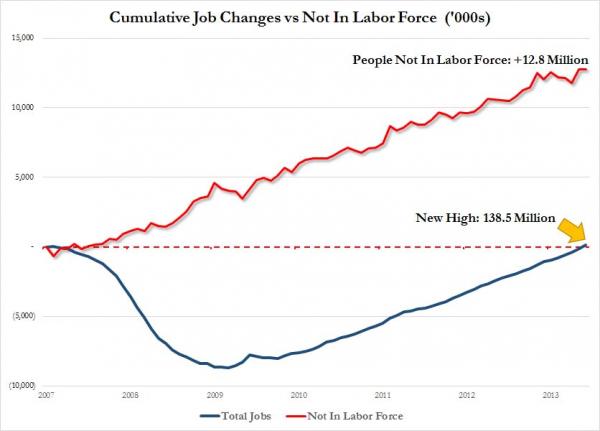
I suppose to big banks and big investors this does seem like noise. I’m sure having 47 million Americans on food stamps seems like noise and the startling reality that 13 million Americans have been added to the “not in the labor force” category since the recession ended is also just noise:
record-jobs-in-context
This is more than noise. This is the devouring sound of inflation. It has a deep impact on the way you live your life and your standard of living. Do you really trust in those banks that led the country into the biggest financial crisis since the Great Depression? The Fed has given them full authority to manage the economy and it is no wonder that their balance sheets look incredibly happy while most Americans continue to face a declining standard of living.
Let us all chant “it is only noise” as we pump that gas into our cars. Let us chant “it is only noise” when we see college tuition go up year after year. Let us chant “it is only noise” when we see our grocery bill surge. Let us chant “it is only noise” when we see housing values increase thanks to floods of investor money. Get those inflation ear plugs out, because I have a feeling we are in for a whole lot of noise.