Showing posts with label surveillance. Show all posts

Autonomous drones may have ‘hunted down’ and attacked troops in Libya without human control – UN report

 RT News

May 29, 2021


A UN report found that autonomous drones armed with explosive devices may have “hunted down” fleeing rebel fighters in Libya last year. If true, the report chronicles the world’s first true robot-on-human attack.

According to the report, anti-government Libyan National Army fighters, under military commander Khalifa Haftar, were retreating last March following an unsuccessful attack on Tripoli, when they ran into a swarm of terrifying aerial opponents.

They were “hunted down” by unmanned drones, as well as “lethal autonomous weapons systems,” the latter of which can be programmed by controllers to seek out and attack targets, and carry out these instructions even if communications with the controllers are severed.

Haftar’s fighters “were neither trained nor motivated to defend against the effective use of this new technology and usually retreated in disarray,” the report continues. While in retreat, “they were subject to continual harassment” from the killer robots.

It is unclear whether the drones were in contact with human controllers during these reported attacks, or whether they were directly responsible for any casualties or deaths. Were they operating autonomously, the scenario described in the report would likely mark a horrifying milestone: the first recorded incidence of truly independent robots attacking humans on the battlefield. However, the report does not specify what level of autonomy the robots were functioning under.

The drones, known as “loitering munitions,” are quadcopter-type vehicles outfitted with cameras and carrying small explosive devices. Left in an area to operate, they identify targets and dive from the air, blowing themselves up upon impact. The devices identified in Libya were ‘Kargu-2’ loitering munitions, deployed on the Libyan battlefield by Turkish forces allied with the UN-backed and Tripoli-based Government of National Accord.

Read the entire article

In Effort to Bypass Spy Warrants, Biden Admin to Partner with Private Firms to Surveil So-Called ‘Domestic Terrorists’ Online

 Gateway Pundit

May 3, 2021


The Biden Administration will be partnering with private firms to surveil “domestic terrorists” online.

In other words, since the Biden Admin can’t spy without a warrant or probable cause/ongoing investigation, they will outsource it to the private sector.

The Department of Homeland Security can only browse through open social media platforms such as Twitter, Facebook etc. and cannot assume false identities to infiltrate private messaging apps.

However, there is a plan in the works to circumvent the Department’s limits so the government can monitor online chatter in private messaging apps like Telegram.

“If [the DHS] can find willing external partners that would help provide access to private groups on these encrypted apps, DHS and its federal partners, including the FBI, would be able to legally identify potential domestic terrorists and access information that could inform investigative efforts,” a source familiar with the effort told CNN.

Read the entire article

Dubai Introduces Facial Recognition On Public Transport

 Barron's

October 25, 2020


Dubai, which is introducing facial recognition technology on public transport, opened a 'smart simulation training station' this week to help improve security


Dubai is introducing a facial recognition system on public transport to beef up security, officials said Sunday, as the emirate prepares to host the global Expo exhibition.

"This technology has proven its effectiveness to identify suspicious and wanted people," said Obaid al-Hathboor, director of Dubai's Transport Security Department.

The emirate already operates a biometric system using facial recognition at its international airport.

Dubai, which sees itself as a leading "smart city" in the Middle East, has ambitions to become a hub for technology and artificial intelligence.

Both sectors will be on show when it opens the multi-billion-dollar Expo fair.

"We aspire to raise our performance by building on our current capabilities, to ensure a high level of security in metro stations and other transport sectors," said Hathboor.

Earlier this week, under the watch of Dubai's Crown Prince Sheikh Hamdan bin Mohammed, the city's police used facial recognition in a simulated scenario to identify gunmen launching an attack on a metro station.

A special police unit, trained in the United States, helped "evacuate" commuters from the station in the mock attack, before working in tandem with a control centre to apprehend the suspects.

Members of the special unit will be sent to major metro stations during Expo 2020.

The six-month event was delayed by one year due to coronavirus, and is now set to open in October 2021.

Jamal Rashed, of Dubai Police's Transport Security Department, said the facial recognition technology will be rolled out in the coming months in all metro stations.

Other technology already in use to combat the spread of the coronavirus, such as helmets with thermal cameras and smart glasses, will also be used to identify and manage large crowds.

"It took at least five hours to identify a suspect before," said Rashed. "With this technology, it takes less than a minute."

But while the technology to identify individuals has simplified lives, such as being used for unlocking phones, it has also raised concerns over privacy.

Berlin-based advocacy group AlgorithmWatch says that at least 10 European police forces use facial recognition technology -- a trend that privacy and rights groups are concerned about.

China has also been criticised for the facial recognition systems in its public surveillance network.

REVEALED: Chinese Govt. Killed and Imprisoned 18-20 CIA Spies After Penetrating Hillary Clinton’s Private Server

Gateway Pundit
August 29, 2018

Hillary’s carelessness and criminal actions may have led to the deaths of 20 CIA operatives in China.

The Chinese government killed or imprisoned 18 to 20 CIA operatives in China from 2010 to 2012.
At the same time a Chinese-owned company operating in the Washington, D.C., area hacked Hillary Clinton’s private server throughout her term as secretary of state.
The Chinese government was obtaining Hillary Clinton’s emails in real time.

Her criminal behavior severely damaged US foreign policy.

And the FBI refused to act.

The Chinese government murdered or imprisoned 18-20 CIA sources from 2010 to 2012 while Feinstein had a Chinese spy as her office manager.

Business Insider reported:
China killed or imprisoned 18 to 20 CIA sources from 2010 to 2012, hobbling U.S. spying operations in a massive intelligence breach whose origin has not been identified, the New York Times reported on Saturday.Investigators remain divided over whether there was a spy within the Central Intelligence Agency who betrayed the sources or whether the Chinese hacked the CIA’s covert communications system, the newspaper reported, citing current and former U.S. officials.The Chinese killed at least a dozen people providing information to the CIA from 2010 through 2012, dismantling a network that was years in the making, the newspaper reported.One was shot and killed in front of a government building in China, three officials told the Times, saying that was designed as a message to others about working with Washington.The breach was considered particularly damaging, with the number of assets lost rivaling those in the Soviet Union and Russia who perished after information passed to Moscow by spies Aldrich Ames and Robert Hanssen, the report said. Ames was active as a spy in the 1980s and Hanssen from 1979 to 2001.The CIA declined to comment when asked about the Times report on Saturday.

Bans don’t seem to be lessening reach of Alex Jones, InfoWars

MyStatesman
August 12, 2018


Some of the nation’s largest technology and social media companies have tried to stop Alex Jones and his conspiracy theories. But in a digital world, their attempts seem to have barely slowed him down.
After YouTube, Facebook and others this week removed content by Jones and his website, the InfoWars leader, talk show host and Austin resident fired back, accusing the companies of censorship and urging his audience to fight back against what he called an “unprecedented attack.”
Meanwhile, Jones’ website and other online platforms have remained popular destinations.
InfoWars continues to see more than 1 million page visits per day and has trended upward this month, according to Amazon’s Alexa website traffic report, which also said InfoWars averages more than 25 million page views per month.
Consumers still can access InfoWars through the same tech companies that just banned it. Google still offers the Infowars app for Android users, and Apple customers can download it through the App Store.
As of Friday, the show’s phone app remained near the top of the charts in both the Apple App and Google Play stores. Infowars Official, an app that lets viewers stream Jones’ shows and read news of the day, was ranked fourth among trending apps in the Google Play store Friday. In the news category on Apple’s App Store, Infowars earned the fourth slot under the top free apps, behind Twitter and News Break, a local and breaking news service, revealing a sudden boost of user downloads.
Apple told The Washington Post in a written statement: “We put great effort into curating the App Store to provide the very best experience for everyone. We strongly support all points of view being represented on the App Store, as long as the apps are respectful to users with differing opinions, and follow our clear guidelines, ensuring the App Store is a safe marketplace for all.”

CIA denies report over mystery Russian who promised Trump info

Yahoo News
February 11, 2018

The CIA denied reports that US spies paid a Russian $100,000 in an attempt to buy back top secret hacking tools stolen from the National Security Agency, seen here

The CIA denied reports that US spies paid a Russian $100,000 in an attempt to buy back top secret hacking tools stolen from the National Security Agency, seen here (AFP Photo/SAUL LOEB)
Washington (AFP) - The CIA on Saturday categorically denied reports that it was fleeced by a mystery Russian who promised compromising information on US President Donald Trump.
The secretive agency rarely issues any kind of comment, but came out to deny the report in The New York Times and a similar one in The Intercept, an online journal focusing on national security issues.
"The fictional story that CIA was bilked out of $100,000 is patently false," the Central Intelligence Agency said in a statement sent to AFP.
"The people swindled here were James Risen and Matt Rosenberg," the CIA said, referring to Times reporter Rosenberg, who wrote the story, and Risen, a former Times reporter who authored The Intercept's article.
Both reports appeared on Friday.
The president tweeted approvingly that The Times article shows a need to "drain the swamp" in Washington.
In a story worthy of a John le Carre novel that included secret USB-drive handovers in a small Berlin bar and coded messages delivered over the National Security Agency's Twitter account, CIA agents spent much of last year trying to buy back from the Russians hacking programs stolen from the NSA, the Times reported.
The seller, who was not identified but had suspected links to both cyber criminals and Russian intelligence, tantalized the US spies with an offer of the NSA hacking tools that had been advertised for sale online by a group called the Shadow Brokers.
Some of the tools, developed by the NSA to break into the computers of US rivals, were used by other hackers last year to crack or infect computer systems around the world. The Times described the Americans as "desperate" to get the tools back.
Reached through a chain of intermediaries, the seller reportedly wanted $1 million after quickly dropping his opening demand of about $10 million.
The $100,000 was an initial payment by US agents still dubious he really had what he was promising.
In its report, the Times cited US and European intelligence officials, the Russian, and communications the newspaper reviewed.
The seller also repeatedly pressed US agents with offers of compromising materials, or kompromat, on Trump, the Times said.

Amazon patents wristband that tracks warehouse workers' movements

The Guardian
February 5, 2018

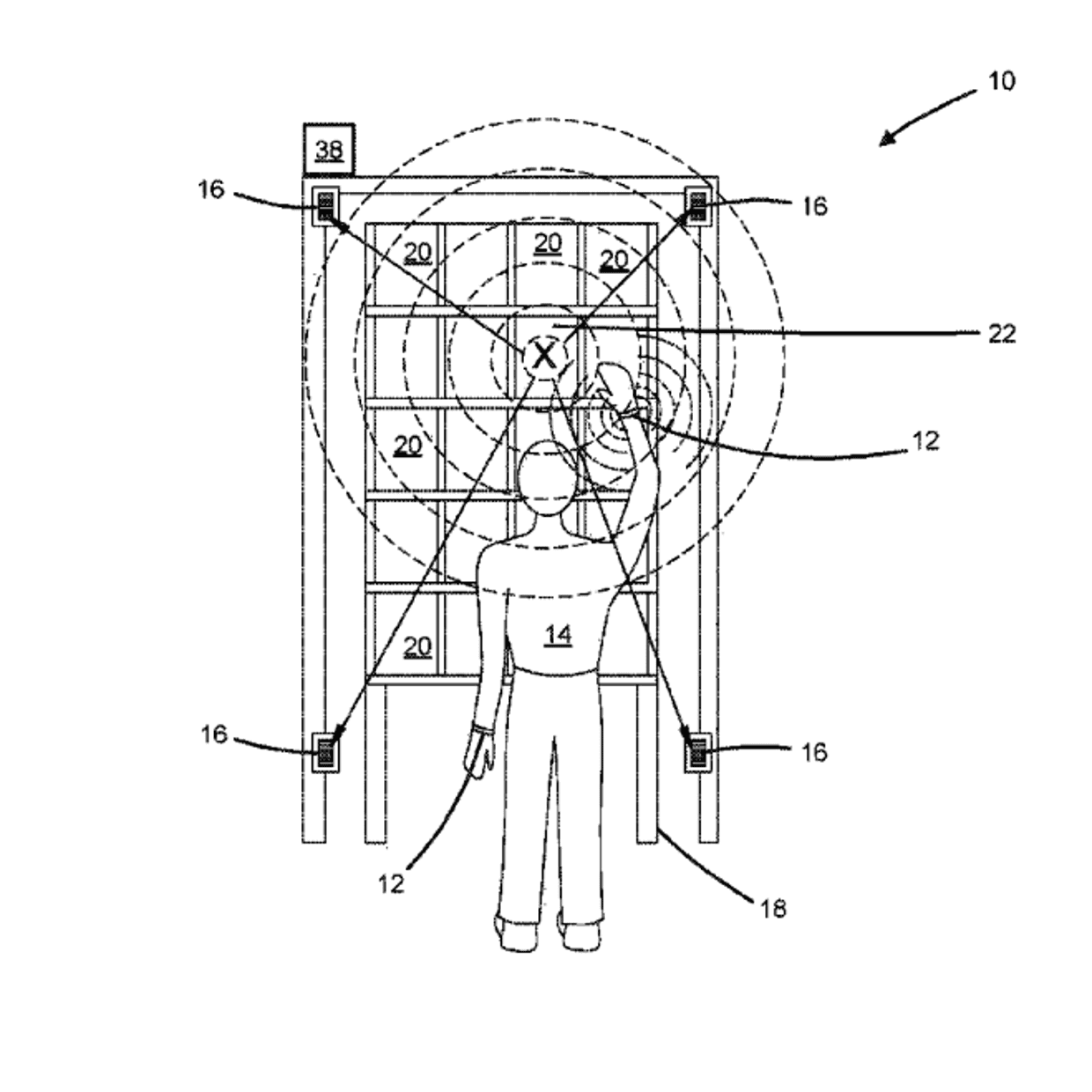
Amazon has patented designs for a wristband that can precisely track where warehouse employees are placing their hands and use vibrations to nudge them in a different direction.
The concept, which aims to streamline the fulfilment of orders, adds another layer of surveillance to an already challenging working environment.
When someone orders a product from Amazon, the details are transmitted to the handheld computers that all warehouse staff carry. Upon receiving the order details, the worker must rush to retrieve the product from one of many inventory bins on shelves, pack it into a delivery box and move on to the next assignment.
The proposed wristbands would use ultrasonic tracking to identify the precise location of a worker’s hands as they retrieve items. One of the patents outlines a haptic feedback system that would vibrate against the wearer’s skin to point their hand in the right direction.
The result? Human workers can fulfil more orders – until robots develop the dexterity to replace them altogether.
Ultrasonic bracelet and receiver for detecting position in 2D plane
worker’s hands as they retrieve items. Photograph: Amazon / USPTO
The wristbands are, according to the patent documents, first spotted by GeekWirFacebook
TwitterPinterest
 The proposed wristbands would use ultrasonic tracking to identify the precise location of a e, designed as a labour-saving measure to keep track of products throughout the warehouse.
A less generous interpretation would be that the wristbands provide Amazon management with new workplace surveillance capabilities that can identify the workers wasting time scratching, fidgeting or dilly-dallying.
Amazon already has a reputation for turning low-paid staff into “human robots” – working alongside thousands of proper robots – carrying out repetitive packaging tasks as fast as possible in an attempt to hit goals set by handheld computers.
This month, the 24-year-old warehouse worker Aaron Callaway described having just 15 seconds to scan items and place them into the right cart during his night shifts at an Amazon warehouse in the UK. “My main interaction is with the robots,” he said.
In 2016, a BBC investigation found that agency workers making Amazon deliveries reported defecating in bags, speeding and falling asleep at the wheel as they desperately tried to hit ambitious delivery targets issued by an Amazon logistics app.

More texts turned over from FBI agent taken off Mueller team

Yahoo News
January 21, 2018


WASHINGTON (AP) — The Justice Department has turned over to Congress additional text messages involving an FBI agent who was removed from special counsel Robert Mueller's investigative team following the discovery of derogatory comments about President Donald Trump.
But the department also said in a letter to lawmakers that its record of messages sent to and from the agent, Peter Strzok, was incomplete because the FBI, for technical reasons, had been unable to preserve and retrieve about five months' worth of communications.
New text messages highlighted in a letter to FBI Director Christopher Wray by Sen. Ron Johnson, the Republican chairman of the Senate's Homeland Security and Governmental Affairs Committee, are from the spring and summer of 2016 and involve discussion of the investigation into Hillary Clinton's use of a private email server. They reference Attorney General Loretta Lynch's decision to accept the FBI's conclusion in that case and a draft statement that former FBI Director James Comey had prepared in anticipation of closing out the Clinton investigation without criminal charges.
The FBI declined to comment Sunday.
Strzok, a veteran counterintelligence agent who also worked the Clinton email case, was reassigned last summer from the team investigating ties between Russia and Trump's Republican presidential campaign after Mueller learned he had exchanged politically charged text messages — many anti-Trump in nature — with an FBI lawyer also detailed to the group. The lawyer, Lisa Page, left Mueller's team before the text messages were discovered.
The Justice Department last month produced for reporters and Congress hundreds of text messages that the two had traded before becoming part of the Mueller investigation. Many focused on their observations of the 2016 election and included discussions in often colorful language of their personal feelings about Trump, Clinton and other public figures. Some Republican lawmakers have contended the communication reveals the FBI and the Mueller team to be politically tainted and biased against Trump — assertions Wray has flatly rejected.
In addition to the communications already made public, the Justice Department on Friday provided Johnson's committee with 384 pages of text messages, according to a letter from the Wisconsin lawmaker that was obtained by The Associated Press.
But, according to the letter, the FBI told the department that its system for retaining text messages sent and received on bureau phones had failed to preserve communications between Strzok and Page over a five-month period between Dec. 14, 2016, and May 17, 2017. May 17 was the date that Mueller was appointed as special counsel to oversee the Russia investigation.
The explanation for the gap was "misconfiguration issues related to rollouts, provisioning, and software upgrades that conflicted with the FBI's collection capabilities."

Mark Levin: Obama's FBI used unverified Trump dossier to obtain FISA warrant (January 11 2018)

Mark Levin Show
January 12 , 2018

There is a bombshell report by Sara Carter which proves Mark was right about Barack Obama’s FISA abuses! The Trump dossier was used by Obama’s FBI to gain approval for a FISA court warrant to surveil Donald Trump’s presidential campaign. The bastardization of our intelligence agencies and federal law enforcement by a sitting Democrat administration aimed at destroying and defeating a Republican nominee is nothing like we’ve ever seen. We can’t live in a free society when administrations of one party are surveilling transition teams of another party. The dossier circulated throughout our intelligence agencies from the FBI and was broadly used by the Obama administration. There is so much that has to be uncovered here which has involved the felonious leaking of names of Americans leaked to the media and abuse of the Patriot Act.


Secret court rebukes NSA for 5-year illegal surveillance of U.S. citizens

Miami Herald
May 27, 2017


U.S. intelligence agencies conducted illegal surveillance on American citizens over a five-year period, a practice that earned them a sharp rebuke from a secret court that called the matter a “very serious” constitutional issue.
The criticism is in a lengthy secret ruling that lays bare some of the frictions between the Foreign Intelligence Surveillance Court and U.S. intelligence agencies obligated to obtain the court’s approval for surveillance activities.
The ruling, dated April 26 and bearing the label “top secret,” was obtained and published Thursday by the news site Circa.
It is rare that such rulings see the light of day, and the lengthy unraveling of issues in the 99-page document opens a window on how the secret federal court oversees surveillance activities and seeks to curtail those that it deems overstep legal authority.
The document, signed by Judge Rosemary M. Collyer, said the court had learned in a notice filed Oct. 26, 2016, that National Security Agency analysts had been conducting prohibited queries of databases “with much greater frequency than had previously been disclosed to the court.”
It said a judge chastised the NSA’s inspector general and Office of Compliance for Operations for an “institutional ‘lack of candor’ ” for failing to inform the court. It described the matter as “a very serious Fourth Amendment issue.”
The Fourth Amendment protects people from unreasonable searches and seizures by the government, and is a constitutional bedrock protection against intrusion.


Social media groups join forces to counter online terror content

Financial Times
December 5, 2016


Facebook, Google, Microsoft and Twitter on Monday announced they had joined forces in an attempt to curb explicit terrorist imagery online.

The move follows criticism from Brussels that big US social media groups have made insufficient effort to clamp down on hate speech.
In a statement, the technology groups said they were building new technology that would identify extremist content, including terrorist recruitment videos and images of executions, via a digital fingerprint known as a “hash”, which would then be compiled into a shared global database. Once created, the hash would be attached like a watermark to content, which would then be easy to identify and take down.
“Our companies will begin sharing hashes of the most extreme and egregious terrorist images and videos we have removed from our services,” the companies said. “By sharing this information with each other, we may use the shared hashes to help identify potential terrorist content on our respective hosted consumer platforms.”
The project will be presented at the EU Internet Forum on Thursday, with the database launching in early 2017.
The companies said the collaboration was not a knee-jerk response to European demands but had been under development for several months.

Virtual machine guns, robo-security guards and drones will protect your home from burglars in 2025

Daily Mail
March 30, 2016

From burglar alarms that identify intruders, to robotic guards and even 'gun' turrets, homeowners of the future will have far more imaginative options to protect their property than today.

A report about the future of home security predicts a future that's a cross between the Minority Report and The Crystal Maze in which burglars would have to run a high-tech gauntlet to make off with goods.

For example, burglar alarms could shout at intruders by name, while indelible sprays could mark them out in case of escape, and drones could give chase. 
In a vision of the future, burglar alarms could shout at intruders by name, while indelible sprays could mark them out in case of escape, and drones could give chase (illustrated) 

The report, by future trends experts Futurizon, was commissioned by security company ADT.
In a survey, the Florida-based firm found only four out of ten people feel safe being at home, while one in ten believe their home is at greater risk today than it was only five years ago.

Read the entire article

Mass surveillance silences minority opinions, according to study

Washington Post
March 28, 2016

A new study shows that knowledge of government surveillance causes people to self-censor their dissenting opinions online. The research offers a sobering look at the oft-touted "democratizing" effect of social media and Internet access that bolsters minority opinion.
The study, published in Journalism and Mass Communication Quarterly, studied the effects of subtle reminders of mass surveillance on its subjects. The majority of participants reacted by suppressing opinions that they perceived to be in the minority. This research illustrates the silencing effect of participants’ dissenting opinions in the wake of widespread knowledge of government surveillance, as revealed by whistleblower Edward Snowden in 2013.
The “spiral of silence” is a well-researched phenomenon in which people suppress unpopular opinions to fit in and avoid social isolation. It has been looked at in the context of social media and the echo-chamber effect, in which we tailor our opinions to fit the online activity of our Facebook and Twitter friends. But this study adds a new layer by explicitly examining how government surveillance affects self-censorship.

The Best Explanation Yet Of How The NSA's PRISM Surveillance Program Works

Business Insider
May 8, 2015

The Associated Press has published a detailed report about how the NSA's PRISM program — established to acquire data from tech giants including Apple, Google, Microsoft, and Facebook — is a small part of a massive domestic dragnet run by the nation's premier covert intelligence gathering organization.
The report reaffirms what we already know, specifically that "the NSA copies Internet traffic as it enters and leaves the United States, then routes it to the NSA for analysis," and it also shores up a few things about how PRISM works.
First, it clears up the controversy around the assertion that PRISM involves nine tech companies providing "direct access" to their servers.
From AP (emphasis ours):
Technology experts and a former government official say that ["direct access"] phrasing, taken from a PowerPoint slide describing the program, was likely meant to differentiate Prism's neatly organized, company-provided data from the unstructured information snatched out of the Internet's major pipelines.
In slide made public by the newspapers, NSA analysts were encouraged to use data coming from both Prism and from the fiber-optic cables.
Prism, as its name suggests, helps narrow and focus the stream.
So PRISM leverages the direct access the NSA has to the Internet's major pipelines and then uses court orders authorized by Section 702 of the Foreign Intelligence Surveillance Act (FISA) to collect specific data from tech companies.
[UPDATE 7/11] Here's the corresponding PRISM slide, published by The Washington Post:
prismNSA
Here's how the AP explains the court order part (emphasis ours):
Every year, the attorney general and the director of national intelligence spell out in a classified document how the government plans to gather intelligence on foreigners overseas.
By law, the certification can be broad. The government isn't required to identify specific targets or places.
A federal judge, in a secret order, approves the plan.
With that, the government can issue "directives" to Internet companies to turn over information.
While the court provides the government with broad authority to seize records, the directives themselves typically are specific, said one former associate general counsel at a major Internet company. They identify a specific target or groups of targets. Other company officials recall similar experiences.
All adamantly denied turning over the kind of broad swaths of data that many people believed when the Prism documents were first released.
Here's where it's still murky — the government has a authority to take troves of data, and wants as much data as possible, but tech companies say they aren't providing broad swaths of data.
When PRISM leaked, The Washington Post reported that the 702 orders given to tech companies "serve as one-time blanket approvals for data acquisition and surveillance on selected foreign targets for periods of as long as a year."
Tech companies say it doesn't play out that way.
Microsoft said in a statement: "We only ever comply with orders for requests about specific accounts or identifiers."
Google chief architect Yonatan Zunger wrote that Google only responds to "lawful, specific orders about individuals.”
And Facebook revealed it received between 9,000 and 10,000 requests for user data in the second half of last year, and said "we respond only as required by law."
So it remains to be seen how just much data the NSA can acquire from tech companies.
It should be noted that in July the court that was established to "hear applications for and grant orders approving electronic surveillance," called the Foreign Intelligence Surveillance Court (FISC), found that government 7o2 orders at the heart of PRISM had violated the Fourth Amendment's restriction against unreasonable searches and seizures "on at least one occasion."