Showing posts with label Federal Reserve. Show all posts

Do We Even Need the Fed?

Schiff Gold
December 4, 2019


Do we even need the Federal Reserve?
Whether on the political left, right, or in the middle, virtually everybody thinks we do. After all, without the Fed, we’ll have wild economic swings and crashes.
Economist Edward Stringham disagrees. In this It’s Your Dime Interview, he talks about it with host Mike Maharrey and makes the case that the economy would function just fine without a central bank pulling strings. In fact, as he explains, the Fed actually stirs up economic chaos.
In this interview, Mike and Edward talk about how the Fed messes up our money, the Fed-induced business cycle, and the economic impact of the current easy-money policy. We also talk about the idea of private governance. Is that even possible?


Read the entire article

EXPERT: TRUMP POISED TO TAKE CONTROL OF THE FEDERAL RESERVE

CNBC
July 22, 2018

The Fed doesn’t stabilize markets and money — it does the opposite


President Donald Trump has multiple reasons as to why he should take control of the Federal Reserve.
He will do so both because he can and because his broader policies argue that he should do so. The president is anti-overregulating American industry.
The Fed is a leader in pushing stringent regulation on the nation. By raising interest rates and stopping the growth in the money supply it stands in the way of further growth in the American economy.
First, He Can
The Board of Governors of the Federal Reserve is required to have seven members. It has three. Two of the current governors were put into their position by President Trump. Two more have been nominated by the president and are awaiting confirmation by the Senate.

Re-Energized Dollar Looms Over the Rest of the World

Wall Street Journal
January 1, 2017

On Wall Street, the rising dollar has been one of the most visible signals of growing optimism in the U.S. economy. For many other countries, it spells trouble.
Most analysts expect the U.S. currency to strengthen in 2017, extending a gain that has boosted the value of the dollar by more than one-third since the U.S. credit downgrade in 2011.
That expectation is mostly because a strengthening economy appears likely to enable the Federal Reserve to enact its plan for multiple rate increases in 2017. Higher rates make it more attractive to hold dollar-denominated assets, attracting money into the U.S.
“Right now, there is an incredible amount of pressure to sell just about every type of currency and buy the dollar,” said Christopher Stanton, chief investment officer at Sunrise Capital LP, which manages $700 million.
Mr. Stanton recently bet that the U.S. currency will appreciate against the Australian dollar, Japanese yen and euro in the next few months.
A stronger dollar raises the buying power of U.S. consumers and businesses by making imported items cheaper and reducing the costs of traveling abroad. By the same token, however, it hurts U.S. exporters by making their goods less competitive overseas, cutting into corporate earnings and potentially weighing on stock prices.
In emerging markets, sustained dollar strength could undercut prices for oil and other dollar-denominated commodities, pressuring developing economies that export raw materials. Emerging-market companies and governments that have borrowed heavily in the U.S. currency will also find their debt more difficult to service.

Yellen seen resisting pressure to resign if Trump wins election

Chicago Tribune
October 24, 2016

Federal Reserve Board Chair Janet Yellen testifies during a hearing before the House Financial Services Committee September 28, 2016 on Capitol Hill in Washington, DC. 
(Alex Wong /)

Federal Reserve Chair Janet Yellen will resist pressure to step down should Donald Trump be elected president next month.
That's the firm conviction of people who've known and worked with her over the years. They described speculation in financial markets to the contrary as off base.
"It's ridiculous," former Fed Vice Chair Alan Blinder said of suggestions Yellen would leave the central bank if Trump wins the Nov. 8 election. "I'm just as sure as I can be that she would never do that," added Blinder, who worked with Yellen at the Fed from 1994 to 1996.
Trump, who is running well behind Hillary Clinton in many opinion polls, has slammed the Fed chief for keeping interest rates low, a policy he says is designed to help cement departing President Barack Obama's legacy.

By Exposing the Federal Reserve, Trump Does America a Huge Favor

The New American
October 16, 2016


In this video, The New American magazine's Alex Newman explains what a yuuuge (or huge) service GOP presidential nominee Donald Trump performed by exposing the Federal Reserve and its manipulation of the economy. From touting gold and sound money, to highlighting the damage done by artificially low interest rates and Fed stock-market intervention, Trump has hit on some of the key reasons why this shadowy institution is so dangerous and harmful to America. Trump is also a proponent of "Audit the Fed," legislation backed by a massive movement that seeks to properly audit the central bank.
By contrast, Democrat nominee and mega banker-funded establishment candidate Hillary Clinton claims presidents and presidential candidates should not even talk about the Fed. So, no matter what you think of him, Trump has performed a giant favor for Americans by exposing the Fed on the national stage. Alex argues that we should seize this historic opportunity to educate ourselves and others about the havoc the Fed has inflicted on America--and also about how to restore an honest monetary system.

ESSENTIAL HISTORY: ‘FOREVER DEBT’ FEDERAL RESERVE SYSTEM INVENTED TO PAY INTEREST WITHOUT EVER EVER EVER REPAYING DEBT – DEFINITION OF ‘PONZI SCHEME’

Washington's Blog
February 27, 2016

The US federal government debt is now $19 trillion, having risen over a trillion each year of the Obama administration


Ponzi scheme: criminal fraud of paying existing “investors” only and always from new “investors.” Collapse occurs without new “investors” and/or existing “investors” panic to cash-in.
The US Federal Reserve is based on the 1694-created Bank of Englandbecause this model allows government finance with debt that is never meant to be repaid. It is an “investment” model that pays interest guaranteed through tax collection. Its invention was to finance England’s government and military in a history of continuous centuries of war.
It’s cleverness allowed British finance to fund a short-term empire over rival European powers.
Although we can appreciate this historical manipulation, this is a Ponzi scheme because the system collapses without new “investors” of government debt securities.
This Ponzi scheme model is our US Federal Reserve System today:
US Treasury securities of bills, notes, and bonds continuously mature and must be repaid if the owner chooses to cash-in rather than renew the debt security. The US federal government debt is now $19 trillion, having risen over a trillion each year of the Obama administration.
This amount of total debt compared with ~100 million US households means that the average US household of ~$50,000 annual income owes ~$190,000 each should investors withdraw from this US government funding scheme. If your household income is more than $50,000, then use this ratio to estimate your share for repayment; for example, a $150,000 annual family income would owe $570,000 if US Treasury holders requested repayment rather than continue rolling-over their loans to the US government.
Obviously, this system is at risk to at least devalue family’s existing savings to the degree the public reverses considering this Ponzi scheme as a “wise investment strategy.”
The great news is that the top three benefits each of monetary reform andpublic banking total ~$1,000,000 for the average American household, and would be received nearly-instantly.
Please read the above sentence a second time, then verify the following factual claims to confirm its objective accuracy.
Monetary reform is the creation of debt-free money by government for the direct payment of public goods and services. Creating money as a positive number is an obvious move from our existing Robber Baron-era system of only creating debt owed to privately-owned banks (a negative number) as what we use for money. Our Orwellian “non-monetary supply” of adding negative numbers forever causes today’s tragic-comic increasing and unpayable total debt. You learned these mechanics of positive and negative numbers in middle school, and already have the education and life experience to conclude with Emperor’s New Clothes absolute certainty that accelerating total debt is the opposite of having money. As a National Board Certified and Advanced Placement Macroeconomics teacher, I affirm this is also exactly what is taught to all economics students.
The public benefits of reversing this creature of Robber Barons are game-changing and nearly-instant. We the People must demand these, as .01% oligarchs have no safe way to do so without admission of literal criminal fraud by claiming that debt is its opposite of money.
The top 3 game-changing benefits of monetary reform:
  1. We pay the national debt in proportion to removing private banks’ ability to create what we use for money as debt in order to prevent inflation. We retire national debt forever.
  2. We fully fund infrastructure that returns more economic output than investment cost for triple upgrades: the best infrastructure we can imagine, up to full-employment, and lower overall costs.
  3. We stop the ongoing Robber Barons who McKinsey’s Chief Economist documents having ~$30 TRILLION in tax havens, and the Fed finding the US top seven banks creating shell companies to hide $10 trillion. This amount is about 30 times needed to end all global poverty, which has killed more people since 1995 than all wars and violence in all human history.
Public banking creates at-cost and in-house credit to pay for public goods and services without the expense and for-profit interest of selling debt-securities. North Dakota has a public bank for at-cost credit that results in it being the only state with annual increasing surpluses rather than deficits.
Top 3 game-changing benefits of public banking:
  1. a state-owned bank could abundantly fund all state programs and eliminate all taxes with just a 5% mortgage and credit card.
  2. a state-owned bank could create in-house and at-cost credit to fund infrastructure. This cuts nominal costs in half because, as you know, selling debt securities typically doubles the cost. For example, where I live we’re still dismantling the old Bay Bridge in NoCal from the upgrade that cost $6 billion, but the debt-service costs will add another $6 billion when it’s all paid.
  3. CAFRs (Comprehensive Annual Financial Reports) stash “rainy day” funds no longer required with a credit line from a public bank. In addition, the so-called “retirement funds” currently deliver net returns of just a few percent on good years, and negative returns on bad years (here, here). California’s ~14,000 various government entities’ CAFRs have a sampled-data total estimate of $8 trillion in surplus taxpayer assets ($650,000 non-disclosed assets per household, among California’s ~12.5 million households).
  4. Read the entire article

Depressing Chart Shows The Difference Between Income Tax in 1913 and 2015

The Federalist Papers
April 21, 2015

Have you recovered from April 15th yet? Let’s hope so, because this chart is mega depressing.
The income tax officially began in 1913 after Congress passed the Sixteenth Amendment, and this nifty little chart shows how it has progressed.

chart
There’s more from IJ Review:
The first tax bill came from the Woodrow Wilson administration in 1913. Wilson made the income tax a key part of his electoral campaign (the Republican party platform of 1912 did not mention the income take [sic]). …
Supporters of the new amendment called it “a victory for social justice and reform.” The press, however, openly debated the topic in 1913:
The Philadelphia Public Ledger: “Income taxes give rise to mendacity, to espionage, and to inquisitions that are vexatious, but they have one great virtue: direct taxes bring home… the meaning of taxation and of expensive governmental undertakings with certainty and power”
The St. Louis Globe-Democrat: “This is the most objectionable of all forms of taxes.”
The New York Herald: “Wrong in principle and un-American in Spirit.”
The Springfield Republican: “The Sixteenth Amendment owes its existence mainly to the West and South, where individual incomes of $5,000 or over are comparatively few.”
The Evening Mail: “He has a mean spirit who objects to an income tax.” …
Richard Byrd, the Speaker of the Virginia House of Delegates in 1913, gave a harsh prediction of what he imagined income tax would become:
A hand from Washington will be stretched out and placed upon every man’s business; the eye of the Federal inspector will be in every man’s counting house. The law will of necessity have inquisitorial features, it will provide penalties, it will create complicated machinery. Under it men will be hailed into courts distant from their homes.
Heavy fines imposed by distant and unfamiliar tribunals will constantly menace the tax payer. An army of Federal inspectors, spies and detectives will descend upon the state. Who of us who have had knowledge of the doings of the Federal officials in the Internal Revenue service can be blind to what will follow?

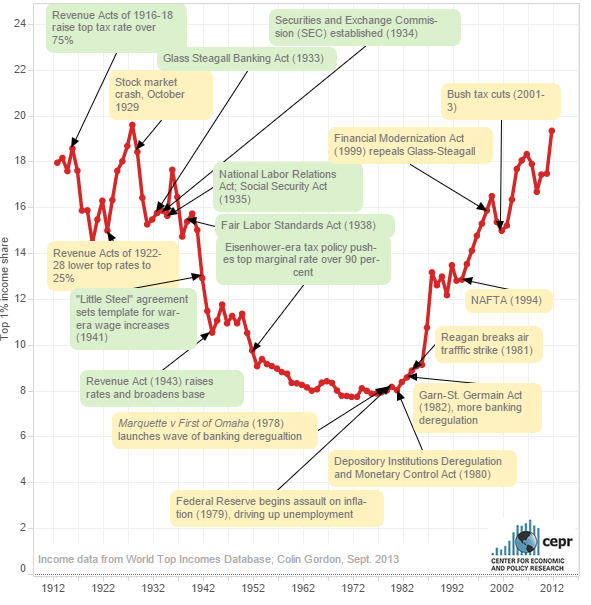
Fed doublespeak and the dismantling of the middle class: Fed states dropping “patient” word doesn’t mean it is impatient on rates. In 1970 roughly 7 percent of all income was earned by the top 1 percent. Today it is closer to 20 percent.

MyBudget360
March 18, 2015

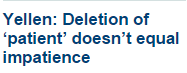
The Fed has taken a page out of George Orwell’s 1984.  Doublespeak is all the rage and the Fed’s statements are analyzed as if sifting for gold.  Even when they don’t do anything markets jump.  The Fed sets the tone on our debt addiction.  The Fed dropped the word “patient” in terms of increasing interest rates but then goes on to say this doesn’t mean that it will be impatient.  Say what?  The Fed hints at tapering and balks because it claims there is “low inflation” but when we look at real inflation, the price of many items is shooting up dramatically.  Many of these items were staples of the middle class including an affordable college education, a home, and being able to earn a good wage.  Back in 1975 roughly 7 percent of all income earned went to the top 1 percent.  Today it is closer to 20 percent.  The last time it was this high was during the years prior to the Great Depression.
Share of income
The middle class is being dismantled by economic forces.  More Americans find that they are working in the low wage economythat is booming.  For most households income does matter because this is how you finance your life.  The Fed has created a system where savers are punished.  Negative interest rates punish traditional savings.  It makes stocks, junk bonds, and other speculative items seem more lucrative.  Those that take on big levels of debt are encouraged.  So it is no surprise then that all items financed by debt are suddenly going up in price: housing (mortgages), college (student debt), and cars (auto debt).  Yet the larger gains are not trickling down to workers.
Take a look at this chart showing the share of income earned by the top 1 percent:
share of income top 1 percent
It is no coincidence that after World War II in 1945 all the way to 1980 was the time the US middle class thrived the most.  It was also a time when the top 1 percent were earning roughly 7 percent of all total income.  When you put more dollars into the hands of middle class Americans, that money will get spent.  However, aggregate the money into fewer hands and you see what we have today.  An army of struggling Americans while a smaller group is pushing up the price on luxury goods and in finance, is creating a new rentier class.
The Fed realizes how addicted Americans are to debt.  This headline speaks of 1984:
fed speak
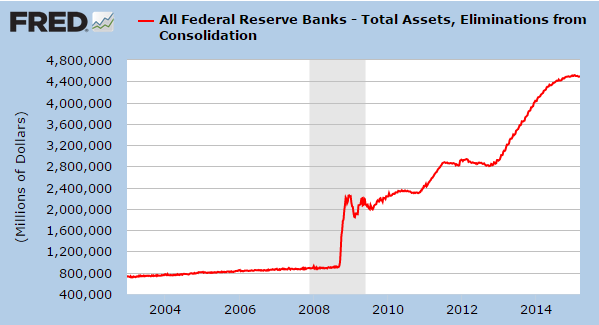
The markets of course responded positively to this.  It only adds to the confusion.  The Fed has kept rates in negative territory for many years now.  Those saying there is no inflation are failing to look in obvious places.  All you need to do is look at the Fed balance sheet and you realize there is no pulling back in this trend:
fed balance sheet
The Fed is playing the confidence card.  They are trying to sway markets with anticipation.  Like the man always telling his anxious girlfriend that “someday” in the future he will pop the question but never does.  Actions speak louder than words.  Look at the Fed balance sheet.  The balance sheet tells us the Fed is incredibly impatient in restoring balance and is doubling-down on this debt based rally.
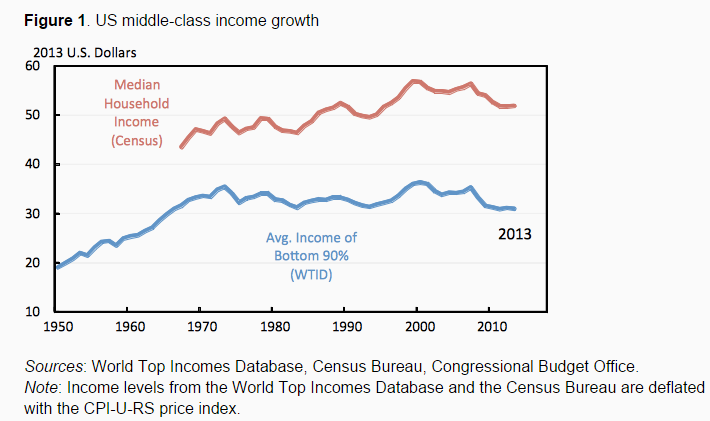
The middle class is falling behind:
middle class us
Incomes have gone stagnant for well over a decade for middle class families.  During this time, the share of income going to the top 1 percent has more than doubled.  Those with the ability to leverage debt or more importantly, create money by full on monetization are the power brokers in this system.  The Fed is out of tricks and is now resorting to doublespeak.  The public is left dealing with a trend of low wage jobs and is being pushed into utilizing debt to chase the artifacts of middle class life.  The market is severely under pricing the risk of too much debt once again.

THE BUILD-UP OF SYSTEMIC RISK, A CRISIS OF CONFIDENCE IS AHEAD, 2008 WAS ABOUT PRIVATE CREDIT – THE NEXT CRISIS WILL BE ABOUT PUBLIC CREDIT

Investment Watch
March 17, 2015


This extensive discussion covers a wide range of subjects including:
  • THE BUILD-UP OF SYSTEMIC RISK
  • A CRISIS OF CONFIDENCE IS AHEAD
  • WHY WE HAVE RECORD ARTIFICIAL HOUSEHOLD WEALTH
  • FINANCIAL FRAGILITY – As long as Credit is expanding things looks good. But it camouflages the underlying financial fragility.
  • 2008 WAS ABOUT PRIVATE CREDIT – THE NEXT CRISIS WILL BE ABOUT PUBLIC CREDIT
  • THE GLOBAL BUBBLE HAS NOW BEEN PIERCED
“You can now expect the unexpected from Policy Makers”

Peter Schiff :Fed Policies Are Creating Another Bubble Which Can't Last

SIC SEMPER TYRANNIS!!! News
Mark Matheny
July 8, 2014


Before the econimic crisis of 2007-8, Peter Schiff was one of the few voices crying out, warning Americans that there was a crisis coming. He warned that the Fed Stimulus from 2001 and on at that time was one of the main factors which would and did bring on the crisis in late 2007 and into 2008. At that time several other strategists and investors laughed at his predictions.


Once again, Peter is warning that the Fed has not done anything different in order to correct the economy and bring true, sound growth, but instead has continued to inflate the stock market while devaluing the dollar, which ultimately steals from the lower and middle class in order to prop the Stock market which primarilly ingratiates only the mega rich and corporations, yet once again, the shills for the Fed and Wall Street are scorning his predictions of a future bubble burst and possible major decline of the dollar.

Peter Schiff on Fox Business (7/8/2014)

  • Peter Schiff Believes the Dow should be more at 12,000 currently and not 17,000. He argues that if the Fed was doing the right thing by removing all the monetary financial props, and let interest rates rise, then the market would fall substantially.
  • He believes, however, that the Fed will instead, sacrifice the dollar in order to continue propping up the Stock Market, and the housing market in order to perpetuate the current phony recovery.
  • He believes foreign investing and gold are safer havens against long term inflation, and is doubtful of U.S. stocks.
  • He charges that the Fed blew up the real estate bubble that caused the 2008 housing crisis,
  • Now the Fed is compounding the current problem by keeping interest rates at the artificially low rate of 0%
  • America is not saving enough, and not investing enough, and not producing enough, but only borrowing, consuming, and speculating, and so the U.S. economy is weakening.
  • He believes the stimulus of 2008 has only prolonged the impending crisis that will come again in the future, and will in fact be much worse than the last crisis in 2008.
We will see if he is again correct. I personally believe he will be, unfortunately.

The loud noise of inflation: Fed underplays current rise in inflation as noise while Americans see higher home prices, tuition, food costs, and energy prices.

MyBudget360
June 22, 2014

It was interesting to hear the Federal Reserve mention that the higher than expected inflation numbers are merely noise. It is highly unlikely that most Americans feel the current rise in prices as noise. Inflation has a way of eating into every penny that you have especially when the market is flooded with debt. Just think of the price of items ten years ago and you will realize that practically everything has increased in cost including; housing, rents, college tuition, healthcare, food, and energy. It is also the case that wages have simply not kept up with price hikes. In other words, the cost of important items is trailing the growth of wages. What we have is a decline in the standard of living brought on by inflation. It happens slowly and many fail to realize it is happening. You see it over the last few years with banks flooding the housing market and crowding out regular families. The Fed has been the number one buyer of mortgage-backed securities and the repercussions are very noticeable in the housing market. The markets saw a stiff rise in commodities recently as people suddenly realize that the Fed is fully addicted to debt and is disconnected from what is happening with average families.
The noise of inflation
The Fed is hungry for inflation. Trying to control inflation is like trying to control a wild tiger. The Fed’s recent comments on inflation are largely disconnected from the lives of working families:
“(WSJ) Recent readings on, for example, the CPI index have been a bit on the high side,” but the data are “noisy,” Ms. Yellen said at a press conference following a meeting of the Fed’s policymaking committee. “I think it’s important to remember that, broadly speaking, inflation is evolving in line with the committee’s expectations. The committee has expected a gradual return in inflation toward its 2% objective, and I think the recent evidence that we’ve seen, abstracting from the noise, suggests that we are moving back gradually, over time, toward our 2% objective.”
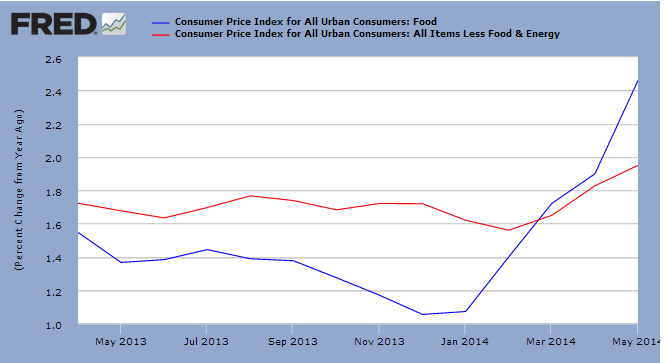
This is an odd target here. The reason this is odd is that wages are not increasing and the Fed certainly doesn’t mention targeting wage growth. So even targeting a 2 percent inflation rate is destructive to households not seeing jumps in wages. Take a look at the noise below:
food and energy
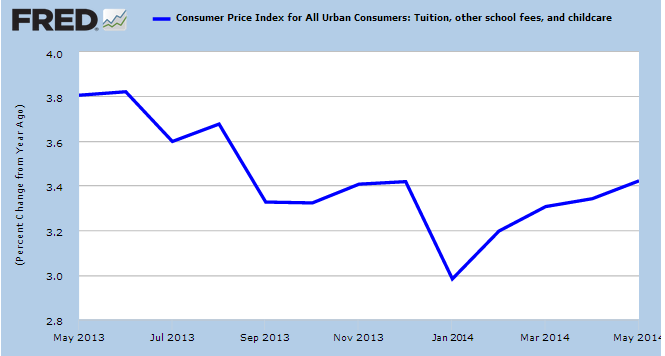
Food and energy costs are increasing at the fastest rate in over a year. These are costs that fall on the backs of Americans on a daily basis. You also have tuition increasing at a rate above 3 percent:
tuition
This looks like more than noise to me. We have a generation of Americans now unable to buy homes and going with rentals. Call them Generation R. Now why is homeownership such a hard task to accomplish for younger Americans? The answer involves depressed wages, high student debt, and housing prices going up thanks to investor demand. In the end, more disposable income is being siphoned away (this is how inflation feels in the long-term if wages don’t keep up).
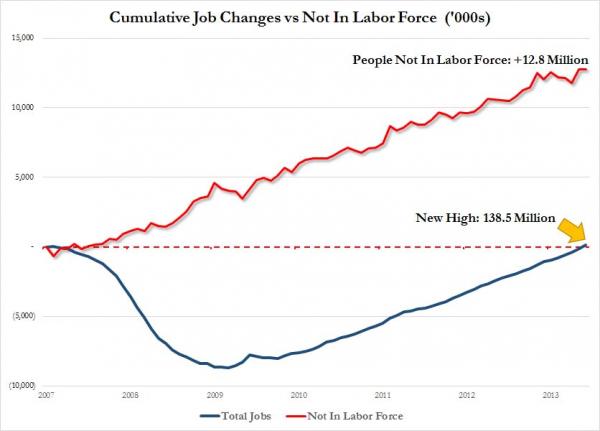
I suppose to big banks and big investors this does seem like noise. I’m sure having 47 million Americans on food stamps seems like noise and the startling reality that 13 million Americans have been added to the “not in the labor force” category since the recession ended is also just noise:
record-jobs-in-context
This is more than noise. This is the devouring sound of inflation. It has a deep impact on the way you live your life and your standard of living. Do you really trust in those banks that led the country into the biggest financial crisis since the Great Depression? The Fed has given them full authority to manage the economy and it is no wonder that their balance sheets look incredibly happy while most Americans continue to face a declining standard of living.
Let us all chant “it is only noise” as we pump that gas into our cars. Let us chant “it is only noise” when we see college tuition go up year after year. Let us chant “it is only noise” when we see our grocery bill surge. Let us chant “it is only noise” when we see housing values increase thanks to floods of investor money. Get those inflation ear plugs out, because I have a feeling we are in for a whole lot of noise.

THE UNITED STATES OF DEBT: TOTAL DEBT IN AMERICA HITS A NEW RECORD HIGH OF NEARLY 60 TRILLION DOLLARS

Economic Collapse
June 16, 2014

What would you say if I told you that Americans are nearly 60 TRILLION dollars in debt?

What would you say if I told you that Americans are nearly 60 TRILLION dollars in debt?  Well, it is true.  When you total up all forms of debt including government debt, business debt, mortgage debt and consumer debt, we are 59.4 trillion dollars in debt.  That is an amount of money so large that it is difficult to describe it with words.  For example, if you were alive when Jesus Christ was born and you had spent 80 million dollars every single day since then, you still would not have spent 59.4 trillion dollars by now.  And most of this debt has been accumulated in recent decades.  If you go back 40 years ago, total debt in America was sitting at about 2.2 trillion dollars.  Somehow over the past four decades we have allowed the total amount of debt in the United States to get approximately 27 times larger.  This is utter insanity, and anyone that thinks this is sustainable is completely deluded.  We are living in the greatest debt bubble of all time, and there is no way that this is going to end well.  Just check out the chart…
Total Debt
When the last recession hit, total debt in America actually started going down for a short period of time.
But then the Federal Reserve and our politicians in Washington worked feverishly to reinflate the bubble and they assured everyone that everything was going to be just fine.  So Americans once again resorted to their free spending ways, and now total debt in the United States is rising at almost the same trajectory as before and has hit a new all-time record high.
We see a similar thing when we look at a chart for consumer debt in America…
Total Consumer Credit
For a while after the recession it was trendy to cut up your credit cards and get out of debt.
But that fad wore off rather quickly, didn’t it?
It is almost as if 2008 never happened.  We are making the same mistakes with debt that we did before.
As I noted recently, total consumer credit in the U.S. has risen by 22 percent over the past three years alone, and at this point 56 percent of all Americans have a subprime credit rating.
And have you noticed that a lot of people are not afraid to extend themselves in order to buy shiny new vehicles these days?
During the first quarter 0f this year, the size of the average vehicle loan soared to a new all-time record high of $27,612.
Five years ago, that number was just $24,174.
And as I noted in one recent article, the size of the average monthly car payment in this country is now up to $474.
That is practically a mortgage payment.
Speaking of mortgage payments, even though home sales have been falling and the rate of homeownership in the United States is the lowest that it has been in 19 years, a very large percentage of those who own homes are still overextended.
In fact, one recent survey discovered that a whopping 52 percent of Americans cannot even afford the house that they are living in right now.
At the same time, an increasing number of Americans are acting as if the last financial crisis never happened and are treating their homes like piggy banks.   Home equity loans are soaring again, and when the next great crisis strikes a lot of those people are going to end up getting into a lot of financial trouble.
There has been much written about what is wrong with the housing industry, but the truth is that home prices are still way too high and young adults cannot afford to purchase homes because they are already loaded down by huge amounts of debt even before they get to the point where they are ready to buy.
In fact, a newly released survey found that 47 percent of millennials are spending at least half of their paychecks on paying off debt…
Four in 10 millennials say they are “overwhelmed” by their debt — nearly double the number of baby boomers who feel that way, according to a Wells Fargo survey of more than 1,600 millennials between 22 and 33 years old, and 1,500 baby boomers between 49 and 59 years old.
To try to get out from underneath it, 47% said they spend at least half of their monthly paychecks on paying off their debts.
When I read that I was absolutely astounded.
Of course the biggest debt that many young adults are facing is student loan debt.  According to the Federal Reserve, there is now more than 1.2 trillion dollars of student loan debt in this country, and about 124 billion dollars of that total is more than 90 days delinquent.
What we have done to our young people is shameful.  We have encouraged them to sign up for a lifetime of debt slavery before they even understand what life is all about.  The following is an excerpt from my previous article entitled “Is College A Waste Of Time And Money?“…
In America today, approximately two-thirds of all college students graduate with student loan debt, and the average debt level has been steadily rising.  In fact, one study found that “70 percent of the class of 2013 is graduating with college-related debt – averaging $35,200 – including federal, state and private loans, as well as debt owed to family and accumulated through credit cards.”
That would be bad enough if most of these students were getting decent jobs that enabled them to service that debt.
But unfortunately, that is often not the case.  It has been estimated that about half of all recent college graduates are working jobs that do not even require a college degree.
Considering what you just read, is it a surprise that half of all college graduates in America are still financially dependent on their parents when they are two years out of college?
According to the U.S. Census Bureau, only 36 percent of all Americans under the age of 35 own a home at this point.  That is the lowest level that has ever been recorded.
And we are passing on to our young people the largest single debt in all of human history.  Weighing in at 17.5 trillion dollars, the U.S. national debt is a colossal behemoth.  And almost all of that debt has been accumulated over the past 40 years.  In fact, 40 years ago the U.S. national debt was less than half a trillion dollars.
But this is just the beginning.  As the Baby Boomer “demographic tsunami” washes through our economy, we are going to be facing a wave of red ink unlike anything we have ever contemplated before.
Meanwhile, the rest of the planet is drowning in debt as well.
As I wrote about the other day, the total amount of debt in the world has risen to a new all-time record high of $223,300,000,000,000.
Our “leaders” keep acting as if these debt levels can keep growing much faster than the overall level of economic growth indefinitely.
But anyone with even a shred of common sense knows that you can’t spend more money that you bring in forever.
At some point, a day of reckoning arrives.
2008 should have been a major wake up call that resulted in massive changes.  But instead, our leaders just patched up the old system and reinflated the old bubbles so that they are now even larger than they were before.
They assure us that they know exactly what they are doing and that everything will be just fine.
Unfortunately, they are dead wrong.