Showing posts with label world currency. Show all posts

Dollar Heads for Biggest Monthly Advance Against Yen Since 2009

Bloomberg Markets
November 29, 2016


The dollar was on pace for its best month against the yen since 2009 as signs of U.S. economic strength spurred bets that monetary tightening will accelerate.
The greenback has risen more than 7 percent in November amid speculation U.S. President-elect Donald Trump will pursue reflationary policies, as futures signal growing bets that the Federal Reserve will follow an interest-rate increase in December with additional hikes next year.
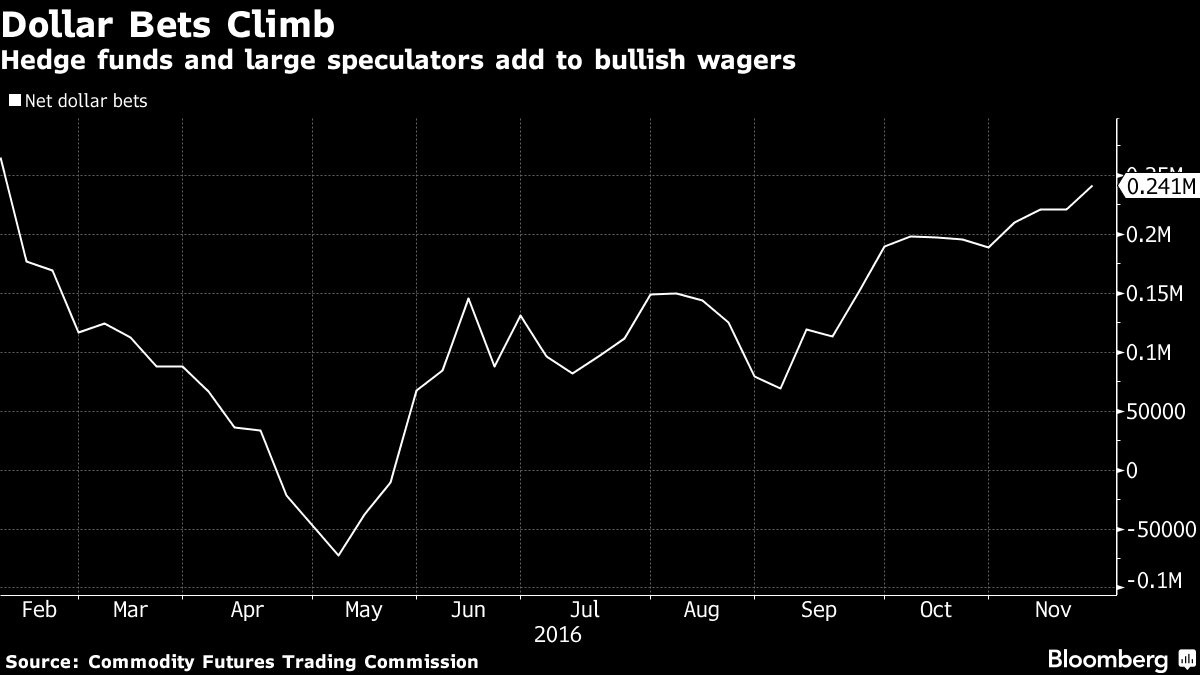
The three-week rally since Nov. 4 was the dollar’s biggest versus the yen in more than two decades. Hedge funds and other large speculators have boosted bullish dollar wagers to the most since February, according to Commodity Futures Trading Commission data. A report Tuesday showing the U.S. economy expanded more than previously reported last quarter added to the bullish backdrop.
“The dollar’s going to appreciate and we think the biggest move is actually going to come against the yen,” Steven Saywell, global head of foreign-exchange strategy at BNP Paribas SA, said in an interview on Bloomberg Television. “The greatest policy divergence, or difference between central-bank policies, is going to be between that of the U.S. and the Japanese.”
The bank expects the dollar to move toward 115 yen at the end of the first quarter and to 128 by the end of 2017.
The dollar appreciated 0.4 percent to 112.38 yen as of about 4:30 p.m. in New York, after reaching an eight-month high of 113.90 last week. The Bloomberg Dollar Spot Index, which measures the greenback against 10 major peers, is up 3.4 percent in November.
“Dollar-yen is particularly sensitive to the Trump-reflation trade -- that’s clearly what we’ve witnessed over the last three to four weeks since the election,” said Ned Rumpeltin, European head of currency strategy at Toronto-Dominion Bank in London. Still, “we’re past the point where markets are willing to embrace the policy shift with blind optimism.”

3-minute video: Public banks and monetary reform generate ~$1 million near-instant benefits for every US household: 2nd American Revolution more important than 1776

Washington's Blog

March 27, 2016


This article provides detailed history and data to explain what all macroeconomics courses teach: what we use for money is created as debt.
What these courses don’t usually teach are the consequences of creating what we use for money as negative numbers increasing forever: unpayable and ever-increasing total debt.

The top three benefits each of monetary reform and public banking total ~$1,000,000 for the average American household, and would be received nearly instantly.
Monetary reform is the creation of debt-free money by government for the direct payment of public goods and services. Creating money as a positive number is an obvious move from our existing Robber Baron-era system of only creating debt owed to privately-owned banks (a negative number) as what we use for money. Our Orwellian “non-monetary supply” of adding negative numbers forever causes today’s tragic-comic increasing and unpayable total debt. You learned these mechanics of positive and negative numbers in middle school, and already have the education and life experience to conclude with Emperor’s New Clothes absolute certainty that accelerating total debt is the opposite of having money. As a National Board Certified and Advanced Placement Macroeconomics teacher, I affirm this is also exactly what is taught to all economics students.

The public benefits of reversing this creature of Robber Barons are game-changing and near-instant. We the People must demand these, as .01% oligarchs have no safe way to do so without admission of literal criminal fraud by claiming that debt is its opposite of money.
The top 3 game-changing benefits of monetary reform:
  1. We pay the national debt in proportion to removing private banks’ ability to create what we use for money as debt in order to prevent inflation. We retire national debt forever.
  2. We fully fund infrastructure that returns more economic output than investment cost for triple upgrades: the best infrastructure we can imagine, up to full-employment, and lower overall costs.
  3. We stop the ongoing Robber Barons who McKinsey’s Chief Economist documents having ~$30 TRILLION in tax havens, and the Fed finding the US top seven banks creating shell companies to hide $10 trillion. This amount is about 30 times needed to end all global poverty, which has killed more people since 1995 than all wars and violence in all human history.

Public banking creates at-cost and in-house credit to pay for public goods and services without the expense and for-profit interest of selling debt-securities. North Dakota has a public bank for at-cost credit that results in it being the only state with annual increasing surpluses rather than deficits.

SWISS POLITICIANS SLAM ATTEMPTS TO ELIMINATE CASH, COMPARE PAPER MONEY TO A GUN DEFENDING FREEDOM

Zero Hedge
February 19, 2016


As we predicted over a year ago, in a world in which QE has failed, and in which the ice-cold grip of NIRP has to be global in order to achieve its intended purpose of forcing savers around the world to spend the taxed product of their labor, one thing has to be abolished: cash.
This explains the recent flurry of articles in outlets such as BBG and the FT, and op-eds by such “established” economists as Larry Summers, all advocating the death of cash, a process which would begin by abolishing high denomination bills and continue until all physical cash in circulation is eliminated, something we warned about when the first made it first NIRP hint last September.
We were s rather surprised by the candor of a WSJ piece overnight which actually told it how it is:
The real reason the war on cash is gearing up now is political: Politicians and central bankers fear that holders of currency could undermine their brave new monetary world of negative interest rates. Japan and Europe are already deep into negative territory, and U.S. Federal Reserve Chair Janet Yellen said last week the U.S. should be prepared for the possibility. Translation: That’s where the Fed is going in the next recession.
* * *
By all means people should be able to go cashless if they like. But it’s hard to avoid the conclusion that the politicians want to bar cash as one more infringement on economic liberty. They may go after the big bills now, but does anyone think they’d stop there? Why wouldn’t they eventually ban all cash transactions much as they banned gold and silver as mediums of exchange?
Beware politicians trying to limit the ways you can conduct private economic business. It never turns out well.
We were even more surprised when we read that in Switzerland, the place which offers the highest denomination banknote in Europe, the 1,000 Swiss Franc note (and the second highest in the world after the Singapore $10,000 note) two politicians, Philip Brunner and Manuel Brandberg, members of the right-wing Swiss People’s Party, have proposed a motion that they hope Zug will support for a cantonal initiative seeking changes to the federal currency law.
They argue that the creation of 5,000-franc notes will ensure that the Swiss franc maintains its status as a safe haven currency.
As we reported previously, this proposal is the diametrical opposite of what the ECB hopes to do, and of where the European Union wants to go, where finance ministers have talked about withdrawing 500-euro bills from circulation to deter their use for “financing terrorism, money laundering and other illegal activities”, all made up terms designed to give the impression that politicians are slowly eliminating physical currency in circulation for your own good.
They are not.
This is what the Swiss politicians admit too: Brunner and Brandberg maintain that the tendency in the EU and in OECD member countries is to “weaken individual liberties” and to exercise greater control over citizens.
But it is what they say next that may define the libertarian political platforms around the globe for the next several years – also known as the global NIRP period – because it is 100% spot on:
In this context “cash is comparable to the service firearm kept by Swiss citizen soldiers,” the pair argued in their motion, saying they both “guarantee freedom”.
“In France and Italy already cash payments of only up to 1,000 euros are allowed and the question of the abolition of cash is being seriously discussed and considered in Europe, “ Brunner said on his Facebook page.
The move toward electronic payments allows governments “total surveillance” over individuals, the pair claim.
Of course, the proposal was promptly shot down by the Swiss National Bank: “Walter Meier, a spokesman for the Swiss National Bank, which is responsible for Switzerland’s money, told 20 Minuten newspaper the introduction of banknotes of a higher denomination is “not an issue.”
Keep in mind this is the same central bank which in late 2014 pushed hard against a popular referendum to replenish Swiss sovereign gold by buying gold in the open market, only to generate billions in paper losses months later when it admitted defeat in the currency war with the ECB; a central bank which then lost even more billions when it decided to buy shares of AAPL at their all time high price and is now sitting on substantial paper losses.
As for the Swiss proposal to print higher denomination currencies, we are confident it won’t pass now: if it did, there would be an unprecedented rush from around the globe to park savings in Swiss cash, just like in the good old days.
But the time of big currency denominations is coming one way or another: after all, NIRP is the falling Keynesian system’s penultimate hope. When it fails, there is just one last option, the one we have said is coming ever since 2009, the one which even the “smartest money in the world” agreed today is inevitable: helicopter money.
And as Ben Bernanke made it all so clear in 2002, once the helicopter money comes, hyperinflation is very close behind. And one thing hyperinflation always brings with it, is very highly denominated bank notes. Just ask Zimbabwe.
Why there’s a war on cash; it’s about central banks consolidating power

Personal Liberty
February 13, 2016

cash hidden in mattress
The war on cash has gone from overt to covert. Having expended all their ammo with Quantitative Easing to infinity and zero interest rate policy (ZIRP), central banks are now looking toward negative interest rates.
What are negative interest rates? Right now, banks pay only slightly above 0 percent interest on savings. In reality, that’s already a negative rate of return. Real inflation   (not the government’s fiction inflation) of the money supply is running north of 7 percent.  So your money depreciates while in savings.  You might as well hide it under the mattress.
But banksters now are looking for ways to make use of cash difficult and also charge people a fee (negative interest) to deposit and hold their money. Likewise, all deposits are now subject to a “haircut” if the bank is about to go belly-up.  That means banksters will skim some off the top of all deposit accounts in order to keep the “too-big-to-fails” afloat.
JP Morgan Chase recently implemented new controls on cash. Want to make a cash deposit or pay a loan or credit card with cash? You must show ID. And now Citibank is preparing new policies for cash deposits. Cash deposits to an account will require the depositor to state the purpose of the deposit, provide a Social Security number, provide identification and provide a place of employment and job type.
Apparently there’s begun such a huge increase in people using cash to pay off debts for other people or expand other people’s savings accounts that banksters are becoming concerned. (Excuse the sarcasm.)
So why are banksters suddenly opposed to cash? There are three reasons (at least): they can’t control or track its use, to prevent people from pulling their money out of banks if negative interest rates (where people pay the bank to hold their cash) are introduced, and to consolidate their power.
Of course, that is not the excuse the banksters use. They claim cash is tool of criminals. In a report  for the Harvard Kennedy School for Business, Peter Sands proposes eliminating “high value currency notes” like $100 bills because, “Such notes are the preferred payment mechanism of those pursuing illicit activities, given the anonymity and lack of transaction record they offer, and the relative ease with which they can be transported and moved. By eliminating high denomination, high value notes we would make life harder for those pursuing tax evasion, financial crime, terrorist finance and corruption.”

Abolishing Cash – The New Age Of Economic Totalitarianism

Zero Hedge
May 18, 2015

Europe is moving full speed ahead to eliminate all cash.
Euro Bank Notes

Instead of reforming and tackling the economic problems, government always seeks to maintain the same course of thinking that now leads us to the totalitarian approach coming from Brussels.
To maintain the euro, they must maintain the banks. However, the bank reserves are debts of all member states. As government becomes insolvent as in Greece, the banking system is undermined. The only way to prevent the banking collapse is to prevent people from withdrawing cash.
Hence, we see this trend is surfacing in all the mainstream press to get the people ready for what is coming after 2015.75 – the elimination of cash. We are even starting to see this advocated in parts of Germany. We will not be able to buy or sell anything without government approval. That is where we are going, and it may be the major event that erupts after 2015.75.
The bail-in that took place in Cyprus managed to get away without bloodshed. The people just took it.
This has encouraged governments everywhere, since now they know they can safely do the same thing and the people are like sheep – dumb and stupid.
Sheep Herd

Just how much will society take before they say no?

Bank of America: Markets Are in a 'Twilight Zone' and It's Time to Hold More Cash and Gold

Bloomberg
May 19, 2015

In a note sent out this morning, Bank of America Merrill Lynch has a warning for investors: 
Investors remain trapped in “The Twilight Zone”, the transition period between the end of QE and the first rate hike by the Fed, the start of policy normalization...until (a) the US economy is unambiguously robust enough to allow the Fed to hike and (b) the Fed’s exit from zero rates is seen not to cause either a market or macro shock (as it infamously did in 1936-7), the investment backdrop will likely continue to be cursed by mediocre returns, volatile trading rotation, correlation breakdowns and flash crashes. For this reason we continue to advocate higher than normal levels of cash, adding gold and owning volatility in mid 2015. Given extremities of liquidity, profits, technological disruption, regulation, income inequality…potential for a cleansing drop in asset prices cannot be dismissed. Most likely catalysts: Consumer, Rates, A-shares, Speculation, High Yield.
The note also highlights two interesting disconnects in the markets:
  1. Investors say they are optimistic, but there is a high level of cash on the sidelines
  2. U.S. stock prices are at record highs, but equity funds are seeing outflows
Regarding the first point, one of Bank of America's surveys showed investor sentiment as being “risk-on," which it says is normally associated with less cash on the sidelines.
To the second point, the note says U.S. equity funds have suffered $100 billion of outflows in 2015 while the S&P 500 is near all-time highs, which its data says isn't exactly typical. 
The analysts led by Michael Hartnett attribute this to clients favoring European and Japanese equities at the expense of the U.S and that buying from those not captured in flow data (sovereign wealth funds, pension funds and central banks) could be what's giving U.S. equity indices a boost. 
The note hints that that you actually ought to sell in May and go away, at least for certain asset classes. 

The summer months offer a lose-lose proposition for risk assets: either the macro improves and the Fed gets to hike, which will at least temporarily cause volatility; or more ominously for consensus positioning, the macro does not recover, in which case EPS downgrades drag risk-assets lower. 

Citi Economist Says It Might Be Time to Abolish Cash

Bloomberg Business
April 17, 2015

The world's central banks have a problem.
When economic conditions worsen, they react by reducing interest rates in order to stimulate the economy. But, as has happened across the world in recent years, there comes a point where those central banks run out of room to cut — they can bring interest rates to zero, but reducing them further below that is fraught with problems, the biggest of which is cash in the economy.
In a new piece, Citi's Willem Buiter looks at this problem, which is known as the effective lower bound (ELB) on nominal interest rates.
Fundamentally, the ELB problem comes down to cash. According to Buiter, the ELB only exists at all due to the existence of cash, which is a bearer instrument that pays zero nominal rates. Why have your money on deposit at a negative rate that reduces your wealth when you can have it in cash and suffer no reduction?
Cash therefore gives people an easy and effective way of avoiding negative nominal rates.
Buiter's note suggests three ways to address this problem:
  1. Abolish currency.
  2. Tax currency.
  3. Remove the fixed exchange rate between currency and central bank reserves/deposits.
Yes, Buiter's solution to cash's ability to allow people to avoid negative deposit rates is to abolish cash altogether. (Note that he's far from being the first to float this idea. Ken Rogoff has given his endorsement to the idea as well, as have others.)
Before looking at the practicalities of abolishing currency, we should first look at whether it could ever be necessary. Due to the costs of holding large amounts of cash, Buiter puts the actual nominal rate at which the move to cash makes sense as closer to -100bp. So, in order for a cash abolition to become necessary, central banks would need to be in a position where they wished to set nominal rates much lower than that.
Buiter does not have to go far to find an example of where a central bank may have wanted to set interest rates much lower to -100bp. He uses (a fairly aggressive) Taylor Rule to show that Federal Reserve rates should have been as low as -6 percent during the financial crisis.
It seems Buiter is correct: Sometimes strongly negative nominal rates are called for. 
Buiter is aware that his idea may be somewhat controversial, so he goes to the effort of listing the disadvantages of abolishing cash.
  1. Abolishing currency will constitute a noticeable change in many people’s lives and change often tends to be resisted.
  2. Currency use remains high among the poor and some older people. (Buiter suggests that keeping low-denomination cash in circulation — nothing larger than $5 — might solve this.)
  3. Central banks and governments would lose seigniorage revenue.
  4. Abolishing currency would inevitably be associated with a loss of privacy and create risks of excessive intrusion by the government.
  5. Switching exclusively to electronic payments may create new security and operational risks.
Buiter dismisses each of these concerns in turn, finishing with:
In summary, we therefore conclude that the arguments against abolishing currency seem rather weak.
Whatever the strength of the arguments, the chances of an administration taking the decision to abolish cash seem vanishingly small. 

IT’S STARTING: RUSSIANS AND CHINESE ARE DITCHING THE DOLLAR AND EUROPEANS ARE USING RENMINBI IN THEIR RESERVES

Economic Policy Journal
October 19, 2014


At present, US dollar accounts for roughly 61% of the world's foreign exchange reserves.

It's still a safe bet for most, not because the currency is actually strong, but because so many others are already so reliant on it.

Between those with reserves in and pegs to the US dollar, many countries have given their allegiance, and now have a vested interest in the health of the currency.

Due to this common interest, a sort of unofficial, involuntary alliance has been formed between them all.

Together, they’re all playing along, pretending that everything is fine. If the dollar collapses, they're all screwed, so they've got to get each other’s backs.

From the throne of the world’s reserve currency, the Federal Reserve, with the power to print the US dollar, feels dangerously omnipotent.

They can get away with just about anything. For now.

The central bankers get to print dollars and spend them at current prices, before the stuff hits the wider market and diminishes its overall value.

And for the time being they don’t really face any consequences. The whole world just absorbs it. Other countries really have no other choice.

But
they’re getting tired of putting up with this abuse, and the unrest is growing. New alliances are being made, this time to dethrone the dollar.

Just this week yet another currency swap agreement was made between the Chinese and Russian central banks. This time for 150 billion renminbi.

Trade volume between China and Russia will reach $100 billion (600 billion renminbi) next year, and is expected to reach $200 billion in 2020. This latest currency swap agreement will greatly reduce the need for dollars in their transactions.

Currently, 75% of trade between the two countries is settled in dollars. When they signed the agreement for the bilateral currency swap, Russian deputy Prime Ministers said this will “encourage companies from the two countries to settle trade in local currencies and avoid the use of a third country’s currency.”

Who do you think that was aimed at?

Threatened by the growing strength of China and Russia, the US is actively working to vilify the two. Between the headlines of war, both cyber and military, the government is unsubtly trying to bring back the days of yellow peril and the red scare.

However, it can't use the same tactics on its longstanding ally—Europe.

Even the European Central Bank has started discussions on the possibility of including the renminbi as one of its reserve currencies.

And the euro and the renminbi are already directly tradable as of this month.

On Tuesday the UK also became the first country besides China to issue a sovereign bond in renminbi.

This coincided with the issuing of 180 million renminbi of corporate bonds by China’s ICBC in South Korea. Another first. South Korea is firmly on the renminbi train as renminbi deposits in the country jumped 55-times in just one year.

It’s very clear where the trend is going. All these news items are pieces of the same puzzle. The US dollar’s throne is shaking as it’s losing its importance and status as the preeminent currency in the world. Renminbi is on the way up.

The whole existing order of a single ruling currency is currently being challenged.

A new financial era is coming.

Simon Black is Senior Editor, SovereignMan.com

Point de Presse Cashless Society

You Tube
August 5, 2014


Published on Jun 25, 2014

Cashless payment with cards is rapidly catching up. Sweden is years ahead of Switzerland in this respect, which is why SIX used this opportunity to consider and present Sweden as an example of a possible benchmark: "the cashless society" was a SIX press event with the kind support of the Swedish Swiss Chamber of Commerce.

Business Document Reveals Cashless Society Coming Soon

SIC SEMPER TYRANNIS!!! News
Mark Matheny
July 11, 2014


" And he causeth all, both small and great, rich and poor, free and bond, to receive a mark in their right hand, or in their foreheads:
 And that no man might buy or sell, save he that had the mark, or the name of the beast, or the number of his name.
 Here is wisdom. Let him that hath understanding count the number of the beast: for it is the number of a man; and his number is Six hundred threescore and six." Revelation 13:16-18

A Report from Cubic Corporation reveals the reality of a coming Cashless society in the near future.


According to the Cubic Corporation website they are:
....diversified systems and services company in transportation and defense markets worldwide. We are a leading technology and specialized services company with a worldwide presence in nearly 60 nations. Cubic employs approximately 8,000 people worldwide. 
 Cubic’s defense businesses provide comprehensive mission support services and training systems that strengthen the readiness of national militaries and security forces. Our communications and cyber products safeguard and transmit data in real world operations.We also track assets for commercial and military customers who need to know about their assets 24/7 anywhere in the world.
 The Document published in 2012 by Cubic Corporation  titled: "Urban Intelligence II-A Cashless Society is Coming Soon"discusses the near future of a cashless society, and some of the benefits that will be enjoyed by banking institutions and governments:

  • Cash is expensive to print, inspect, move, store and guard
  • Counterfeiting is always going to be a problem as long as paper currency exists 
  • Cash is favored by criminals because it does not leave a paper trail. Eliminating cash would make it much more difficult for drug dealers and other criminals to do business
  • A cashless society would give governments more control.Governments would be able to track virtually all transactions and would also be able to monitor tax compliance much more closely
The document reveals that currently in the United States, only about 7% of all transactions are still done in paper and coin currency. The document also discusses the use of facial recognition, voice analysis and the use of RFID implants in the current time and near future for improved security measures against identity theft.
The article states RFID use may be utilized by the TSA in the near future as well:

An RFID chip can be read up to four feet away, making it a prime candidate for TSA identity scanning. So the convenience factor on many levels may move the technology forward to enable a future cashless society


The video report by the Financial Times discusses the use of electronic currencies such as bitcoin, and the use of meta data attached which would be able to put limits on what could actually be purchased with the electronic credits.


By Mark Matheny

THE ALMIGHTY DOLLAR IS IN PERIL AS THE GLOBAL ‘DE-DOLLARIZATION’ TREND ACCELERATES

The Economic Collapse
July 7, 2014
Image Credits: Public domain


As the Obama administration continues to alienate almost everyone else around the entire planet, an increasing number of prominent international voices are starting to question why the U.S. dollar should be so overwhelmingly dominant in global trade.  In previous articles, I have discussed Russia’s “de-dollarization strategy” and the fact that Gazprom is now asking their large customers to start paying in currencies other than the dollar.  But this is not just a story about Russia any longer.  As you will read about below, China and South Korea have just signed a major agreement to facilitate trade with one another using their own national currencies, and even prominent French officials are now talking about the need to use the dollar less and the euro more.  John Williams of shadowstats.com recently said that things have never “been more negative” for the U.S. dollar, and he was right on the mark.  The power of the almighty dollar has allowed all of us living in the United States to enjoy an extremely high standard of living for decades, but as that power now fades it is going to have profound implications for the U.S. economy.  In future years the value of the dollar will go down substantially, all of the imported goods filling our stores will become much more expensive, and it is going to cost the federal government a lot more to borrow money.  Unfortunately, with the stock market hitting all-time record highs and with the mainstream media endlessly touting an “economic recovery”, most Americans are not paying any attention to these things.
French oil giant Total is one of the largest energy companies in the entire world.  On Saturday, Total’s CEO made an absolutely stunning statement.  According to Reuters, he told reporters that there “is no reason to pay for oil in dollars”…
“Doing without the (U.S.) dollar, that wouldn’t be realistic, but it would be good if the euro was used more,” he told reporters.
Read the entire article