Showing posts with label Tax. Show all posts

Ohioans will benefit from tax reform

Record Herald
December 28, 2017

Rob Portman is a Republican U.S. Senator from Ohio


After years of talk, research, and debate, Congress passed tax reform legislation that the president recently signed into law. I’m proud of the bill because I know it will make a real difference for the people of Ohio.
The Tax Cuts and Jobs Act will provide tax relief for middle-class families and tax reform for American workers and businesses so they can be more competitive in the global market.
It will help Ohioans by doubling the standard deduction to $24,000 per family, doubling the child tax credit to $2,000 per child, and lowering tax rates across middle-class income levels.
While our economy has seen some improvements recently, many hardworking Ohioans I represent are still not feeling the benefits. For a couple of decades, expenses have gone up—healthcare being the biggest expense of all—and wages have been flat. That’s the middle-class squeeze. The tax cuts in this plan, and the increased jobs and wages that will result from it, will give families the relief they deserve.
A typical family of four at the median income level will save more than $2,000 a year on their taxes as a result of this plan. That extra money can be used to help pay for health care, buy gas or groceries, or save for retirement.
In total, we are told that the tax cuts in this plan will take approximately three million people who have federal income liability now off the tax rolls altogether.
Workers will also benefit through more jobs and higher wages as a result of the business tax reforms in this plan. Already, a number of companies, including Fifth Third Bank in Ohio, have announced they will increase pay or investments, or both, because of this tax reform.
The U.S. has the highest corporate tax rate in the industrialized world. By lowering that rate to be more competitive, companies will be encouraged to expand jobs and investments in this country rather than going overseas.
The status quo is not working. Because of our broken international tax code, American workers and businesses have been forced to compete with one hand tied behind their backs. Last year, there were three times as many American companies taken over by foreign companies than foreign companies taken over by American companies. And there is currently between $2.5 trillion to $3 trillion of U.S. company earnings trapped overseas because of our outdated international tax code. We want that money invested in America. The tax reforms in this plan encourage jobs and investments to return to the U.S. rather than going overseas.
As a member of the tax-writing committee and the House-Senate tax conference that negotiated the final bill, I worked throughout this process to develop and improve the bill on behalf of Ohioans.
I advocated for, and successfully protected, a number of incentives for urban redevelopment. We preserved the 20 percent Historic Tax Credit, which has been instrumental in raising private funds to restore historic landmarks in Central Ohio.
We also protected the New Markets Tax Credit and Private Activity Bonds. In Ohio, these tax incentives have leveraged more private sector investments for economic development and affordable housing. They have also spurred economic growth and job creation and have ultimately generated increased tax revenue.
I worked tirelessly as we developed this bill. I think the final result we have is a good tax reform bill that will achieve things Republicans and Democrats alike have long supported: tax cuts for the middle class and a more competitive tax code for American workers and businesses.
This is an investment into American families, American workers, and American businesses. Ohioans in Fayette County, and across the state, will be better off because of these overdue changes to the broken tax code.
Rob Portman is a Republican U.S. Senator from Ohio.

Depressing Chart Shows The Difference Between Income Tax in 1913 and 2015

The Federalist Papers
April 21, 2015

Have you recovered from April 15th yet? Let’s hope so, because this chart is mega depressing.
The income tax officially began in 1913 after Congress passed the Sixteenth Amendment, and this nifty little chart shows how it has progressed.

chart
There’s more from IJ Review:
The first tax bill came from the Woodrow Wilson administration in 1913. Wilson made the income tax a key part of his electoral campaign (the Republican party platform of 1912 did not mention the income take [sic]). …
Supporters of the new amendment called it “a victory for social justice and reform.” The press, however, openly debated the topic in 1913:
The Philadelphia Public Ledger: “Income taxes give rise to mendacity, to espionage, and to inquisitions that are vexatious, but they have one great virtue: direct taxes bring home… the meaning of taxation and of expensive governmental undertakings with certainty and power”
The St. Louis Globe-Democrat: “This is the most objectionable of all forms of taxes.”
The New York Herald: “Wrong in principle and un-American in Spirit.”
The Springfield Republican: “The Sixteenth Amendment owes its existence mainly to the West and South, where individual incomes of $5,000 or over are comparatively few.”
The Evening Mail: “He has a mean spirit who objects to an income tax.” …
Richard Byrd, the Speaker of the Virginia House of Delegates in 1913, gave a harsh prediction of what he imagined income tax would become:
A hand from Washington will be stretched out and placed upon every man’s business; the eye of the Federal inspector will be in every man’s counting house. The law will of necessity have inquisitorial features, it will provide penalties, it will create complicated machinery. Under it men will be hailed into courts distant from their homes.
Heavy fines imposed by distant and unfamiliar tribunals will constantly menace the tax payer. An army of Federal inspectors, spies and detectives will descend upon the state. Who of us who have had knowledge of the doings of the Federal officials in the Internal Revenue service can be blind to what will follow?

Rising inequality and greater investment risks

Financial Times
July 8, 2014

Matheny's Note: The old saying of "follow the money" in this case shows that middle class families are feeling the pain of government intervention in the economic sector. Families are paying in higher taxes while corporations get a pass. This is not a recovery, but a restructure of our country, consolidating power into the hands of a few and securing of Elite family "Dynasties" who really run things here in the U.S. and around the world....


Households are bearing the weight of austerity, while corporate taxes are reduced. This can't last, says Luca Paolini, chief strategist at Pictet Asset Management. He tells John Authers why emerging market government debt is a risk worth considering.


For more video content from the Financial Times, visithttp://www.FT.com/video

Congressional Budget Office Confirms Obama's Attack on the Middle Class

The New American
April 25, 2014

Congressional Budget Office Confirms Obama's Attack on the Middle Class
Robert Klein, a nationally renowned accountant who has written widely on taxes for many respected journals, was astonished to learn how much the taxes on his wealthy clients jumped just in the last year:
For [my] clients in the 39.6% tax bracket … their average federal income tax liability was $436,000, $51,000 greater than their 2012 tax liability … an average increase [of] 13.3%....
In summary, if you were in the 39.6% tax bracket in 2013, the 4.5% increase in your tax bracket, combined with additional income-tax liability resulting from additional tax on Medicare wages, a loss of itemized and personal exemption deductions, a 5% surcharge on long-term capital gains and qualified dividends, and the 3.8% tax on net investment income, reduced your spendable income considerably.

Libertarianism 101:Taxation + Money Creation = Legalized Robbery

SIC SEMPER TYRANNIS!!!
Mark Matheny
June 2, 2013

1+1=2
and
Taxation +Money Creation=Legalized robbery.

So says  Dutch libertarian leader Toine Manders, in an interview on RT.


So what did the Founding Fathers of the United States think of  taxation?

This from (Before It's News)
During the framing of the Constitution, the founding fathers quarreled over many issues. The issue of taxation was no different. The two main schools of thought, in regards to taxation, resided between Federalists and anti-Federalist parties. Federalists pushed for national authority over the power to tax, in addition to state proposals. Anti-Federalists objected to federal authority to tax, feeling the power would be illiberally abused.[1] There were, however, issues in which the majority of the founding fathers agreed upon. Contrary to today’s popular beliefs, many of the founding fathers believed the poor should be taxed at a higher rate, in an attempt to motivate them to work thus propelling them out of their poverty.  Also conflicting with modern beliefs, they felt those who worked should be taxed less heavily so as to remunerate them for their endeavors: “To take from one, because it is thought that his own industry and that of his fathers has acquired too much, in order to spare to others, who, or whose fathers have not exercised equal industry and skill, is to violate arbitrarily the first principle of association.”[2] These views are found in the founding fathers private papers as well as delineated throughout the Constitution. 
As previously mentioned, the amount of power in which the Federal Government should be granted regarding taxes, was a major altercation amid Federalist and anti-Federalist parties. To further explain these viewpoints, however, one must first understand the difference between external and internal taxation.  An external tax was a duty on any item which was being shipped to a specific colony or state. The tax would be originally paid by the shipper, but then imposed unto the item itself. This is known in present day terms as a tariff. An internal tax, however, was a tax which was imposed directly upon an item, such as a sales tax. The anti-Federalists made a clear distinction between these two types of taxes, which they argued the Federalists grouped into one category. Richard Henry Lee, a renowned anti-Federalist, argued that external taxes were safe because their abuses were minimal and bounded. In regards to internal taxation, he felt the national government would gradually shift tax policy in order to favor their personal prosperity.[3] He explained: “…the power would be improperly lodged in congress, and that it might be abused by imprudent and designing men.”  Lee also questioned the authority of those in power, and made arguments for the power to be left with the people.  “Why give the power to the few, who, when possessed of it, may have address enough to prevent the increase of representation? Why not keep the power, and, when necessary, amend the constitution”[4]
The Federalists tried the best they could to compromise on the issues being voiced at the time. Alexander Hamilton directly addressed the issue in the New York Packet writing:“There is a simple point of view in which this [tax dispute] may be placed that must be altogether satisfactory. The national legislature can make use of the system of each state within that state. The method of laying and collecting taxes in each State can, in all its parts, be adopted and employed by the federal government.”[5]
Hamilton felt the power should reside in the Federal Government first, and then distributed throughout each state. Lee on the other hand, believed the power should reside in the state first, and maintained by the government. The preeminent argument of the Federalists remained in the belief that one could have a ‘rule of the people’ through representation of the government. Alexander Hamilton argued: “whether the representation of the people be more or less numerous, it will consist almost entirely of proprietors of land, of merchants, and of members of the learned professions, who will truly represent all those different interests and views.”  While authority cannot reside directly in the hands of each individual, he believed that within a state, but both the state and the individual are indirectly granted power by means of representation. 
            In regards to the amount which one should be taxed, Federalists, those in between, and even some anti-Federalists all thought the like. If those who were out of work are taxed a low amount, they would feel only a small need to try and get a job. If the taxes were higher, ample enough to cause burdensome upon the individual, they would need to find work in order to survive. This was the view of Thomas Jefferson, James Madison, George Washington, John Adams, and Benjamin Franklin alike.  While this seems an extreme position to take, Benjamin Franklin argues: I am for doing good to the poor, but I differ in opinion of the means. — I think the best way of doing good to the poor, is not making them easy in poverty, but leading or driving them out of it. In my youth I travelled much, and I observed in different countries, that the more public provisions were made for the poor, the less they provided for themselves, and of course became poorer. And, on the contrary, the less was done for them, the more they did for themselves, and became richer.[6] 
While the poor would clearly object to higher taxes, Franklin argues that those poor who have harder initial burdens, do better on average verses those having money given to them or deducted from payments by a higher authority. Thus, clearly objecting to tax cuts and extreme national help on low-income families. 
            When it came down to the specific arguments that were made, Federalist and anti-Federalists parties were not in disagreement of national verses no national authority. Rather, what and how much power should be given to the national authority in order to assure it would not be abused nor mistreated. Internal Taxes were one of the issues which the anti-Federalists felt would be abused. Although their opinions were different, the Founding Fathers were able to work together and compromise on the issue of taxation. As can be seen by the wording of the Constitution, which addresses the needs of both parties: “The Congress shall have Power to lay and collect Taxes, Duties, Imposts and Excises…Representatives and direct taxes shall be apportioned among the several States which may be included within this Union, according to their respective numbers”[7]

 What did the Founding Fathers of the United States think of  money creation?


NEW YORK–If a time machine whisked Americas Founding Fathers from Philadelphia on July 4, 1776 to Washington, D.C.’s Bureau of Engraving and Printing on Independence Day, 2011, what might they think? Watching high-speed presses spew giant sheets of greenbacks would dazzle the eyes of even Benjamin Franklin, a professional printer. Beyond that, though, they would be disgusted.They would be appalled, says Dr. Judy Shelton, Ph.D, co-director of the Sound Money Project at the Atlas Economic Research Foundation, with which I am a Senior Fellow. The integrity of the dollar has been utterly compromised by fiscal malfeasance, Shelton adds. Monetary policy has become the default mechanism for budgetary irresponsibility.Shelton echoes the Framers words:As George Washington wrote Thomas Jefferson on August 1, 1786, Paper money has had the effect in your state that it will ever have, to ruin commerce, oppress the honest, and open the door to every species of fraud and injustice.Paper is poverty, Jefferson, in turn, observed in 1788. It is only the ghost of money, and not money itself. In 1817, the author of the Declaration of Independence wrote that paper moneys abuses also are inevitable and, by breaking up the measure of value, make a lottery of all private property.Paper money is unjust, declared James Madison, chief architect of the Constitution. It is unconstitutional, for it affects the rights of property as much as taking away equal value in land.The Founders recognized the perils of legal-tender paper money, which coerces people to accept something that may be inherently worthless   as is the case with our paper money today, says Dr. Lawrence M. Parks, Ph.D., executive director of the Foundation for the Advancement of Monetary Education (FAME) in New York City.Why did the men who launched this nation disdain paper money? They had watched British-colonial governments debauch their currencies and, consequently, impoverish their citizens including some Founders.During the American Revolution, Virginia also issued paper money. Its unbearable lightness eventually made Madison and Washington wince as their tenants paid for leased land with worthless currency. For his part, Virginia’s devaluation left Jefferson on the losing end of a large bond transaction. He then lived impecuniously and died broke.Jefferson’s experience with fiat currency surely influenced his views. If we determine that a Dollar shall be our Unit, he wrote in 1784, we must then say with precision what a Dollar is. Indeed, the Coinage Act of 1792 declared each dollar worth 371.25 grains of pure silver or 24.75 grains of pure gold.For 179 years, the dollar and gold remained linked. But on August 15, 1971, President Richard Milhous Nixon ordered the Treasury to suspend temporarily the dollar-gold connection. Since then, Washington has created cash as easily as saying, Shazzam! The M3 money-supply measure soared from $688.4 billion in 1971 to $10.3 trillion in March 13, 2006, whereupon the Fed suddenly stopped publishing these inconvenient truths. This loose cash has helped Washington boost the national debt, from $398.13 billion in 1971 to $14.34 trillion today. The dollars purchasing power has slid, meanwhile, even as gold has climbed from $35 per ounce in 1971 to $1,511 on Thursday.Federal Reserve Chairman Ben Bernanke once marveled at the Feds nearly supernatural powers. It has a technology called a printing press (or, today) its electronic equivalent) that allows it to produce as many U.S. dollars as it wishes at essentially no cost.From his lair high above Manhattans Midtown East, FAMEs Dr. Lawrence M. Parks monitors all of this with a single-mindedness that skirts obsession. As the repercussions of letting politicians invent money simmer in Washington and boil in Athens, Parks sees the path to economic sanity as clearly in 2011 as the Founders did in 1776.All we need to do is reassert the monetary powers and disabilities of the Constitution, Dr. Parks says, which require that America re-monetize gold and silver as money.

100 Days Until Taxmageddon

Americans for Tax Reform
September 21, 2012


Sunday will mark the start of the 100-day countdown to “Taxmageddon” – the date the largest tax hikes in the history of America will take effect.  They will hit families and small businesses in three great waves on January 1, 2013:

First Wave: Expiration of 2001 and 2003 Tax Relief
In 2001 and 2003, the GOP Congress enacted several tax cuts for small business owners, families, and investors (later re-upped by President Obama and Democrat Congress in 2010).  The following tax hikes will occur on January 1, 2013:

Personal income tax rates will rise on January 1, 2013.  The top income tax rate will rise from 35 to 39.6 percent (this is also the rate at which the majority of small business profits are taxed).  The lowest rate will rise from 10 to 15 percent.  All the rates in between will also rise.  Itemized deductions and personal exemptions will again phase out, which has the same mathematical effect as higher marginal tax rates.  The full list of marginal rate hikes is below:
-The 10% bracket rises to a new and expanded 15%
-The 25% bracket rises to 28%
-The 28% bracket rises to 31%
-The 33% bracket rises to 36%
-The 35% bracket rises to 39.6%

Higher taxes on marriage and family coming on January 1, 2013.  The “marriage penalty” (narrower tax brackets for married couples) will return from the first dollar of taxable income.  The child tax credit will be cut in half from $1000 to $500 per child.  The standard deduction will no longer be doubled for married couples relative to the single level. 

Middle Class Death Tax returns on January 1, 2013.  The death tax is currently 35% with an exemption of $5 million ($10 million for married couples).  For those dying on or after January 1 2013, there is a 55 percent top death tax rate on estates over $1 million.  A person leaving behind two homes and a retirement account could easily pass along a death tax bill to their loved ones.

Read the entire article

They Want To Sterilize American Women: Sterilization Won’t Cost Women A Penny Under Obamacare


Michael Snyder
The American Dream
July 13, 2012
Did you know that sterilization will not cost women a penny under Obamacare? A new regulation that goes into effect on August 1st requires that health plans cover sterilization for all women with “reproductive capacity”.
That includes teenage girls. According to the new regulation, women must have access to sterilization “without having to pay a co-payment, co-insurance or a deductible.” So women will not have to pay a single penny out of pocket if they want to get sterilized. Of course this sterilization mandate will make health insurance more expensive for all of us, but the social engineers in Washington D.C. feel that increasing access to sterilization is a very important public policy goal. So why are they doing this? They are doing this because they love death. They truly believe that they are saving the planet by reducing human numbers. That is why “family planning” is always at the very heart of the “green agenda”. They want to sterilize women because that will help keep the population down. And if there are less people running around, there will be less of us to ruin “their planet” with all of our pollution.
The new Obamacare regulation requires health insurance policies to offer 100% coverage for all “approved contraceptive methods, sterilization procedures, and patient education and counseling for all women with reproductive capacity.”
But to fully understand what is going on, you have to look at this in context with what is being implemented all over the globe.
Have you heard of Agenda 21? It is an international effort coordinated by the United Nations to make the world a more “sustainable” place in the 21st century.
To the social engineers at the forefront of this effort, the number one threat to “sustainable development” is overpopulation. That is why population control is one of the central pillars ofAgenda 21.
So all over the globe, family planning programs are being pushed and funded by the United Nations. In many UN-funded family planning facilities all over the planet sterilizations are being offered for free.
The United Nations seems absolutely obsessed with population issues. In particular, they seem quite determined to get women in poorer countries to have less children. For example,the March 2009 U.N. Population Division policy brief began with the following statement….
What would it take to accelerate fertility decline in the least developed countries?
A statement like that should be setting off all kinds of alarm bells in your head.
Questions like that are only a few steps away from all-out genocide.
But the social engineers at the United Nations are so obsessed with “saving the earth” that the fact that human lives are being destroyed in the process does not seem to bother them.
Many in the environmental movement believe that the number one problem facing the earth is climate change, and many of them also believe that carbon emissions being produced by human activity are the number one cause of climate change.
So that makes all of us the number one enemy of the planet.
This disturbing philosophy was clearly reflected in a 2009 report released by the United Nations Population Fund entitled “Facing a Changing World: Women, Population and Climate“. The following are three quotes that were pulled directly out of that report….
1) “Each birth results not only in the emissions attributable to that person in his or her lifetime, but also the emissions of all his or her descendants. Hence, the emissions savings from intended or planned births multiply with time.”
2) “No human is genuinely “carbon neutral,” especially when all greenhouse gases are figured into the equation. Therefore, everyone is part of the problem, so everyone must be part of the solution in some way.”
3) “Strong family planning programmes are in the interests of all countries for greenhouse-gas concerns as well as for broader welfare concerns.”
So the goal is to reduce the human population by as much as possible in order to reduce greenhouse gas emissions.
That is why those associated with this movement like abortion and absolutely LOVE sterilization.
When a woman has an abortion, she might get pregnant again.
But when a woman is sterilized, her “problem” is gone for good.
And guess what?
Your tax dollars go to pay for abortions and sterilizations all over the planet.

The Supreme Court is wrong: ObamaCare is UNCONSTITUTIONAL

Sciff Report
June 28, 2012


The Schiff Report - 6/28/2012 Two wrongs do not make a right. The fine for not buying health insurance is not a tax, its a penalty. And even if it is a tax, its unconstitutional anyway, as its a direct tax that must be apportioned. The Supreme Court is wrong twice.

Note on the Income Tax. The Supreme Court in the Pollock case struck down the Income Tax taxes because it was an unapportioned direct tax, as it taxed wages and rents, which amounted to direct taxes on land and labor. After the 16th amendment was passed, the court in Burshaber ruled that the Income Tax, to be consistent with Pollock (a descison the court said it was in no way changing), must be imposed not as direct tax, a category into which it inherently belonged, but as an indirect, excise tax. 

According to the court, that meant separating income from its source. So for example, neither wages nor rents would be taxable, only the income derived from wages and rents, once both were first separated from their source, such as labor or land. The only way to do that is through a corporate balance sheet, so according to the Supreme Court, the only income that congress may tax indirectly, without apportionment is corporate income. Taxes on personal income, such as wages or rents are direct taxes, and must be apportioned, which is why the present personal income tax is voluntary. 

A mandatory personal income tax would violate the apportionment provision of the U.S Constitution, as confirmed by the Supreme Court in both Pollock and Burshaber. Of course, if you do not volunteer, you go to jail, which is why the current income tax is being enforced unconstitutionally.

Listen to The Peter Schiff Show Weekdays LIVE and FREE onhttp://www.SchiffRadio.com
Follow me on Twitter @SchiffRadio
Friend me on http://www.Facebook.com/PeterSchiff
Buy my new book at http://www.tinyurl.com/RealCrash


Who will pay for the massive US public debt? 30 percent of those with incomes above $10 million audited.

MyBudget360
May 18, 2012


Now that tax seasons is mostly finished for your average American and people can exhale and take a breather, some interesting data is released by the IRS.  Audit data is fascinating because it highlights that in terms of those getting an audit, the more you make the more likely you are to be audited.  It is useful to get a sense of how this plays out.  The IRS is unlikely to audit the average American making $25,000 a year because in reality, the cost and return of going after this group is so minimal.  As the famous bank robber Willie Sutton once replied to a reporter as to why he robbed banks, “because that’s where the money is.”  The government is running lean and as many of you know, carrying over a $15 trillion in public debt is starting to become a burden.  Debt ceiling talks are already out in the open as if we are already preemptively ready to spend more money we don’t have.  Ultimately all Americans will need to shoulder some piece of this debt via cuts or tax increases and that is the painful reality.
IRS audit data
The IRS data is fascinating in terms of where they focus the large portion of their audits:
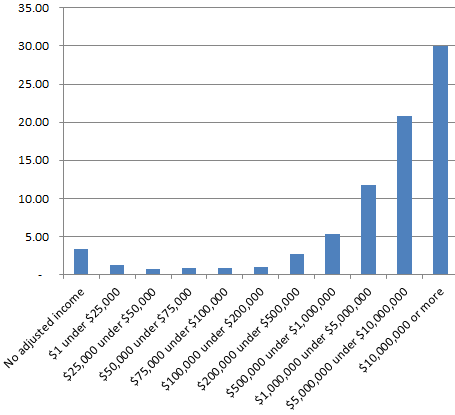
Individual Income Tax Returns Examined by Size of Adjusted Gross Income
Source:  Sober Look
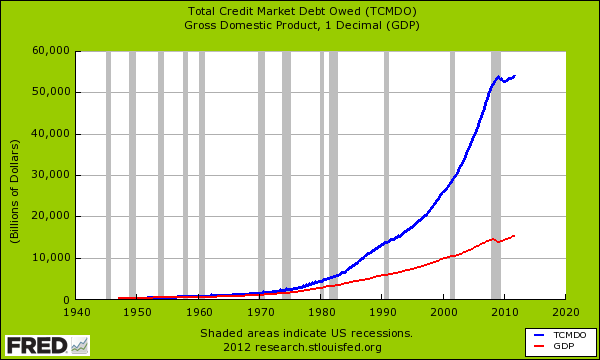
You’ll notice that once a $200,000 income is hit, the risk of being audited increases.  I also found it interesting that those reporting no adjusted income had a higher chance of being audited than those who made between $25,000 and $500,000.  This is probably another group that will show up on the radar.  However, those with incomes of $10 million or more have a 30 percent chance of being audited.  Yet as we know many Americans are simply struggling to get by with a per capita income of $25,000.  Our total credit market debt is simply off the charts and over three times annual GDP:
total-credit-market-debt-owed
Some serious challenges are coming online in the near future:
-1.  Unemployment benefits are phasing out and expiring for many
-2.  2001 and 2003 tax cuts set to expire
-3.  The debt limit will be reached again by the end of the year
-4.  Payroll tax cut will expire and increase from 4.2% to 6.2%
-5.  AMT will drop from $74,000 or higher to $45,000 or higher.  This will make it harder for middle class families to use deduction in effect creating a tax increase
Many purists would argue that we either go full on tax increases or full on cuts.  The reality is, the economy is incredibly weak.  Most of the economy is still fueled by subsidies via home owner mortgage interest deductions, bailout funds to banks, government backed student loans, food stamps, and unemployment insurance.  In other words, transfer payments are holding many people from full on economic disaster.  For example, 1 out of 3 retirees relies on Social Security for most of their post-work income.

Chart of the Week: Nearly Half of All Americans Don’t Pay Income Taxes

Heritage.org
February 22, 2012


Editor's Note: In English - We're Hit Like a "Soup line" Soup Sandwich!!!

This year’s Index of Dependence on Government presented startling findings about the sharp increase of Americans who rely on the federal government for housing, food, income, student aid or other assistance. (See last week’s chart.)
Another eye-popping number was the percentage of Americans who don’t pay income taxes, which now accounts for nearly half of the U.S. population. Meanwhile, most of that population receives generous federal benefits.
“One of the most worrying trends in the Index is the coinciding growth in the non-taxpaying public,” wrote Heritage authors Bill Beach and Patrick Tyrrell. “The percentage of people who do not pay federal income taxes, and who are not claimed as dependents by someone who does pay them, jumped from 14.8 percent in 1984 to 49.5 percent in 2009.”
That means 151.7 million Americans paid nothing in 2009. By comparison, 34.8 million tax filers paid no taxes in 1984.
The rapid growth of Americans who don’t pay income taxes is particularly alarming for the fate of the American form of government, Beach and Tyrrell warned. Coupled with higher spending on government programs, it is already proving to be a major fiscal challenge.
“This trend should concern everyone who supports America’s republican form of government,” Beach and Tyrrell wrote. “If the citizens’ representatives are elected by an increasing percentage of voters who pay no income tax, how long will it be before these representatives respond more to demands for yet more entitlements and subsidies from non-payers than to the pleas of taxpayers to exercise greater spending prudence?”

Why the VAT Is Not Pro-Saving

Thecuttingedgenews.com
December 27th 2010

Heritage Foundation


President Barack Obama’s unsustainable near-term fiscal policies are now preamble to the massive and longstanding long-term fiscal problems highlighted in the Bowles–Simpson Commission report, the Domenici–Rivlin report, and elsewhere. As Europe in similar straits is now demonstrating that, in the immortal words of Herb Stein, “what cannot go on forever won’t.”

The preferred solution to excessive deficits for those favoring big government is to turn to a value-added tax (VAT) for additional revenues. In making their case for a VAT, proponents often cite economic advantages of a VAT over an income tax as though the policy was to substitute the VAT for income tax rather than add the VAT. For example, one argument often raised in favor of the VAT is that it would improve the level of private saving. But given that the VAT is being proposed in addition to the income tax rather than as a substitute for it, this argument is flat-out false.

The Fiscal Problem Is Very Real
Federal budget deficits both near- and long-term are unsustainable, a point on which there is finally broad agreement. Something has to give. Either federal spending will be cranked down (as many new incoming Members of Congress are suggesting) from its now-bloated levels of around 25 percent of our economy to a more traditional 20 percent, or federal taxes must soar. For example, if the 2010 budget deficit were reduced entirely through tax increases to long-run sustainable levels, then even if the economy suffered no harm as a result, taxes would need to rise by about $750 billion a year.

In fact, this magnitude of tax increase would be devastating to America’s businesses and families. It is also almost surely beyond the revenue-raising capacity of our current tax system, which is why big government’s defenders are focusing so heavily on the adoption of a European-style VAT as a new, additional revenue source. The Domenici–Rivlin plan, for example, includes a new European-style VAT, though in a bow to the opposition that such a tax has traditionally garnered in the United States, they tried to disguise it by quaintly calling it a Deficit Reduction Sales Tax. A rose by any other name …

Read the entire article

Obama Announces 'Framework' for Deal With Congress to Extend Bush-Era Tax Cuts

Published December 07, 2010
FoxNews.com


AP
Dec. 6: President Obama speaks after meeting with Democratic congressional leaders on a deal to extend tax cuts.
President Obama and White House officials underscored the need to compromise Monday in unveiling a congressional deal to avoid the expiration of the Bush-era tax cuts at the end of the year, but some of the toughest critics of Obama's version of compromise come from within his own party.

Democrats have generally argued that the tax cuts should be extended for the middle class -- but not for the wealthiest 2 percent. Republicans have argued that the cuts should be extended for all taxpayers.

The "framework" of the deal that Obama outlined Monday evening calls for a two-year extension of the cuts in all income tax brackets. It also would extend long-term unemployment benefits through next year. The estate tax rate would be renewed, but at a lower rate than even during the Bush administration. And the Obama administration is proposing a one-year payroll tax reduction that sources say would cut the amount contributed to Social Security from 6.2 percent to 4.2 percent.

"I have no doubt that everyone will find something in this compromise that they don't like," Obama said, but "we cannot play politics at a time when the American people are looking for us to solve problems." He said letting taxes increase for all Americans would create a chilling effect on the economy.

Krugman: Death Panels, VAT Will Fix Debt Crisis


Paul Krugman
Economist and New York Times columnist Paul Krugman says the only way the U.S. will get its debt crisis under control is by the use of "death panels" and a national sales tax.

The national sales tax, referred to as VAT (value-added tax) and widely used by governments across Europe, will help cut the U.S deficit, Krugman argues.

Krugman made his comments on ABC's “This Week with Christiane Amanpour” during a roundtable discussion about the economy and the recent findings of the U.S. Debt Reduction Commission.

Here's the key excerpt:

"Some years down the pike, we're going to get the real solution, which is going to be a combination of death panels and sales taxes. It's going to be that we're actually going to take Medicare under control, and we're going to have to get some additional revenue, probably from a VAT. But it's not going to happen now."

The Obama healthcare plan passed by Congress in 2010 includes government-run healthcare committees with sweeping powers, including the power to engage in competitive pricing and cost analysis, a system used by Britain that has led to rationing of medical care for the elderly.

Critics of the Obama plan, including former Alaska Gov. Sarah Palin, quickly dubbed the committees "death panels," saying government agencies would decide who would live and who would die. Supporters of the Obama health plan dismissed such suggestions as nonsense.

Krugman apparently thinks otherwise, and suggests that such death panels could be one way the federal government will be able to deal with soaring medical costs under control as the Baby Boomers enter retirement.

He continued: "If they [the Debt Commission] were going to do reality therapy, they should have said, ‘OK, look, Medicare is going to have to decide what it's going to pay for. And at least for starters, it's going to have to decide which medical procedures are not effective at all and should not be paid for at all. In other words, it should have endorsed the panel that was part of the healthcare reform.’"

Krugman also criticized Republican plans to fully extend the Bush tax cuts, including those who make more than $250,000 a year.

He said: "The cost of permanently extending just the upper-end Bush tax cuts, as opposed to only extending the middle-class tax cuts, the 75-year cost of that is just about identical to the 75-year accounting shortfall in Social Security. So we've got people who are saying, ‘Oh, Social Security, got to do something about it, but let's extend those tax cuts for rich people. This is showing how the priorities are all skewed.’”

Apparently realizing his comments were inflammatory, Krugman took to his blog Sunday afternoon to immediately “clarify” his comments.

“I said something deliberately provocative on This Week, so I think I’d better clarify what I meant, which I did on the show, but it can’t hurt to say it again,” he wrote. “So, what I said is that the eventual resolution of the deficit problem both will and should rely on “death panels and sales taxes”.

“What I meant is that:

"(a) health care costs will have to be controlled, which will surely require having Medicare and Medicaid decide what they’re willing to pay for — not really death panels, of course, but consideration of medical effectiveness and, at some point, how much we’re willing to spend for extreme care

"(b) we’ll need more revenue — several percent of GDP — which might most plausibly come from a value-added tax

And if we do those two things, we’re most of the way toward a sustainable budget.

He then provided a link to a June 20th column in which he also described “death panels,” but only in passing and in a mocking way. The column is actually about budget deficits.

What he doesn't say is that he has written at least half a dozen columns repeatedly referring to death panels the last year in an ongoing effort to malign Palin and other conservatives.

Krugman also conceded his solution may be “politically impossible.” But, he added, “I believe that some day — maybe in the first Chelsea Clinton administration — it will actually happen.”

Global 'Robin Hood' Tax Idea to Be Pushed at G-20 Summit

President Barack Obama walks past South Korean honor guard members as he arrives to attend the G-20 Summit in Seoul, South Korea, Wednesday, Nov. 10, 2010. (AP)
FOXNews.com
 
As President Obama huddles with world leaders for the G-20 summit in South Korea to weigh proposals aimed at stabilizing the global economy ,one idea being pushed is a so-called "Robin Hood tax," aimed at collecting money from rich nations to give to the poor.


The Robin Hood tax -- a global financial transaction fee that could raise hundreds of billions of dollars to pay the cost of the global financial crisis and support developing nations struggling to recover -- is not popular.
While Britain, France and Germany have championed a bank tax for all G-20 nations, finance chiefs from the industrialized nations shot down the idea at a previous summit held in Toronto last summer. 

Still, the tax's supporters, which include unions, environmental groups, Comic Relief, UNICEF and others in a multinational coalition, say the tax could go to canceling debt from poor nations. Or it could be used for social programs to fight hunger, diseases such as HIV/AIDS and malaria or other causes, programs to which the United States and other nations already donate billions.

The crusaders -- a coalition of 183 organizations from 42 countries -- issued a plea this week urging leaders at the G-20 summit in South Korea to adopt the measure. While specifics have not been outlined, the idea would be to charge a small transaction fee, anywhere from 0.05 percent to 1 percent, on each stock transaction made. 

Rep. King: ‘I’m For Abolishing the IRS and the Federal Income Tax Code’

CNSNEWS.com


During a pre-tax day event on Capitol Hill, Rep. Steve King (R-Iowa) said he supports “abolishing” the Internal Revenue Service (IRS) and the federal income tax code.

Rasmussen: 62% in Ohio Support Bush Tax Cuts

Newsmax.com
Sunday, 22 Aug 2010 01:51 PM


Sixty-two percent of likely voters in Ohio are in favor of extending the so-called Bush tax cuts that are scheduled to end Dec. 31, according to a new Rasmussen Reports statewide telephone survey.

The level of support in Ohio is 8 points above the finding on the national level. Thirty percent of voters in the Buckeye State believe the tax cuts should expire at the end of the year.

Overall, 51 percent in Ohio believe letting the tax cuts expire at the end of the year would hurt the economy, which mirrors voter sentiment on the national level. And 27n percent believe allowing expiration would help the economy.

Given the choice, 52 percent of Ohio voters would prefer the government extend the tax cuts for all Americans, rather than excluding the wealthy. Almost 40 percent would rather the government extend the cuts for everyone except the wealthy. Nationally, voters are a bit more evenly divided on this question.

Strong majorities of Republicans and voters not affiliated with either major political party in Ohio favor extending the tax cuts. Just over half of Democrats (54 percent) would prefer the cuts expire at the end of 2010.

While 66 percent of white voters in the state favor an extension of the tax cuts, 64 percent of black voters favor their expiration.

The statewide survey of 750 likely voters in Ohio was conducted on Aug. 16.

© All Rights Reserved.


Fred Thompson: 'Catastrophic' If Bush Tax Cuts Not Renewed

Newsmax.com
Monday, 26 Jul 2010 09:48 PM

By: David A. Patten

Former GOP presidential candidate and U.S. Sen. Fred Thompson warns that not extending the Bush tax cuts could have "devastating" and "catastrophic" consequences for the American economy.

"We must urge Congress and the president to renew the Bush tax cuts early, before they expire and before investors lose confidence in the U.S. economy," Thompson stated in a letter he signed on behalf of the League of American Voters, a nonpartisan organization that advocates conservative principles.

Beginning Tuesday, Thompson will be promoting the proposed tax-cut renewal in a national TV ad campaign and petition drive the league is funding.


The former actor is joining forces with the League of American Voters as spokesman for a campaign to pressure members of Congress to renew the Bush tax cuts.


The Bush tax cuts were passed in 2001 and 2003 after the dot-com recession and 9/11. The cuts slashed income tax rates at every level, and later reduced capital gains and dividend taxes.

The Bush cuts will expire en masse on Dec. 31, unless Congress renews them.

"Our nation faces a massive automatic tax increase at the end of this year when the Bush tax cuts expire," Thompson warns in the ad, which can be viewed at RenewTheTaxCuts.com.

Read the entire story