Showing posts with label credit rating. Show all posts

S&P keeps US rating unchanged, outlook 'negative'

Yahoo News
June 9, 2012


The United States held onto its AA+ rating from Standard & Poor's Friday but the agency said it also kept a negative outlook on the country, citing the political deadlock over fixing the fiscal deficit.
Ten months after delivering a historic rate cut to Washington, removing its top-level AAA rating, S&P warned that the reasons for the downgrade remained in place and that if anything they were deteriorating.
The ideological deadlock between Republicans and Democrats continued to block real solutions for closing the government's deficit and bringing down debt, S&P said.
It reiterated its August 2011 warning that if politicians do not come together to address the gaping fiscal hole and reduce debt over the medium term, the United States could be dealt another downgrade.
"The negative outlook reflects our opinion that US sovereign credit risks, primarily political and fiscal, could build to the point of leading us to lower our 'AA+' long-term rating by 2014."
The US still merits a high grade, S&P said, as the issuer of the world's key reserve currency.
"We see the US economy with an economy as highly diversified and market-oriented, with an adaptable and resilient economic structure, all of which contribute to strong credit quality."
However, it said, the government's ability to implement reforms "has weakened in recent years... particularly with regard to broad fiscal policy direction."
"We think that recent shifts in the ideologies of the two major political parties in the US could raise uncertainties about the government's ability and willingness to sustain public finances consistently over the long term."

Moody's downgrades Danske, other Danish banks

Reuters
May 31, 2012


May 30 (Reuters) - Moody's Investors Service on W ednesday downgraded nine Danish financial institutions, pointing to sluggish economic growth, risks from the euro zone debt crisis and structural changes to the covered bond market, a reliable source of cash.

The Moody's cut comes the same day that Standard & Poor's lowered Danske Bank, Denmark's biggest financial institution, one notch to A-minus/A-2 from A/A-1.

However, Moody's cut Danske Bank's long-term rating two notches, to Baa1 from A2, with a stable outlook - still within investment grade. Moody's rating is now one step below S&P's rating.

Other banks hit by downgrades include Jyske Bank, Spar Nord Bank, Ringkjobing Landbobank and Sydbank.

Moody's is in the middle of a wider review of European banking systems and has recently cut the credit ratings of banks in Italy, Spain and the Nordic region.

"Danish financial institutions face sluggish domestic economic growth, weakening real estate prices and higher levels of unemployment, as well as the risk of external shocks from the ongoing euro area debt crisis," Moody's said in a statement.

The agency highlighted the risks to the financial institutions from relying on markets for their funding.

"Most market funds are in the form of covered bonds which have historically been a stable funding source. But structural changes to that market have increased refinancing risk, posing a particular concern for mortgage credit institutions whose access to alternative funding is limited."

The cascading waves of debt implosion – 5 charts looking at debt leverage, velocity of money, and contagion impacts from the European crisis.

MyBudget360
May 1, 2012


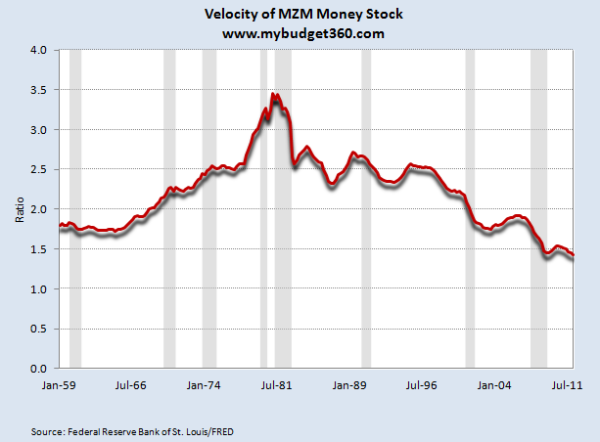
If you inject money out of thin air into thebanking sector but no quality jobs emerge, is the result a success?  The bailout mission statement revolved around keeping credit available for the American public.  The absolute opposite has occurred.  A massiveinternal credit deleveraging has been taking place but the banks have simply hoarded the money like a squirrel hogging all the nuts.  The public is dealing with a great deal of austerity in the form of higher inflation in daily good items and an employment market that is extremely constricted.  The issue continues to be that we are treating this crisis as one of liquidity when it has always been one of solvency.  What function is it giving a bank billions of additional dollars if there are so few qualified people to lend to?  We even see this restriction of money circulation when we examine the velocity of money.  We are simply injecting more debt into the economy with decreasing results.  Higher energy, food, healthcare, and other daily goods have risen beyond the average paycheck of most Americans as a consequence.
 Chart #1 – Velocity of money
velocity of money
We are getting less bang for each buck that is being injected into the economy.  Sure, we can promise unlimited amounts of debt to the public but you have to have actual production to back this up.  Need we remind you of the people with $20,000 annual incomes buying $500,000 and $600,000 homes?  Being able to finance your debts is core to our global economy.  You see what happens when this breaks down.  Banks are willing to lend in today’s market but they are now performing due diligence.  And guess what?  Not many are qualified to borrow.  So the money sits earning interest for banks while more debt is chasing the same amount of goods.  If simply printing money was a good thing the Fed’s trillion dollar spending spree would have made this nation much richer instead of bankrupting the middle class through a hidden tax with inflation.  If you examine the above chart, the velocity of money has come to a screeching halt yet here we are bailing out banks only so they can give each other multi-million dollar bonuses for essentially passing on bad losses to taxpayers.
Economist Paul Samuelson was quoted as saying:
“In terms of the quantity theory of money, we may say that the velocity of circulation of money does not remain constant. “You can lead a horse to water, but you can’t make him drink.” You can force money on the system in exchange for government bonds, its close money substitute; but you can’t make the money circulate against new goods and new jobs.”
Read the entire article 

Another Downgrade


IJ Review
April 6, 2012
The United States credit rating was downgraded again yesterday, from AA+ to AA. Egan-Jones, considered the 4th largest credit rating agency, cited growing concern over the public debt.
The company statement read, “Without some structural changes soon, restoring credit quality will become increasingly difficult.” The debt has reached 100% of Gross Domestic Product and the debt is up 24% from 2008 to 2010.
Chances of a U.S. default according to Egan-Jones? 1.2%.

U.S. unease hits stocks; ECC supports Italy, Spain

Yahoo News
August 8, 2011

LONDON (Reuters) - Deep-rooted jitters about the U.S. debt rating cut sent world stocks tumbling toward 11-month lows on Monday, overshadowing relief that the European Central Bank was buying bonds of strugglers Italy and Spain.

Having seen some $2.5 trillion wiped off its global share values last week, MSCI's all-country world stock index <.MIWD00000PUS> was down a further one percent.

Wall Street, meanwhile, looked set to add to the rout with S&P 500 futures down around 2.5 percent.
European share measured by the FTSEurofirst 300 index <.FTEU3> were down 2 percent after earlier registering gains on the ECB action, intended to take the heat out of the spreading euro zone debt crisis.
Since July 29, European shares as measured by MSCI have lost $932 billion, more than the combined economies of Greece, Ireland and Portugal.

ECB buying was lifting some peripheral bond prices. Yields on five-year Italian and Spanish bonds were down around 70 basis points, spreads against German debt narrowed and the cost of insuring Spain and Italy against default dropped.

But safe-haven buying sent gold soaring to a new record above $1,700 an ounce.
Investors were seemingly unimpressed by weekend talks between industrialized countries aimed at safeguarding the smooth functioning of financial markets following agency S&P's cut in its U.S. rating late on Friday to AA-plus from AAA.

"It won't be long now before other ratings agencies follow suit, considering the state of the U.S.' finances. One thing is for certain, and that's that volatility will continue to remain high, making trading conditions difficult," said Angus Campbell, head of sales at Capital Spreads.

Moody's repeated a warning on Monday it could downgrade the United States before 2013 if the fiscal or economic outlook weakened significantly, but said it saw the potential for a new deal in Washington to cut the budget deficit before then.
Read the entire article

Weiss Ratings Downgrades United States Debt to C-Minus


Weiss Ratings

JUPITER, Florida (July 15, 2011) — Weiss Ratings, an independent rating agency of U.S. financial institutions and sovereign debts, has downgraded the debt of the United States government from C to C-minus.

The C-minus rating for the U.S. reflects a continued deterioration in the weaknesses cited in the Weiss Ratings release of April 28, 2011, including heavy debt burdens, shaky international stability, and poor economic health.

Weiss Ratings senior financial analyst Gavin Magor commented: “Our downgrade today is not contingent on the outcome of the debt ceiling debate in Washington. It is driven exclusively by the numbers, which indicate that, in addition to a decline in the long-standing weaknesses we noted three months ago, the U.S. has already lost the golden halo that helped guarantee liquidity and acceptance of its government securities in global markets.”

On the Weiss Ratings scale, which ranges from A (excellent) to E (very weak), a C-minus rating is the approximate equivalent of a triple-B-minus on the scales used by other credit rating agencies, or approximately one notch above speculative grade (junk).

For the Weiss Sovereign Debt Ratings on all 49 countries covered, click here. For more information on the Weiss Ratings approach, refer to our white paper, “Introducing The Weiss Sovereign Debt Ratings.”


About Weiss Ratings

Weiss Ratings, the nation’s leading independent provider of financial strength ratings on banks, credit unions, insurance companies as well as sovereign debt ratings on 49 countries, accepts no payments for its ratings from rated entities. By adhering to its independent business model, Weiss outperformed Standard and Poor’s, Moody’s, A.M. Best and Duff & Phelps (now Fitch) in warning of future life and health insurance company failures according to a 1994 study by the U.S. Government Accountability Office (GAO), while also outperforming its competitors in identifying the safest insurers, according to its follow-up study using the GAO’s research methodology. Similarly, Weiss was the only one to identify, in advance, nearly all major banks that failed or required a federal bailout in the 2008-2009 debt crisis.

Merkel caves on Greece, Gross on QE3, rating agencies fraud?

SIC SEMPER TYRANNIS!!!
Mark Matheny
June 20, 2011

Greece is still in financial trouble and will call on its taxpayers to fit the bill, while here in the U.S. the Federal Reserve will continue to destroy our currency with their counterfeiting scheme called "quantitative easing". And all the Credit Rating Agencies will just continue to ignore the destruction of the U.S. credit status, while continuing to assign to the disaster a "AAA" rating.


Nothing changes.


The Schiff Report
Schiiff Report Video Blog June 17st 2011