Showing posts with label jobs. Show all posts

Black Americans Are Reentering The Work Force Faster Than Whites

Zero Hedge
October 7, 2018


While a strong economy isn't a cure for racism, it sure is doing a lot to help smooth out inequality in the labor market. As economists have taken a closer look at Friday's monthly labor-market update from the BLS, an interesting pattern has emerged that would seem to cut against the idea that only white Americans are benefiting from President Trump's policies.

To wit, Axios pointed out that the employment-to-population ratio for blacks is rising much more quickly than that of whites. Presently, roughly 59% of black Americans are employed, compared with more than 60% for whites.
According to Axios, the rise in black relative employment can be attributed to black Americans being more willing to take relatively lower-paying jobs, while white Americans are typically more inclined to wait for a higher salary. And if unemployed whites truly are holding out for higher-paying jobs, they're in for a wait, because as Deutsche Bank's Torsten Slok pointed out back in August,high-paying jobs have actually been declining throughout 2018 as employers have shifted their hiring to low-wage occupations.


Trump Jobs Numbers Out: Unemployment at 17 year Low, 2.2 Million New Jobs Since Election, More Americans Working than Ever!

cnbc
December 8, 2017


President Trump’s Economy is Simply “On Fire”.

Job numbers released today through the end of November show an increase of 2.2 million jobs since last years election and an unemployment rate of 4.1 percent. After the same period under Obama, (4.8) million jobs were lost and unemployment skyrocketed to 9.9 percent!

President Trump’s economic results could arguably be the best all time. The stock market is the highest ever and jobs are being created by the thousands.
Jobs
According to data released today by the Bureau of Labor Statistics, President Trump added a projected 1.9 million jobs in the first eleven months of the year (January through November 2017) and 2.2 million jobs since last year’s election. 
The same cannot be said for President Obama’s first eleven months as he lost 4.8 million jobs. Obama was so bad at creating jobs that by the end of his second term he said that jobs were not coming back. This showed in his first eleven months in office because in every month the US lost jobs.
According to the Bureau of Labor Statistics, under President Trump more Americans are in the work force than ever before. Over 160 million Americans are working for the first time in US history. President Trump is working hard to bring good paying jobs back to the US and his efforts are showing historic results.  ADP reported 40,000 new manufacturing jobs in November.  This was the highest reported monthly amount of new manufacturing jobs in the history of their report!

Read the entire article

Fewest Jobless Claims Since 1973 Show Firm U.S. Job Market

Bloomberg Market
October 19, 2017

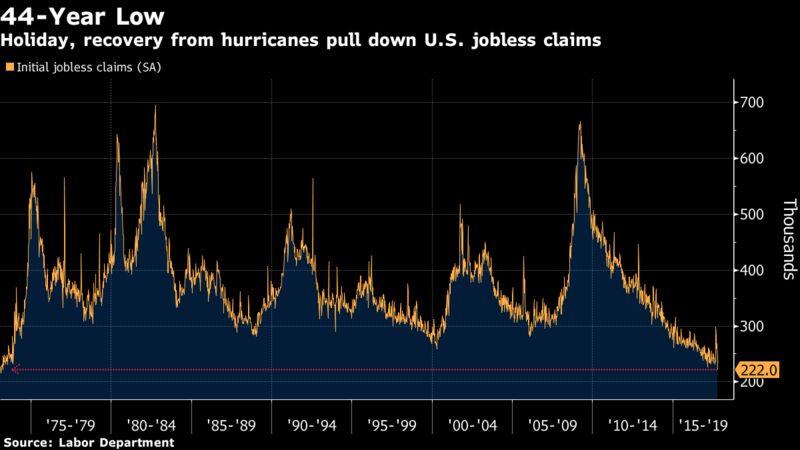
Filings for unemployment benefits plunged last week to the lowest level since 1973 as workers affected by hurricanes Harvey and Irma continued to return to their jobs, Labor Department figures showed Thursday.

The larger-than-projected decrease in claims probably reflected difficulty adjusting for the Columbus Day holiday. At the same time, the report showed further declines in claims in hurricane- affected states. The storms initially led to a spike in applications in Texas and the southeastern U.S. in late August and early September.
The latest period also encompasses the reporting week that the Labor Department surveys for its October employment figures. Claims are at the lowest level in more than four decades, indicating employers have little desire to cut staffing levels amid a shortage of qualified workers.

Other Details

  • Prior week’s reading was revised to 244,000 from 243,000
  • Unemployment rate among people eligible for benefits fell to 1.3 percent from 1.4 percent
  • Applications slumped in Florida, Texas, Georgia and Michigan
  • Claims were estimated only for the Virgin Islands last week, according to the Labor Department
— With assistance by Jordan Yadoo

Unemployment claims fall to lowest level in 43 years, despite hurricanes

Washington Examiner
October 12, 2017


The total number of laid-off workers receiving unemployment benefits fell to 1.89 million at the end of September, the Department of Labor reported Thursday, the lowest such mark in nearly 44 years.
And new claims for unemployment benefits dropped 15,000 to 243,000 in the first full week of October, according to the agency, as the job market bounces back from hurricane damage even faster than forecasters expected.
Low new jobless claims are a good sign. They indicate that layoffs are rare, and accordingly that job creation is strong.
Unemployment benefits are available for up to 26 weeks in most states. Fewer people are now receiving benefits of all duration than at any time since December of 1973, when the total workforce was much smaller. That is a reflection of the strength of the jobs market, and the availability of new positions for laid-off workers.
Prior to the landfall of Hurricanes Harvey, Irma, and Maria, claims had been running at ultra-low rates. With Texas and Florida now recovering, new claims again appear to be sinking to levels that indicate robust job creation. First-time claims in the states most affected by the storms are still high, but have fallen in recent weeks.
"The data suggest that payrolls will bounce back quickly after last month's hurricane-related weakness and that the underlying trend in employment growth remains strong -- more than strong enough to keep the unemployment rate declining," noted Jim O'Sullivan, chief U.S. economist for High-Frequency Economics.
Economists calculate that new claims below the 300,000 mark indicate that unemployment will remain stable or fall.
Good claims numbers, which are released weekly, are one of the factors that will reassure officials in the Trump administration and at the Federal Reserve that the jobs recovery is intact, even though the hurricanes generated net job losses in September.
Minutes from the Fed's September monetary policy meeting, released Wednesday, suggested that the central bank still sees the economy as healthy enough to justify raising rates again this year.

How Trump compares with Obama so far on jobs

CNN Money
October 6, 2017


President Donald Trump loves to talk about creating jobs, and now has more than a million jobs to point to.

With July's jobs report, employers have added a total of 1,074,000 jobs during Trump's first six full months in office.
That essentially matches the 1,084,000 jobs created during President Barack Obama's last six months in office. Both round to 1.1 million, and the 10,000 difference is well within the margin of error of the Labor Department estimate.
Of course, Trump's six-month record is far better than Obama's first six months, when 3.4 million jobs were lost. That's because Obama was sworn in during the worst economic downturn since the Great Depression, when the economy was hemorrhaging jobs.

Trump: Opening of New Pennsylvania Coal Mine Is Due to “Less Regulation”

The New American
June 19, 2017
Trump: Opening of New Pennsylvania Coal Mine Is Due to “Less Regulation”
In a videotaped message played during the opening ceremony of a new coal mine in Friedens, Pennsylvania, on June 1 President Trump celebrated the opening as an example of what can be accomplished when government eliminates the regulations that have stifled the coal industry.
“One by one, we’re eliminating the regulations that threaten your jobs, and that’s one of the big reasons you're opening today: Less regulation,” Trump said. “We have withdrawn the United States from the horrendous Paris Climate Accord, something that would have put our country back decades and decades; we would have never allowed ourselves to be great again.”
“The war on coal is over,” the company's chief executive, George Dethlefsen asserted. “Easing the regulatory burden, lowering taxes, stimulating infrastructure spending, balancing out the interest of economic growth versus environmental policy — it’s very good for coal.” 
The Associated Press reported that the mine opening was attended by business leaders and about 200 miners whose “mining headgear lay atop red, white, and blue tablecloths labeled ‘Make Coal Great Again’ ” — a play on Trump’s 2016 campaign slogan: “make America Great Again.”
Pennsylvania’s Democratic Governor Tom Wolf, who endorsed Hillary Clinton in last year’s presidential election, said the mine was part of an effort to bring back jobs and industry to the state. Pennsylvania awarded a $3 million grant for the project.
“We have not always capitalized on our standing as one of the world’s leaders in these resources, but we’re changing that,” Wolf said.
An article posted on the industry website Mining.com noted:
Trump made the revitalization of the U.S. coal industry — which had been targeted by the Obama Administration including tighter restrictions on coal-fired power plants — a central plank of his election campaign. He has made good on deregulating the coal industry through legislation signed in February to end the regulation protecting waterways from coal mining waste. The Surface Mining’s Stream Protection Rule enacted by Obama was resisted by coal miners.
During the 2016 presidential campaign, Trump promised to “put our miners back to work.”
In contrast, his rival, Hillary Clinton, at a West Virginia town hall in March, pledged to “Put a lot of coal miners and coal companies out of business” in pursuit of transitioning America to what she described as clean, renewable energy.
One of Trump’s earliest actions after he assumed the presidency was to sign a bill on February 16 that eliminated the Obama administration’s Office of Surface Mining’s Stream Protection Rule. Two days earlier, he signed a Congressional Review Act (CRA) resolution undoing a financial disclosure requirement for energy companies.
At the signing, Trump called the regulation “another terrible job killing rule” and said ending it would save “many thousands of American jobs, especially in the mines, which, I have been promising you — the mines are a big deal.”
The Hill reported on February 16 that both the mining and financial disclosure bills were at the forefront of a Republican effort to undo a slate of regulations instituted in the closing days of the Obama administration.
An article in The New American on January 26, shortly after the new Congress was sworn in, cited House Majority Leader Kevin McCarthy, who explained in an op-ed in the Wall Street Journal two days earlier just how Congress is planning to roll back numerous harmful rules promulgated by the Obama administration.
McCarty said that the Republican-majority Congress would utilize the Congressional Review Act (CRA), which was included in the “Contract With America Advancement Act of 1996.” CRA allows Congress to review, and to cancel by majority rule, new federal regulations issued by federal agencies. There’s a window of 60 “legislative” days to disapprove, which explains some of the Trump administration’s haste in pushing to repeal them. Once passed by both houses, repeals then become effective with President Trump’s signature.
Though there are plenty of targets, noted the article, McCarthy focused on just three: the Interior Department’s Stream Protection Rule impacting the coal-mining industry, new methane gas regulations that would cost up to $1 billion and force many small energy developers out of business, and the Social Security Administration’s new rule that states that if a S.S. recipient needs a third party to manage his finances, he will be added to the gun background check list.
The New American’s Bob Adelmann wrote about the use by Congress of the CRA: “[It] will be equivalent to hacking off some of the branches of the Fourth Branch’s tree, but leaves the trunk and the root intact. It’s a start, but only a start.”
Though the rollback of regulations on the coal industry and other energy industries by the Trump administration and Congress has barely started, Corsa Coal’s George Dethlefsen nevertheless said that the administration has made the mining industry more optimistic.
Photo of new coal mine in Friedens, Pa.: AP Images

IBM unveils plan to hire 25,000 in US on eve of Trump meeting

Daily Mail
December 13, 2016


US technology giant IBM said Tuesday it would hire 25,000 people in the country over the next four years, a day before President-elect Donald Trump meets with tech industry leaders.
About 6,000 of those hirings will occur in 2017, IBM chief executive Ginni Rometty said in an opinion article published in the newspaper USA Today.
IBM, which has undertaken in recent years a restructuring of its activities, will invest $1 billion on employee training and development in the next four years, said the IBM president, chairman and CEO.

IBM, which has undertaken in recent years a restructuring of its activities, will invest $1 billion on employee training and development in the next four years ©Ethan Miller (Getty/AFP/File)
"We are hiring because the nature of work is evolving -- and that is also why so many of these jobs remain hard to fill," Rometty said, noting that many industries were being reshaped by data science and cloud computing.
"Jobs are being created that demand new skills -- which in turn requires new approaches to education, training and recruiting," she said.
"This is not about white collar vs. blue collar jobs, but about the 'new collar' jobs that employers in many industries demand, but which remain largely unfilled."
Rometty is a member of Trump's Strategic and Policy Forum, a group of US business leaders focused on boosting economic growth and jobs.
The IBM jobs investment news came before the highly anticipated meeting Wednesday of the Republican property tycoon-turned-next US president and the leaders of several major technology companies.
Among those expected to attend are Amazon's Jeff Bezos, Apple's Tim Cook, Satya Nadella of Microsoft, Larry Page of Alphabet (Google) and Elon Musk of Tesla and SpaceX, according to US media.
Trump is expected to push them to create jobs after saying last week that he would like Apple -- whose coveted iPhones are made in China -- to open a large factory in the United States.
Read the entire article

McDonald’s Response to $15 Minimum Wage: Automation in Every Store

The New American
December 6, 2016
McDonald’s Response to $15 Minimum Wage: Automation in Every Store
It’s official: McDonald’s says that every one of its 14,000 stores nationwide will be replacing cashiers with automated touch-screen kiosks. They’re starting with stores where minimum-wage laws mandate the highest rates, such as Florida, New York, San Francisco, Boston, Chicago, Washington, D.C., and Seattle.
According to CNNMoney:
So the fast food giant is rolling out self-order kiosks, mobile pay options, an updated interior design, even table service. The changes are already starting to show up at locations in Florida, New York and Southern California, where 500 restaurants have been updated. Restaurants in San Francisco, Boston, Chicago, D.C. and Seattle will get upgrades in early 2017. Now, McDonald's loyalists will be able to place their customized order on a touch screen, take a seat and have their meal brought right over. Next year, they'll even have the option of mobile ordering.
That means that, eventually, more than 20 million customers every day will place their own orders at a kiosk or on a mobile device and then have them delivered by a human to their table. And it’s just a matter of time before those humans will be replaced by machines as well.

Read the entire article

The math on income inequality: Average annual income of the top 1% is $1,153,293 while that of the bottom 99% is $45,567.

MyBudget360
July 24, 2016


Part of the challenge with distorted income distributions is that it hollows out the middle class.  The middle class in the United States is now a minority.  We have more people making higher incomes and more people making way less and this group is growing much faster.  Our economy has taken a bimodal distribution with extremes on both sides.  We have a record number of people onfood stamps but also a record number of higher income households.  The only problem is that the low range of the ladder is growing much faster than that at the top.  For every person that makes it into the upper income brackets you have three that fall out of the middle class and into the low income wage trap.  Part of the political anger we are seeing in the US and other parts of Europe is that the elites are simply ignoring the needs of the masses.  In many cases this purposeful ignorance is because their wealth is built on keeping many stuck on a perpetual hamster wheel where productivity gains only go to a small section of society.
The math on income inequality
There was a time when extreme wealth inequality led to eras like the Gilded Age.  While we don’t have the soup lines of the Great Depression, we have other challenges that accompany mass income inequality including high housing costs, rising college tuition, and being one medical emergency away from bankruptcy.  These are all challenges that come when you have extreme wealth inequality.
First, how unbalanced are we?

Source:  EPI
The current level of inequality rivals that of the years leading up to the Great Depression.  It is of course no coincidence that during the glory days of the US middle class that income inequality was less extreme meaning the middle class actually had a larger share of total income earned.  That is no longer the case.
It is interesting to hear the media continually harp on the notion that $250,000 a year is somehow middle class.  This is a lie.  The median US household income is around $52,000.  Someone making $250,000 a year puts them in the top 2 to 5 percent of all income earners.  In fact, let us look at the figures even more closely:
To be in the top 1% you need to make $389,436.  The average annual income of the top 1% is $1,153,293 while the average income of those in the bottom 99% is $45,567. 
These are interesting figures.  It also highlights how distorted the media’s view is on income since most in large TV networks essentially represent the connected class.  They live in an echo chamber bubble.
There is obviously going to be income inequality in any market system.  That is understood.  But some of this gap is being brought on by a modern day plutocracy that is simply rigging the system in their benefit.  One obvious way is the housing market.  Homeownership, the traditional means of most families building their wealth is now becoming harder to do so because many big banks and investors have crowded out regular families who are unable to afford inflated prices.  Each year this trend goes on is a year where average families are not building equity.  This is also not “free market” based since the bailouts largely have helped big banks and investors while working class families have seen a shrinking idle class.  A decade later, the facts are clearly showing the end result.
This is where the inequality argument takes a path down cognitive dissonance.  Many of the banks that had massive handouts like to believe they are rugged free market individualist that can stand on their own two feet yet they are the biggest recipients of political and corporate welfare.  While receiving large sums of money, they rail against the poor for not doing enough or for not working hard enough.  As if taking in zero percent interest loans and finding something to buy with a slightly higher yield is difficult.  Building a computing OS is hard.  Finding new treatments for cancer is hard.  Trying to make an electric car with style is hard.  Making rockets is hard.  Taking handouts from the government at zero percent and raiding single family homes in the market and collecting rents is not hard.

Once upon a time, there was a middle class: This election year will determine whether the middle class falls into obscurity.

MyBudget360
June 1, 2016

In the not too distant past the United States had a vibrant middle class.  Prosperity for most families was the rule rather than the exception.  This didn’t happen by accident or some odd twist of luck.  It happened because as a country we setup a foundation that valued a robust middle class.  The Great Depression had taught us some profound economic lessons and humility.  But like a car that is neglected and falls into disrepair, the middle class is now a minority group in this country.  We tend to romanticize the past but in this case there is some truth to this view of history.  Going to college is now putting millions of Americans into incredible levels of debt.  Buying a home is moving further out of arms reach for most working families.  And the notion of a secure retirement is turning out to be more of a fairy tale than reality.  Once upon a time, the U.S. had a majority living in the middle class.
Where does the middle class go from here?
The middle class used to represent economic stability.  For anyone with the desire to work hard providing economic stability was doable.  That is no longer the case.  And this isn’t some relentless free market capitalism that we are seeing.  It is financial cronyism in many cases.  The public is pushed into a narrative that discusses austerity and financial belt tightening.  Then you have financial institutions using the government as a piggybank and gaming the system – bad bets they win, good bets they win.  The losses are charged onto the public’s credit card.  Privatizing the gains, socializing the losses.
So it is no wonder why the middle class has eroded into a minority:

Most Americans that took a hit from the Great Recession went from middle-income to lower-income households.  The good paying jobs simply did not come back at a rate in which they were lost.  We also have a large number of Americans not in the labor force.  What is being asked of many younger workers is for higher taxes, bigger college expenses, smaller paychecks, and a less certain future.  They hear their parents saying, “once upon a time, the U.S. had a vibrant middle class.”
This isn’t intended to be some long lament but a recognition that many families are being shafted under the guise of free market capitalism.  This is not that.  There is largely no disagreement that on a large scale, competition is extremely healthy because it caters to what people know best, their self interest.  The financial system should serve as a means of revving up the real economy.  Yet what we have now is a financial system that largely operates as a predatory vampire extracting real wealth from the economy and families and funneling it into the wallets of few on Wall Street that essentially operates as modern day loan sharks.
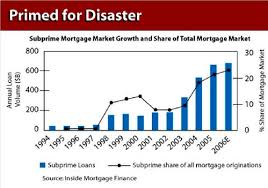
Once upon a time, the financial system operated more like a utility rather than a casino.  Glass-Steagall a law that came about in 1933 after the economic horrors of the Great Depression was repealed in 1999 by Bill Clinton and fully supported by both Republicans and Democrats.  This legislation that largely separated commercial and investment banks was broken down.  So it is no surprise that subprime lending took off nearly at the same time:
download
These were the toxic mortgages that set the American housing market on fire.  But what brought the system down was the side bets made by Wall Street (see The Big Short for a short crash course).  When everything came crashing down the financial system was bailed out at the expense of the U.S. middle class.  Now the homeownership rate is near a generational low.  Once upon a time, we had a sane financial system.
There was once a vibrant and healthy middle class in the United States.  Today that is not the case.  The anger you see in the country today being manifested in a contentious election year stems from this.  Once upon a time, our representatives cared about a middle class.  Now most are millionaires serving those with the deepest pockets.

The Two Income Trap has only gotten worse: America has become a dual-income nation since one income isn’t enough to maintain a household.

MyBudget360
April 30, 2016

America has become a nation where households depend on multiple streams of income just to get by.  Many people think that having two incomes is a luxury when in most cases, you need two incomes just to get by and keep up with the rising cost of living.  This is reflected in the two income trap. Take for example a couple that works and makes the median household income of $52,000.  In many cases if the couple has a child, daycare costs are needed and these can run exceptionally high. Healthcare costs are also incredibly high and have grown unbelievably fast over the last two decades.  This recent recession could have been called aMancession since most of the jobs lost went to men.  America is a nation of dual-income households because people are too broke to get by on one income.  The current state of the economy hasn’t helped much in supporting economic growth for working families.
The two income trap
Back in 1965 47% of families had both spouses working.  That figure is now up to 66% and it is extremely rare to find a household where only the husband works.  You also find it more common today that a household will have only the wife working.
Women entering the workforce has shifted how people deal with daily life.  But the thought of economic freedom by having an additional income in the household has been largely swept away by inflation.  Take a look at this chart:
You would think that this would be providing American families more financial freedom but instead it is merely keeping people from being out on the streets.  The homeownership rate is now down to generational lows.  Why?  Because home prices are inflated thanks to banking policies and investors that have gutted the market and have created a shortage of housing for working families.  So what is left is higher rents and higher home prices.

In 1950 typical healthcare costs ran about $1,000 per year adjusting for inflation.  Today they run over $10,000 per year and this isn’t factoring a serious illness or injury. This is merely to have routine insurance coverage for your family.
More money does not mean more flexibility if inflation is eating away the cost of living.  With two working people, you have more money spent on childcare, food, and it is very likely that two cars are necessary with people commuting to separate jobs.  Cars eat up a lot of money in payments, gas, and maintenance.  In the end, you have a large amount of unexpected expenses that eat away at that additional paycheck.
This is the trap.  You have two incomes so why are people struggling more today than that single income from the 1950s and 1960s?  In short the answer is inflation and the destruction of our manufacturing base.  There is a race to the bottom in this low wage economy.  The middle class is now a minority and the two income trap is even getting harder to dig out of.  This is why people are so angry during this election because there really isn’t a champion for the middle class.
People do have options to make things better and being able to budget is absolutely critical.  Many couples also buy homes that are beyond their means just to keep up with the Joneses.  And you absolutely need to plan for retirement.  Don’t be like many that are using the “work until you die” model of retirement.  The two income trap may make things hard but don’t compound your financial problems with inadequate planning.