Showing posts with label Oil. Show all posts

Fossil Fuels Aren't Dying, They're Shifting To National And State Backed Companies

 Zero Hedge

June 12, 2021


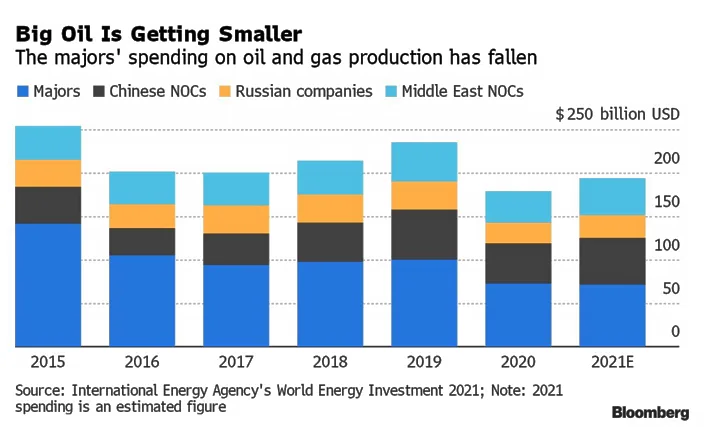
Despite the activist shareholder battles, calls for ESG changes and just outright negative press about fossil fuels, it looks like rumors of oil's death have been greatly exaggerated. Fossil fuels aren't dying - rather, their output is just being shifted to national and state owned companies. 

Even as the supermajor oil companies shrink in size and adhere to incessant criticism, fossil-fuel demand holds strong, according to Yahoo Finance. Activists have been the busiest they have been in years...

Recent weeks saw Exxon and Chevron rebuked by their own shareholders over climate concerns, while Shell lost a lawsuit in the Hague over the pace of its shift away from oil and gas.

...and this has been a tailwind for national oil companies (NOCs) and state owned players who aren't under the same pressure to play ball with activists. The report notes that "Saudi Aramco and Abu Dhabi National Oil Co. are spending billions to boost their respective output capacities", as is Qatar Petroleum. 

NOC's share of global oil output is expected to rise to 65%, from about 50% today, by 2050. Companies like Exxon and Chevron are keeping output at lows and curtailing future investment in traditional oil and gas infrastructure. 

Patrick Heller, an adviser at the Natural Resource Governance Institute, told Yahoo Finance: “We hear government officials and NOC officials say, ‘We look at the divestment of international oil companies from some projects as an opportunity for us to grow. And I do think that’s potentially really risky.”
Jason Bordoff, director of the Center on Global Energy Policy at Columbia University’s School of International and Public Affairs, thinks that the shift to government owners could wind up doing just the opposite of what activists are intending on doing. 

"A shift in production to major nationally owned companies — such as in Latin America or the Gulf or Russia — carries geopolitical supply risks, while smaller independents have often demonstrated poorer safety and environmental practices,” he said.

And emissions and carbon footprints from NOCs will eventually need to be addressed. 

“NOCs are sort of the biggest keys when it comes to looking at country-level emissions. It’s easy to see how taking action on NOC emissions, especially methane, will yield pretty quick and more effective climate results,” Ratnika Prasad, director of energy strategy at the Environmental Defense Fund, said.

Recall, just days ago we wrote how Saudi and Russian oil producers were actually benefitting from activism in the industry involving Western producers. Wins in the courtroom for activists against Shell, Chevron and Exxon have been a tailwind for Saudi Aramco, Abu Dhabi National Oil Co and Gazprom, we wrote. The pressure for U.S. names to cut carbon emissions faster pushes more business to companies in Saudi Arabia and Russia, and to OPEC, Reuters reported. 

Among the recent wins was a Dutch court ruling that required Shell to "drastically cut emissions". Exxon and Chevron also both activist battles with shareholders who have accused the giants of not being proactive enough in addressing climate change. 

Amrita Sen from consultancy Energy Aspects said: “Oil and gas demand is far from peaking and supplies will be needed, but international oil companies will not be allowed to invest in this environment, meaning national oil companies have to step in.”

The Saudis, meanwhile, don't seem quite as alarmed by the issue of climate change. When The International Energy Agency issued guidance last month to scrap all new oil and gas developments, Saudi Energy Minister Prince Abdulaziz bin Salman responded by stating: 

"It (the IEA report) is a sequel of the La La Land movie. Why should I take it seriously? We (Saudi Arabia) are ... producing oil and gas at low cost and producing renewables. I urge the world to accept this as a reality: that we’re going to be winners of all of these activities."
A spokesperson from Gazprom jabbed: "It looks like the West will have to rely more on what it calls 'hostile regimes' for its supply".

"Western oil majors like Shell have dramatically expanded in the last 50 years" as a result of the West trying to cut reliance on Middle Eastern and Russian oil, Reuters notes. Now these producers must balance a growing chorus of criticisms about climate change with continued output. 

Nick Stansbury at Legal & General, which manages $1.8 trillion, said: "It is vital that the global oil industry aligns its production to the Paris goals. But that must be done in step with policy, changes to the demand side, and the rebuilding of the world’s energy system. Forcing one company to do so in the courts may (if it is effective at all) only result in higher prices and foregone profits."

While Saudi Arabia claims to have targets to cut carbon emissions, it isn't beholden to U.N.-backed targets or activist investors like Western companies are. Gazprom has indicated a shift to natural gas to try and manage its carbon emissions. 

Western names account for about 15% of all output globally, while Russia and OPEC make up about 40%. At the same time, global oil consumption has risen to 100 million barrels per day from 65 million barrels per day in 1990. 

“The same oil and gas will still be produced. Just with lower ESG standards,” one Middle Eastern oil executive concluded.


Cyberattack Forces Shutdown Of Largest Gasoline Pipeline In United States

 Zero Hedge

May 7, 2021


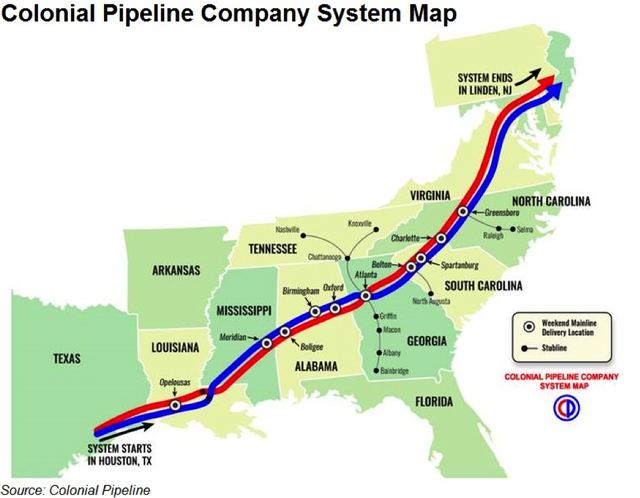
The largest gasoline pipeline on the East Coast, and the US in general, was shut down on Friday after its operator struggled to contain a cyberattack which threatened its systems. The 5,500-mile Colonial Pipeline, which is the single largest refined-products pipeline in the United States, halted transit as the company was forced to take "certain systems offline to contain the threat, which has temporarily halted all pipeline operations," according to The Wall Street Journal on Saturday. It's reportedly still offline into early Saturday.

Colonial Pipeline System

Colonial's network is responsible for supplying fuel that originates with refiners on the Gulf Coast to most of the eastern and southern US, accounting for over 2.5 million barrels per day in gasoline, diesel, and jet fuel, or other refined products transferred, making up 45% of all the East Coast's fuel supply. It spans from Texas through southern states and up to New Jersey.

"At this time, our primary focus is the safe and efficient restoration of our service and our efforts to return to normal operation," the Alpharetta, Georgia-based company stated. "This process is already underway, and we are working diligently to address this matter and to minimize disruption to our customers."

Read the entire article

Hundreds Of Tankers Amid 2020 Oil Industry Collapse Are Stopped

Epic Economist
April 28, 2020


The economic collapse is happening in a worldwide proportion. The dollar is operating high, and the stock markets are crashing, and even temporarily suspending trading in some countries. This is happening due to a price war in the international oil market, led by Russia and Saudi Arabia, causing a sudden oil price crash.
Read the entire transcript here

The Geopolitics of Oil: America’s About to Unleash Its “NOPEC Superweapon” Against the Russians and Saudis

Global Research
August 8, 2018


The US Congress has revived the so-called “NOPEC” bill for countering OPEC and OPEC+.
Officially called the “No Oil Producing and Exporting Cartels Act”, NOPEC is the definition of so-called “lawfare” because it enables the US to extraterritorially impose its domestic legislation on others by giving the government the right to sue OPEC and OPEC+ countries like Russia because of their coordinated efforts to control oil prices. Lawsuits, however, are unenforceable, which is why the targeted states’ refusal to abide by the US courts’ likely predetermined judgement against them will probably be used to trigger sanctions under the worst-case scenario, with this chain of events being catalyzed in order to achieve several strategic objectives.
The first is that the US wants to break up the Russian-Saudi axis that forms the core of OPEC+, which leads to the second goal of then unravelling the entire OPEC structure and heralding in the free market liberalization of the global energy industry. This is decisively to the US’ advantage as it seeks to become an energy-exporting superpower, but it must neutralize its competition as much as possible before this happens, ergo the declaration of economic-hybrid war through NOPEC. How it would work in practice is that the US could threaten primary sanctions against the state companies involved in implementing OPEC and OPEC+ agreements, after which these could then be selectively expanded to secondary sanctions against other parties who continue to do business with them.
The purpose behind this approach is to intimidate the US’ European vassals into complying with its demands so as to make as much of the continent as possible a captive market of America’s energy exporters, which explains why Trump also wants to scrap LNG export licenses to the EU. If successful, this could further erode Europe’s shrinking strategic independence and also inflict long-term economic damage on the US’ energy rivals that could then be exploited for political purposes. At the same time, America’s recently unveiled “Power Africa” initiative to invest $175 billion in gas projects there could eventually see US companies in the emerging energy frontiers of TanzaniaMozambique, and elsewhere become important suppliers to their country’s Chinese rival, which could make Beijing’s access to energy even more dependent on American goodwill than ever before.
If looked at as the opening salvo of a global energy war being waged in parallel with the trade one as opposed to being dismissed as the populist piece of legislation that it’s being portrayed as by the media, NOPEC can be seen as the strategic superweapon that it actually is, with its ultimate effectiveness being dependent of course on whether it’s properly wielded by American decision makers. It’s too early to call it a game-changer because it hasn’t even been promulgated yet, but in the event that it ever is, then it might go down in history as the most impactful energy-related development since OPEC, LNG, and fracking.

Andrew Korybko is an American Moscow-based political analyst specializing in the relationship between the US strategy in Afro-Eurasia, China’s One Belt One Road global vision of New Silk Road connectivity, and Hybrid Warfare. He is a frequent contributor to Global Research.

Sliding oil prices leave socialist Venezuela on brink of financial collapse

Washington Times
December 25, 2014
President Nicolas Maduro — the hand-picked successor to the late socialist Hugo Chavez — faces mounting international criticism for jailing opposition figures after months of street protests. (Associated Press) more >

The ongoing plunge in global oil prices is pushing Venezuela toward economic collapse just as President Nicolas Maduro — the hand-picked successor to the late socialist Hugo Chavez — faces mounting international criticism for jailing opposition figures after months of street protests.
Where Chavez once drew praise from the world’s leftist elite for using the high price of crude oil during the 2000s to underwrite a socialist revolution, a growing number of analysts in Washington say Mr. Maduro is clinging to power in a country on the edge of becoming a failed state.
Venezuela still boasts some of the world’s largest known crude reserves, but it has continued for too long spending more on government programs than it has collected in oil revenue, analysts say. The average price of oil has dropped from more than $100 a barrel to less than $60 during recent weeks, only adding to Venezuela’s woes.

Russia Reignites The Proxy War: Putin Offers "Complete Support" To Iraq Prime Minister Scorned By Obama

Zero Hedge
June 20, 2014

Two days ago, before it was formalized that the US tacitly, if not explicitly, now supports the removal of the Iraqi Prime Minister whom it itself had helped elect, we summarized the geopolitical tensions and "national interests" in Iraq, which is shaping up to be a proxy war that makes last year's Syrian escapade pale by comparison, as follows:
The situation in Iraq, already a jumble of domestic sectarian violence, is now pitting virtually all major (and regional) international players against each other as well. There is:
  • US which tacitly supports Iran intervention in the region, but may have suddenly cooled in its support of Maliki despite sending naval and troop forces in the country after partially evacuating its embassy
  • Saudi Arabia which wants to remain friendly with the US but is antagonistic to the Iraq regime, is potentially aiding the ISIS forces, and clearly refuses to allow Iran entrance in Iraq
  • Iran, which has suddenly become America's best friend in the region, which is willing to enter Iraq and protect its holy sites
  • Syria, whose president is sitting back amused at last year's failed campaign by the US to remove him from power, and whose army is at a stalemate with the local US-armed and funded rebels
  • Qatar, which is supporting the Syrian rebels, but so far has not made its stance clear on Iraq. Like Saudi, it too may be indirectly backing ISIS
  • Jordan, which is a close friend the US, and which may have hosted ISIS in a secret base on its territory with the US instructing the jihadist group according to an unconfirmed report
  • Turkey, which is on constant alert to Kurdish escalation across the border, the same Kurds which now have far more leverage courtesy of ISIS crushing the Iraq army in the north and handing over Kurds access to oil fields in the north.
  • And of course Russia: because while Putin clearly benefits from rising crude prices, it is his Lukoil that is developing (and investing vast amounts of money in) the vast Iraqi West Qurna-2 oil field. It is not clear how he would feel about it falling into ISIS hands.
It was the bolded text that was of biggest interest because as we noted the next day, when discussing the next steps for ISIS, we said that "One wonders how long until the mercenary force finds its latest major backer, because for all the western, US-led intervention, both Russia and China are oddly missing from the scene. We expect that to change soon."
Because clearly one can't have a global proxy war without China, and certainly without Russia.
Well, we said we expected Russia's conspicuous absence to "change soon", and so it did: within just 24 hours. Because apparently all Putin was waiting for was for Obama to pick sides (i.e., not Maliki) before the Russian leader made it clear whom he sides with. US, helpfully obliged yesterday morning when we also reported that "US Slams Its Former Iraq Puppet: "The Maliki Government, Candidly, Has Got To Go"."
So what does Putin - who as a reminder is heavily invested in Iraq' massive West Qurna-2 oil field via Lukoil - do? Why announce his undying support for Maliki, of course, and as AP reported, the former KGB spy offered Iraqi premier Nuri al-Maliki Russia's total backing for the fight against fighters who have swept across the country, as well as his full support for the embattled prime minister.
More:
Russian President Vladimir Putin has spoken by phone to Iraqi Prime Minister Nouri al-Maliki, expressing Moscow’s support for his action against the militant offensive.

The Kremlin said in a statement that al-Maliki informed Putin on Friday about his government’s steps to combat the “terrorist groups in the north of the country.” It added that the insurgency threatens security of the entire region.

Putin confirmed Russia’s “full support for the Iraqi government’s action to quickly free the territory of the republic from terrorists,” the Kremlin said, adding that Putin and al-Maliki also discussed bilateral cooperation.

Putin’s expression of support for the embattled Iraqi prime minister comes as al-Maliki’s rivals have mounted a campaign to force him out of office, with some angling for support from Western backers and regional heavyweights.
And just like in Syria from 2012 to 2013, the chessboard is once again set, with a regional middle-east conflict, this time in Iraq, merely serving as the proxy staging ground in which the Iraqi PM, once an obedient US puppet but now an enemy of Saudi Arabia and thus the US, "simply has to go" in the words of Dianne Feinstein, has suddenly become the fulcrum issue behind yet another soon to escalate conflict between Russia and the US.
One thing is certain: the more the US (and Saudi Arabia, and Qatar) pushes for Maliki's ouster, the more involved Russia will become with its offers of support and bilateral cooperation. And if the Syrian fiasco (for John Kerry) is any indication, Russia is about to expand its "national interest" sphere of influence by one more country.

Peter Schiff on crisis in Iraq hitting world economy

RT News
June 18, 2014
Peter Schiff


Iraq's largest oil refinery shut down Wednesday amid ongoing fighting between military forces and insurgents of the Islamic State of Iraq and Syria (ISIS). The Beji refinery accounts for a quarter of the country's refining capacity, and the shutdown showcases how the economic effects of the crisis may quickly spiral. RT's Ameera David discusses the potential economic impacts of the fighting, with Peter Schiff; President of Euro Pacific Capital.

Will Gold and Oil Crashes Lead to the Big One?

SIC SEMPER TYRANNIS!!!
Mark Matheny
April 18, 2013

Mark Matheny discusses the latest in economic turmoil around the world.


Listen to internet radio with Mark Matheny on Blog Talk Radio

History Tells Us That A Gold Crash + An Oil Crash = Guaranteed Recession

The Economic Collapse
April 17, 2013


History Tells Us That A Gold Crash + An Oil Crash = Guaranteed RecessionIs the United States about to experience another major economic downturn?  Unfortunately, the pattern that is emerging right now is exactly the kind of pattern that you would expect to see just before a major stock market crash and a deep recession.  History tells us that when the price of gold crashes, a recession almost always follows.  History also tells us that when the price of oil crashes, a recession almost always follows.  When both of those things happen, a significant economic downturn is virtually guaranteed.  Just remember what happened back in 2008.  Gold and oil both started falling rapidly in July, and in the fall we experienced the worst financial crisis that the U.S. had seen since the days of the Great Depression.  Well, a similar pattern seems to be happening again.  The price of gold has already crashed, and the price of a barrel of WTI crude oil has dropped to $86.37 as I write this.  If the price of oil dips below $80 a barrel and stays there, that will be a major red flag.  Meanwhile, we have just seen volatility return to the financial markets in a big way.  When volatility starts to spike, that is usually a clear sign that stocks are about to go down substantially.  So buckle your seatbelts - it looks like things are about to get very, very interesting.
Posted below is a chart that shows what has happened to the price of gold since the late 1960s.  As you will notice, whenever the price of gold rises dramatically and then crashes, a recession usually follows.  It happened in 1980, it happened in 2008, and it is happening again...
The Price Of Gold
A similar pattern emerges when we look at the price of oil.  During each of the last three recessions we have seen a rapid rise in the price of oil followed by a rapid decline in the price of oil...
The Price Of Oil
That is why what is starting to happen to the price of oil is so alarming.  On Wednesday, Reuters ran a story with the following headline: "Crude Routed Anew on Relentless Demand Worries".  The price of oil has not "crashed" yet, but it is definitely starting to slip.
As you can see from the chart above, the price of oil has tested the $80 level a couple of times in the past few years.  If we get below that resistance and stay there, that will be a clear sign that trouble is ahead.

Top Economic Advisers Forecast World War


Washington’s Blog
November 18, 2012
Kyle Bass, Larry Edelson, Jim Rogers and Marc Faber Predict Widespread War
Kyle Bass writes:
Trillions of dollars of debts will be restructured and millions of financially prudent savers will lose large percentages of their real purchasing power at exactly the wrong time in their lives. Again, the world will not end, but the social fabric of the profligate nations will be stretched and in some cases torn. Sadly, looking back through economic history, all too often war is the manifestation of simple economic entropy played to its logical conclusionWe believe that war is an inevitable consequence of the current global economic situation.
Larry Edelson wrote an email to subscribers entitled “What the “Cycles of War” are saying for 2013″, which states:
Since the 1980s, I’ve been studying the so-called “cycles of war” — the natural rhythms that predispose societies to descend into chaos, into hatred, into civil and even international war.
I’m certainly not the first person to examine these very distinctive patterns in history. There have been many before me, notably, Raymond Wheeler, who published the most authoritative chronicle of war ever, covering a period of 2,600 years of data.
However, there are very few people who are willing to even discuss the issue right now. And based on what I’m seeing, the implications could be absolutely huge in 2013.
Why are these economic gurus forecasting war?
For one thing, many influential people wrongly believe that war is good for the economy.
In addition, Jim Rogers says:
If it turns into a trade war, it is the most momentous thing of 2011,” said Rogers. “Trade wars always lead to wars. Nobody wins trade wars, except general who end up fighting the physical wars when they happen. This is very dangerous.
Rogers also explains:
A continuation of bailouts in Europe could ultimately spark another world war, says international investor Jim Rogers.
***
“Add debt, the situation gets worse, and eventually it just collapses. Then everybody is looking for scapegoats. Politicians blame foreigners, and we’re in World War II or World War whatever.”
And Marc Faber says that the American government will start new wars in response to the economic crisis:
Faber also believes the U.S., China and Russia may go to war over Mideast oil.

Why Is The Obama Administration Allowing The Chinese Government To Buy Up U.S. Oil And Gas Deposits Worth Billions Of Dollars?


Michael SynderAmerican Dream
Monday, May 14, 2012
If we are trying to become independent of foreign oil, then why is the Obama administration allowing the Chinese government to buy up U.S. oil and gas deposits worth billions of dollars?

This makes absolutely no sense whatsoever.  The United States desperately needs to maintain control over its own domestic energy resources so that we can end our addiction to foreign oil.  As I have written about previously, the United States actually has plenty of oil.  If we would simply use the resources that we already have, we would never have to import a single drop of foreign oil.  But instead, we continue to be the largest importer of oil on the planet and we are allowing China to rapidly buy up oil and gas deposits inside the United States.  This is fundamentally wrong and it is a serious threat to our national security.  But apparently everything is for sale in the United States today, and that includes our precious energy resources.
The Chinese government is using two giant corporations to buy up these energy resources.
The first is the China National Offshore Oil Corporation (CNOOC).  According to Wikipedia, this corporation is 100 percent owned by the Chinese government….
CNOOC Group is a state-owned oil company, fully owned by the Government of the People’s Republic of China, and the State-Owned Assets Supervision and Administration Commission of the State Council (SASAC) performs the rights and obligations of shareholder on behalf of the government.
The second is Sinopec Corporation.  Sinopec Group is the largest shareholder (about 75% of the shares) in Sinopec Corporation.  And as the Sinopec website tells us, Sinopec Group is owned by the Chinese government….
Sinopec Group, the largest shareholder of Sinopec Corp., is a super-large petroleum and petrochemical group incorporated by the State in 1998 based on the former China Petrochemical Corporation. Funded by the State, it is a State authorized investment arm and State-owned controlling company.
So wherever you see CNOOC or Sinopec you can replace those names with the Chinese government.  The Chinese government essentially runs both of those companies.
And both companies have been very busy buying up U.S. oil and gas deposits.
For example, CNOOC recently completed a 570 million dollar deal that gives it a one-third interest in huge oil and gas deposits in Colorado and Wyoming.  The following is from Wyoming Energy News….
Chinese energy company Cnooc Ltd. has agreed to pay $570 million for a one-third interest in Chesapeake Energy Corp.’s 800,000 leased acres in northeast Colorado and southeast Wyoming. The acreage is in the Denver-Julesburg (DJ) and Powder River basins. Cnooc is China’s biggest offshore oil and natural gas producer.
In fact, according to a recent Business Insider article, this deal gives the Chinese government the right to a third of any new oil discovered by Chesapeake Energy in the entire region….
The Niobrara Shale formation stretches over Colorado and Wyoming, as well as Kansas and Nebraska. Chesapeake Energy’s position is in Wyoming and Colorado. If Chesapeake find any more oil in this region, CNOOC has the rights to 33.3% of what is found.
But this is not the only area of the country where China now owns energy rights.  The following is an excerpt from a recent state-by-state breakdown that appeared in the Wall Street Journal….
Louisiana: Sinopec has a one-third interest in 265,000 acres in the Tuscaloosa Marine Shale after a broader $2.5-billion deal with Devon Energy.
Michigan: Sinopec gained a one-third interest in 350,000 acres in a larger $2.5 billion deal with Devon Energy.
Ohio: Sinopec acquired a one-third stake in Devon Energy’s 235,000 Utica Shale acres in a larger $2.5 billion deal.
Oklahoma: Sinopec has a one-third interest in 215,000 acres in a broader $2.5 billion deal with Devon Energy.
Texas: Cnooc acquired a one-third interest in Chesapeake Energy’s 600,000 acres in the Eagle Ford Shale in a $2.16-billion deal.
The Texas deal was particularly noteworthy.  The following is how a San Antonio news sourcedescribed that deal….
State-owned Chinese energy giant CNOOC is buying a multibillion-dollar stake in 600,000 acres of South Texas oil and gas fields, potentially testing the political waters for further expansion into U.S. energy reserves.
With the announcement Monday that it would pay up to $2.2 billion for a one-third stake in Chesapeake Energy assets, CNOOC lays claim to a share of properties that eventually could produce up to half a million barrels a day of oil equivalent.
So why is the Obama administration allowing this to happen?
Are they so desperate to have China continue lending money to the United States that they would allow the Chinese government to pillage our precious energy resources?
Somebody needs to be asking our politicians that question.
But oil and gas are not the only U.S. assets that the Chinese have been buying up.
In a previous article, I detailed how the Chinese have been purchasing huge chunks of real estate all over the country as well.
For example, a recent Forbes article detailed some of the real estate deals that China has been doing in New York….
According to a recent report in the New York Times, investors from China are “snapping up luxury apartments” and are planning to spend hundreds of millions of dollars on commercial and residential projects like Atlantic Yards in Brooklyn. Chinese companies also have signed major leases at the Empire State Building and at 1 World Trade Center, the report said.
In addition, it was recently announced that the Federal Reserve will now allow Chinese banks to buy up American banks.
Where will all of this end?
Should all of us start learning to speak Chinese?
Meanwhile, our trade deficit with China continues to get even larger.  Our trade deficit with China last year was $295.5 billion, which was the largest trade deficit that one country has had with another country in the history of the world.  This year, we are already on a pace to break that record.
So thousands of businesses, millions of jobs and hundreds of billions of dollars will continue to leave the United States and go to China.
And China will continue to use some of the money they are getting from us to buy up pieces of America.
Does anyone else out there see something very, very wrong with all of this?

Executive Order: Feds To Take Control of Domestic Natural Gas Production

SIC SEMPER TYRANNIS!!!
Mark Matheny
April 18, 2012


America: Being Conditioned to Pay More – and Get Less.


Patrick Henningsen
Infowars.com
April 18, 2012
It’s official: Americans have now been safely conditioned to accept $4 per gallon of gasoline.
It worked. While fuel prices skyrocket and stabilize at new highs, a powerful and highly organized cartel of corporations are now reclining in their boardroom chairs and patting each other on the backs for finally conquering the will of the formerly ferrell American consumer.
For an economy begging for recovery, these new price highs cannot mean good news. Why are gas prices so important? Gas prices directly influence inflation. They affect almost every other domestic service and essential commodity we use on a day to day basis – deliveries, labor, materials, food, postage and list goes on.
There’s only one problem with this fuel price picture: it is going against the universal laws of free market economics. The law of supply and demand dictates that demand should drop if there is a glut in market supply, and we should then expect a drop in price. Unfortunately for American consumers, just the opposite has happened.
Hidden within a recent Washington Post article about ‘cutting our fuel consumption’ is proof by their own admission:
The response to $4 gasoline is reinforcing a trend toward lower fuel consumption. This will be the third year in the past five with historically high oil prices. Even before the latest price spike, gasoline consumption had dropped 6 percent from 2007 through 2011, the EIA said.
The Federal Highway Administration adds that the number of vehicle miles driven over a 12-month period ending January was lower than in any year since 2004.
In the case of gas, there are three major factors which have actually lowered demand in the last year.
The first is that due to an increase in fuel efficient and hybrid cars, contributing to a drop in overall gas consumption in the US to its lowest levels in a decade.

Governments Everywhere Having Deep Money Problems


Bob ChapmanInternational Forecaster
Thursday, April 12, 2012
It was 13 months ago we disclosed that the administration passed a stimulus bill known as the $17.5 billion “Hiring Incentives Act” to restore employment. It required that foreign banks not only withhold 30% of all outgoing capital flows, and disclosure of the full details of transactions of non-exempt holders to the Internal Revenue Service. They want the structure of how money ended up at that bank. In addition banks, particularly in Switzerland are required to close the account. That is equivalent to capital controls, so in future it will be easy to put currency controls of all funds entering or leaving the    US.

Now we have a new gem on our hands, Senate Bill 1813, which was presented by California Senator Barbara Boxer. The bill has been passed in the Senate 74-23 under the “Moving ahead for progress legislation in the 21st Century Act.”
Section 4034 of the legislation states that any individual who owes more than $50,000 to the IRS will have their passport confiscated, revoked, or put on special terms and they will be denied exit or entry, out or into the US. The bill is loosely written, so as usual the interpretation is left up to bureaucrats in Washington. Hopefully this inclusion will be struck down in the House. Inasmuch almost all our Congress is bought and paid for – you will have to lobby very hard to eliminate it from the bill. This is not about tax evasion; it is about people control and their assets. E-mail, fax, write and call all House members to stop another nail being put in our coffin.
As we pointed out in past issues, Operation Twist, was just another surreptitious attempt to mask a QE 3 operation the Fed sold the short end of the bond market and bought the long end in order to keep mortgage rate down, which we find was unsuccessful. Thus, the regular QE 3 is ready to be launched.
ADP and BLS employment figures are totally bogus, so we’ll stick with John Williams’ 22.4%.
The Fed is not going to lower interest rates, they can’t. If they increase them the bond market would collapse and all confidence in the system would be gone.
We continue to believe if any military action is going to happen regarding Iran, it won’t happen until next year. This day by day will be negative for the US petrol dollar.

Peter Schiff: "We Could See Oil at $150 A Barrel If We Keep Printing Money"

SIC SEMPER TYRANNIS!!!
 Mark Matheny
February 27, 2012

On Fox Business Feb. 24, 2012 Peter Schiff said the U.S. has no one to blame for higher gas prices but ourselves, - not  Iran or any other country. He stated the reason for the higher gas prices was due to lower payroll taxes. He also stated that inflation will cause the price of everything to go "sky high" soon.

Peter stated that investors putting their money in companies overseas in Asia will fair better than those investing in companies here in the U.S. which may be in decline.

As Europe prints more money to bail itself out once again, Peter also stressed that as confidence grows again in the Eurozone currency, this may be bad for the U.S. by driving the U.S. dollar down faster against other currencies, and cause oil and other prices to rise, as well as putting more upward pressure on interest rates which in turn will cause the Fed to print even more money in order to keep the rates low "putting more fuel on the inflationary fire", as Peter put it.

He also stated that this could bring oil prices again to $150 a barrel just as we saw in July and August of 2008.